A medical consultant may receive income from private patients, insurers, hospitals and medico-legal work.
A clinic may collect deposits through one system, issue invoices through another and record expenses in a spreadsheet.
A domiciliary care provider may receive local-authority payments, private client fees and staff expense claims across several platforms.
The figures may eventually reach the annual accounts, but Making Tax Digital asks a more immediate question: Are the business’s financial records being created, maintained and submitted through a compliant digital process throughout the year?
Making Tax Digital, commonly known as MTD, is changing how many healthcare professionals and business owners keep records and report information to HMRC.
For some healthcare providers, MTD is already part of their VAT compliance.
From 6 April 2026, it also became mandatory for certain sole traders and landlords with qualifying income over £50,000. The threshold falls to more than £30,000 from April 2027 and more than £20,000 from April 2028.
This guide explains what MTD means for:
- Self-employed doctors and medical consultants
- Private clinicians
- Dentists
- Pharmacists
- Physiotherapists and therapists
- Care providers
- Private clinics
- Healthcare partnerships
- Limited healthcare companies
- Healthcare businesses registered for VAT
- Medical professionals with property income
It also explains how healthcare businesses can prepare their records, software and internal processes before their first reporting deadline.
This guide reflects HMRC guidance available on 30 July 2026.
What Is Making Tax Digital?
Making Tax Digital is HMRC’s system for requiring businesses and individuals within scope to:
- Keep specified financial records digitally
- Use compatible software
- Maintain digital links where several systems are used
- Send information to HMRC electronically
- Complete the relevant end-of-year reporting through compatible software
There are currently two areas of particular relevance to healthcare businesses:
- Making Tax Digital for VAT
- Making Tax Digital for Income Tax
MTD for Income Tax applies to qualifying individuals receiving self-employment or property income. It does not currently bring every healthcare company, partnership or employee into quarterly Income Tax reporting.
MTD for Healthcare Businesses: The Quick Answer
| Healthcare business or professional | Current MTD position |
| Sole-trader healthcare professional with qualifying income over £50,000 | MTD for Income Tax applies from 6 April 2026 |
| Sole trader with qualifying income over £30,000 | MTD for Income Tax applies from 6 April 2027 |
| Sole trader with qualifying income over £20,000 | MTD for Income Tax applies from 6 April 2028 |
| Healthcare partnership | Not currently required to use MTD for Income Tax; future timetable not yet confirmed |
| Individual partner with only partnership profit | Partnership profit does not count towards MTD qualifying income |
| Limited healthcare company | Not currently within MTD for Income Tax, but MTD for VAT may apply |
| VAT-registered healthcare business | Generally required to use MTD-compatible VAT software unless exempt |
| Healthcare employee with PAYE income only | Not brought into MTD for Income Tax by employment income alone |
| Clinician with self-employment and rental income | Both income sources are combined when testing the MTD threshold |
| Business making only VAT-exempt healthcare supplies | May not be VAT-registered, but its Income Tax position must still be checked |
The correct answer depends on the provider’s legal structure, income sources, turnover and VAT registration, not simply on whether it operates in healthcare.
Who Must Use MTD for Income Tax in 2026/27?
From 6 April 2026, an individual must use MTD for Income Tax where all the relevant conditions apply, including that they:
- Are registered for Self Assessment
- Receive income from self-employment or property
- Had total qualifying income of more than £50,000 based on the relevant previous tax return
For the first mandatory group, HMRC looks at qualifying income reported for 2024/25 to determine whether MTD applies from 6 April 2026.
This can affect healthcare professionals such as:
- A self-employed medical consultant
- A sole-trader dentist
- An independent physiotherapist
- A self-employed pharmacist
- A private therapist
- A locum operating as a sole trader
- A sole-trader care consultant
- A clinician with both private practice and property income
Important Deadline for the First Group
Healthcare professionals who entered MTD for Income Tax on 6 April 2026 must submit their first quarterly update by 7 August 2026.
HMRC has confirmed that the first update covers income and expense information for the opening quarter of the 2026/27 tax year.
Healthcare professionals who have not yet signed up should not assume they are outside MTD merely because they have not received an HMRC letter. HMRC states that taxpayers remain responsible for checking whether they must join.
What Is Qualifying Income?
Qualifying income is the individual’s total gross income from:
- Self-employment
- UK and relevant property businesses
It is measured before deducting business expenses and may include income from more than one self-employment or property source.
Example: Self-Employed Consultant
A medical consultant receives:
- £54,000 from private consultations
- £9,000 from medico-legal reports
- £15,000 of allowable business expenses
Qualifying income is based on the gross receipts: £54,000 + £9,000 = £63,000
It is not reduced to £48,000 by deducting expenses.
The consultant would therefore exceed the £50,000 threshold, subject to the other MTD conditions.
Example: Clinician with Property Income
A self-employed physiotherapist receives:
- £38,000 from clinical work
- £17,000 from rental property
- £12,000 of combined expenses
Total qualifying income is: £38,000 + £17,000 = £55,000
The self-employment and property income are added together when testing the threshold.
Example: Multiple Healthcare Activities
A practitioner operates:
- A sole-trader therapy clinic generating £42,000
- A separate training business generating £13,000
The combined self-employment income is £55,000.
Where an individual has more than one sole-trader business, HMRC requires separate digital records and separate quarterly updates for each self-employment source.
Income That Does Not Count Towards the MTD Threshold
Not every type of income is included in qualifying income.
For example, the following do not generally count towards the threshold:
- Employment income
- Dividends
- Pension income
- An individual’s share of partnership profit
- Income from a limited company
- Certain other non-business income
The income may still need to be included in the individual’s final tax return, even where it is excluded from the MTD qualifying-income calculation.
Example: Hospital Employee with Private Work
A doctor receives:
- £90,000 salary taxed through PAYE
- £22,000 gross income from independent private consultations
The £90,000 employment salary does not count towards qualifying income.
The relevant figure for MTD is the £22,000 self-employment income. Based on the current phased thresholds, this would not bring the doctor into MTD for Income Tax in 2026/27 or 2027/28, but could do so from April 2028 if the qualifying income for the relevant measuring year remains above £20,000.
Example: Partner with Separate Private Practice
A GP receives:
- £80,000 as their share of GP partnership profit
- £35,000 from a separate sole-trader medical consultancy
The partnership profit does not count towards qualifying income.
The £35,000 sole-trader income does count. That amount is below the April 2026 threshold but above the April 2027 threshold. The timing will depend on the income shown in the relevant preceding return.
Do Healthcare Partnerships Need to Use MTD?
Healthcare partnerships do not currently need to use MTD for Income Tax.
HMRC has confirmed that partnerships will be brought into the system in the future, but the implementation timetable has not yet been announced.
This is important for:
- GP partnerships
- Dental partnerships
- Medical partnerships
- Pharmacy partnerships
- Therapy partnerships
- Limited liability partnerships
Individual partners must still report their partnership profit through Self Assessment.
However, the share of partnership profit does not currently count towards the individual’s MTD qualifying income. It also does not require quarterly digital updates under MTD for Income Tax.
A partner may still need MTD for separate income, such as:
- A sole-trader consultancy
- Independent medico-legal work
- Property rental
- Another unincorporated business
AccounTax Zone Insight
Do not assume a healthcare professional is outside MTD simply because their principal income comes through a partnership.
Review all personal income sources separately. A partner may be outside MTD for the partnership but inside MTD because of a separate private practice or property portfolio.
Do Limited Healthcare Companies Need to Use MTD?
A healthcare limited company is not currently required to use MTD for Income Tax because the company pays Corporation Tax rather than Income Tax on its business profits.
The company may, however, already need to use MTD for VAT if it is VAT-registered.
A director may also have a separate personal MTD obligation if they receive qualifying sole-trader or property income.
HMRC has consulted on extending MTD principles to Corporation Tax, but MTD for Corporation Tax has not yet been implemented as a mandatory reporting regime.
Example
A consultant operates through a limited company and receives:
- £12,570 salary
- £50,000 dividends
- £24,000 gross rental income personally
The salary and dividends do not count as qualifying income for MTD for Income Tax.
The personal property income does count.
The company itself remains outside MTD for Income Tax, although it may have MTD for VAT obligations if registered.
MTD for VAT and Healthcare Businesses
All VAT-registered businesses are generally required to keep the required VAT records digitally and submit VAT Returns through MTD-compatible software, including voluntarily registered businesses below the compulsory VAT threshold.
For healthcare businesses, the important question is whether the provider is VAT-registered in the first place.
Many qualifying medical and care services are VAT-exempt. However, a healthcare provider may also earn taxable income from activities such as:
- Cosmetic procedures
- Medico-legal reports
- Consultancy
- Training
- Staff supply
- Product sales
- Room hire
- Equipment hire
- Administrative services
A mixed healthcare provider may therefore become VAT-registered even where most clinical income is exempt.
Once registered, the business will generally need to follow MTD for VAT requirements for its VAT records and returns unless HMRC has accepted an exemption.
MTD for VAT Is Different from MTD for Income Tax
MTD for VAT concerns:
- VAT records
- VAT calculations
- VAT Returns
MTD for Income Tax concerns:
- Self-employment records
- Property records
- Quarterly income and expense updates
- The individual’s final Income Tax return
A healthcare provider can be subject to:
- MTD for VAT only
- MTD for Income Tax only
- Both systems
- Neither system
What Digital Records Must Healthcare Businesses Keep?
For MTD for Income Tax, businesses must create and store digital records of self-employment and property income and expenses.
Each record must generally include:
- The amount
- The date income was received or the expense incurred
- The relevant income or expense category
MTD uses income and expense categories aligned with Self Assessment.
For a healthcare business, digital records could include:
Income
- NHS contract income
- Self-pay patient fees
- Private medical insurer receipts
- Local-authority income
- Corporate healthcare fees
- Medical-report income
- Training income
- Product sales
- Consultancy fees
- Locum income
- Other clinical income
Expenses
- Clinical supplies
- Medical equipment
- Professional indemnity
- Regulatory fees
- Professional subscriptions
- Staff costs
- Locum fees
- Agency costs
- Premises costs
- Software
- Training
- Travel
- Marketing
- Accountancy fees
- Bank and finance costs
MTD does not mean every expense becomes allowable for tax. The system records transactions digitally, but the normal tax rules still determine whether an expense can be deducted.
Do Businesses Need to Scan Every Receipt?
MTD requires specified transaction data to be kept digitally. This does not necessarily mean every paper receipt must be converted into an image.
However, the business must still retain appropriate supporting evidence under the normal record-keeping rules.
A sensible healthcare finance process should link or attach invoices and receipts where practical, particularly for:
- Medical equipment
- Professional fees
- Training
- Travel
- Premises costs
- Clinical supplies
- Subcontractors
- High-value transactions
Digital supporting documents can make bookkeeping, year-end review and HMRC enquiries easier, even where an image is not itself one of the mandatory MTD data fields.
What Are Digital Links?
Where a healthcare business uses more than one software product, the systems used to maintain records and submit information must be digitally linked.
HMRC recognises digital transfers such as:
- Software integrations
- Application programming interfaces
- CSV imports and exports
- Linked spreadsheet cells
- Automated data transfers
- Importing a spreadsheet into another system
Once a digital record has entered the MTD process, it should not be manually retyped or moved between systems where a required digital link should be used.
Example of a Compliant Healthcare Process
A private clinic may use:
- A patient-management system to record appointments and charges
- A payment system to collect patient fees
- Accounting software to maintain bookkeeping records
- MTD software to submit updates to HMRC
The process should transfer data digitally through integrations, exports, imports or properly linked spreadsheets.
Example of a Weak Process
The receptionist prints a monthly income report.
The clinic manager manually types the monthly total into a spreadsheet.
The bookkeeper manually copies the figure from the spreadsheet into accounting software.
The accountant then manually enters totals into submission software.
This creates multiple opportunities for:
- Missing transactions
- Duplicated income
- Incorrect dates
- Transposition errors
- Broken audit trails
- Non-compliant digital transfers
AccounTax Zone Insight
MTD compliance should be considered when selecting clinical and care-management systems.
A system may manage appointments or care visits effectively but still create finance problems if it cannot export transaction-level data in a usable format.
Can Healthcare Businesses Continue Using Spreadsheets?
Yes. A spreadsheet can form part of an MTD-compliant system.
However, it may need to be connected to bridging or accounting software that can submit the required information to HMRC.
The data transfer between the spreadsheet and submission software must satisfy the digital-link requirements. Linked cells, imports and other digital transfers can be acceptable; repeated manual re-entry creates a greater compliance risk.
Spreadsheets may remain suitable for a small healthcare practice where:
- Transaction volumes are low
- The structure is uncomplicated
- Records are updated regularly
- Formulas are controlled
- Access is restricted
- Backups are maintained
- Digital links are properly established
They become less reliable where the business has:
- Several sites
- Multiple income streams
- Large payroll
- High patient volumes
- Different payment platforms
- Complex VAT
- Several bookkeepers
- Significant equipment purchases
- Group companies
- Inconsistent coding
What Software Is Needed?
Healthcare businesses within MTD need software recognised as compatible with the relevant HMRC service.
The software may be:
- Full cloud-accounting software
- Bookkeeping software
- A mobile record-keeping application
- Bridging software
- A combination of connected products
HMRC does not provide the accounting software itself. Businesses must choose a compatible product suitable for their records, income sources and reporting needs.
Software Features Healthcare Businesses Should Consider
The cheapest product is not necessarily the most suitable.
Healthcare providers should consider whether the software can:
- Connect to business bank accounts
- Separate NHS, insurer and private income
- Track income by clinician
- Track income by service
- Track multiple locations
- Process VAT correctly
- Handle partial exemption
- Integrate with patient-management systems
- Import payment-provider reports
- Attach invoices and receipts
- Restrict user access
- Produce management accounts
- Support MTD for Income Tax
- Support MTD for VAT
- Give the accountant appropriate access
Data Protection and Confidentiality
Healthcare businesses should avoid placing unnecessary patient-identifiable information in bookkeeping records.
The finance system generally needs enough detail to identify:
- The transaction
- The payer
- The amount
- The date
- The accounting category
- The VAT treatment where relevant
It does not normally need complete clinical notes or detailed medical information.
Finance and clinical data should be separated wherever possible.
What Are Quarterly Updates?
MTD quarterly updates provide HMRC with totals for income and expense categories taken from the business’s digital records.
The updates are not full tax returns.
The figures do not usually need all year-end accounting and tax adjustments before submission. Corrections made to digital records can flow into later cumulative updates.
Each update is cumulative from the start of the tax year to the end of the relevant update period.
For example, the second update contains totals from the start of the tax year through to the end of the second period rather than only reporting the second quarter.
Standard Update Periods
| Update period | Submission deadline |
| 6 April to 5 July | 7 August |
| 6 April to 5 October | 7 November |
| 6 April to 5 January | 7 February |
| 6 April to 5 April | 7 May following the tax year |
Calendar Update Periods
| Update period | Submission deadline |
| 1 April to 30 June | 7 August |
| 1 April to 30 September | 7 November |
| 1 April to 31 December | 7 February |
| 1 April to 31 March | 7 May following the tax year |
The deadlines are the same under both approaches. The difference is the accounting period covered by the update.
A healthcare professional using a 31 March accounting year may find calendar update periods easier. The choice must be made in the software before the first quarterly update is submitted and cannot then be changed for that tax year.
Does MTD Mean Paying Tax Quarterly?
No.
Quarterly updates do not currently create quarterly Income Tax payment deadlines.
The individual will continue to submit their final tax return and pay the tax due by 31 January after the end of the tax year, subject to the normal payments-on-account rules.
The updates can provide an estimated tax position during the year, but this estimate may not reflect:
- Capital allowances
- Private-use adjustments
- Disallowed expenses
- Pension contributions
- Other income
- Loss relief
- Final accounting adjustments
- Student-loan liabilities
- Payments on account
- All tax elections and reliefs
Healthcare professionals should not treat the quarterly estimate as a final tax calculation.
What Happens at the End of the Tax Year?
After the fourth quarterly update, the healthcare professional or their accountant must:
- Correct incomplete or inaccurate records
- Make accounting and tax adjustments
- Include other reportable income
- Claim relevant allowances and reliefs
- Finalise the Income Tax position
- Submit the tax return through compatible software
- Pay the tax due
The deadline remains 31 January following the end of the relevant tax year.
For the 2026/27 tax year, the final return and tax payment deadline will generally be 31 January 2028.
Are There Penalties for Missing MTD Deadlines?
HMRC has introduced a points-based late-submission system for MTD for Income Tax.
For taxpayers required to use MTD from 2026/27, HMRC will not apply penalty points for late quarterly updates during the first tax year.
However:
- Quarterly updates still need to be completed before the tax return can be submitted
- Late tax-return penalties can still apply
- Late-payment penalties can still apply
- The first-year relaxation does not remove the digital-record requirement
For later years, missing quarterly deadlines can produce penalty points. Once the relevant threshold is reached, a £200 penalty can apply, followed by further £200 penalties for additional missed obligations.
Healthcare professionals should therefore use 2026/27 to establish a reliable process rather than viewing the penalty concession as permission to delay compliance.
Can an Accountant Handle MTD?
Yes. An authorised accountant can help with:
- Checking whether the individual is within MTD
- Selecting compatible software
- Registering the client
- Reviewing digital records
- Correcting bookkeeping
- Preparing quarterly updates
- Making year-end adjustments
- Completing the final tax return
- Advising on tax payments
However, using an accountant does not eliminate the need for timely and accurate records.
A healthcare professional should still provide:
- Complete income information
- Business expense records
- Bank statements
- Finance agreements
- Equipment purchases
- Property income where relevant
- Details of new income sources
- Personal tax information
- Supporting documentation
The strongest model is usually a shared digital system in which the healthcare business maintains or uploads information regularly and the accountant reviews and reports it.
MTD Challenges Specific to Healthcare Businesses
1. Several Payment Sources
Healthcare businesses may receive money from:
- NHS organisations
- Insurers
- Patients
- Local authorities
- Solicitors
- Employers
- Agencies
- Other providers
Each payer may use a different payment reference and settlement process.
If income is recorded only when money reaches the bank, the business may struggle to identify:
- What the payment relates to
- Which invoice was settled
- Whether fees were deducted
- Whether income has been duplicated
- Whether an invoice remains outstanding
2. Payment Platforms and Patient Systems
Private clinics may use:
- Online booking systems
- Card terminals
- Direct-debit providers
- Patient portals
- Insurer billing platforms
- Practice-management software
The gross sale, processing fee and net bank receipt should be recorded correctly.
Recording only the net bank receipt can understate both income and expenses.
3. Mixed VAT Treatment
A clinic may earn exempt treatment income alongside taxable reports, cosmetics, training or product sales.
Digital records should distinguish these income streams from the point of entry rather than relying on the accountant to reconstruct them at the end of the quarter.
4. Locums and Contractors
Payments to locums and self-employed clinicians must be recorded consistently and supported by:
- Invoices
- Contracts
- Employment-status assessments
- Payment records
- VAT treatment where relevant
A bank payment labelled only with the clinician’s name may not provide enough information for accurate reporting.
5. Equipment and Finance Agreements
Medical and dental equipment may be purchased:
- Outright
- Through hire purchase
- Through a lease
- Using a business loan
- Through a separate group company
The bookkeeping treatment can affect:
- Capital allowances
- Interest deductions
- VAT recovery
- Balance-sheet presentation
- Quarterly expense records
6. Several Locations
Multi-site clinics and care businesses should record income and expenses by site where commercially useful.
MTD may only require tax categories, but location tracking can reveal:
- Underperforming clinics
- High staffing costs
- Unprofitable contracts
- Excess premises costs
- Weak cash collection
7. Personal and Business Spending
Sole-trader clinicians frequently use personal cards for:
- Professional subscriptions
- Travel
- Training
- Equipment
- Medical indemnity
- Software
Unless these payments are entered into the digital records, allowable expenses may be missed.
Common MTD Mistakes in Healthcare
- Waiting Until the Quarter Ends: The business continues using paper records and attempts to enter three months of activity immediately before the deadline.
This defeats the purpose of ongoing digital records and increases the risk of omissions. - Recording Only Bank Receipts: The business does not record invoices, unpaid income, platform deductions or payment fees correctly.
- Combining All Income: NHS, insurer, private patient and taxable non-clinical income are entered under one general category.
- Using Unsupported Software: The business assumes any bookkeeping application can submit MTD updates.
- Breaking the Digital Link: Figures are manually copied between the patient system, spreadsheet, accounting software and MTD product.
- Ignoring Property Income: A self-employed healthcare professional tests only clinical turnover and forgets that property income is also included.
- Including Employment Income in the Threshold: A doctor assumes their NHS salary brings them into MTD even though PAYE employment income is excluded from qualifying income.
- Excluding Gross Costs Deducted by Platforms: A booking platform transfers £950 after retaining a £50 fee, and the business records only £950 of income instead of £1,000 of income and a £50 expense.
- Confusing Partnership and Sole-Trader Income: A medical professional assumes all income is partnership income even though they also invoice independently for consultancy or private services.
- Assuming the Accountant Has Everything: The accountant has access to the bank feed but not the clinic’s cash receipts, finance agreements, personally paid expenses or new income sources.
Are Any Healthcare Professionals Exempt?
Some people may be automatically exempt or able to apply for an exemption.
Partnerships are currently automatically outside MTD for Income Tax until HMRC introduces a future timetable.
Individuals with qualifying income of £20,000 or less are also automatically exempt under the current framework.
A person may be able to apply for digital exclusion where it is not reasonable for them to use digital tools because of circumstances such as:
- Age
- A health condition
- Disability
- Religious beliefs incompatible with digital record keeping
- Inability to obtain internet access because of location
HMRC considers applications according to the individual’s personal circumstances. Being unfamiliar with accounting software, having only a small number of transactions or facing additional cost is not sufficient by itself.
Having an accountant does not automatically remove the possibility of exemption, but the decision is based on the taxpayer’s circumstances rather than the accountant’s.
How Healthcare Businesses Should Prepare for MTD
Step 1: Confirm the Legal Structure
Establish whether the activity is operated through:
- Sole trade
- Partnership
- LLP
- Limited company
- A combination of structures
Step 2: Identify Every Income Source
List:
- Self-employment
- Partnership profit
- Property income
- Salary
- Dividends
- Pensions
- Other income
This allows the qualifying-income test to be applied correctly.
Step 3: Review the Relevant Tax Returns
For the phased MTD dates, review:
- 2024/25 qualifying income for entry from April 2026
- 2025/26 qualifying income for entry from April 2027
- 2026/27 qualifying income for entry from April 2028
The current thresholds are more than £50,000, more than £30,000 and more than £20,000 respectively.
Step 4: Choose Compatible Software
The software should suit:
- The MTD obligation
- Transaction volume
- VAT position
- Number of income sources
- Number of sites
- Existing clinical systems
- The accountant’s workflow
Step 5: Map the Data Flow
Document how information moves from:
- Booking or care-management systems
- Invoicing platforms
- Payment processors
- Bank accounts
- Expense applications
- Spreadsheets
- Accounting software
- HMRC submissions
Step 6: Create a Healthcare Chart of Accounts
Use categories that make tax reporting and management information clear.
For example:
- NHS income
- Insurer income
- Self-pay clinical income
- Reports
- Taxable cosmetic income
- Product sales
- Clinical consumables
- Professional fees
- Locums
- Agency staff
- Equipment
- Premises
- Training
Step 7: Establish a Monthly Bookkeeping Routine
Do not wait for each quarterly deadline.
Every month:
- Reconcile bank accounts
- Review income
- Match insurer and NHS payments
- Enter personally paid expenses
- Upload invoices
- Review VAT coding
- Clear unidentified transactions
- Check unpaid invoices
- Review loan and equipment payments
Step 8: Review Before Each Update
The quarterly figures do not need full year-end adjustments, but the underlying digital records should still be complete and reasonable.
Step 9: Estimate and Reserve Tax
Use the developing information to maintain an appropriate tax reserve.
The MTD estimate is helpful, but it should be reviewed alongside the accountant’s forecast.
Step 10: Complete the Year-End Review
Make final adjustments, include other income and submit the tax return through compatible software.
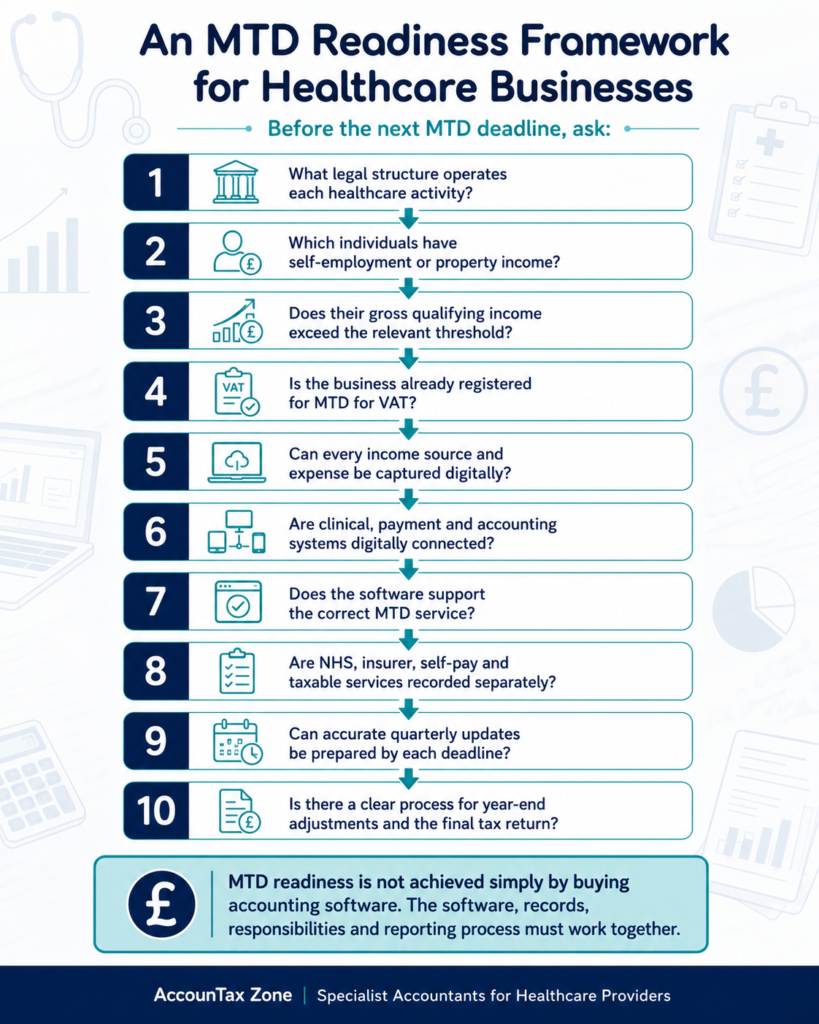
An MTD Readiness Framework for Healthcare Businesses
How AccounTax Zone Helps Healthcare Businesses with MTD
At AccounTax Zone, we help healthcare professionals and businesses prepare for MTD without turning financial administration into another burden on clinical time.
Our support can include:
- MTD eligibility reviews
- Qualifying-income calculations
- MTD for Income Tax registration
- MTD for VAT support
- Compatible software selection
- Cloud-accounting setup
- Spreadsheet and bridging-software reviews
- Digital record keeping
- Bank-feed setup
- Chart-of-accounts design
- Healthcare income mapping
- Quarterly bookkeeping
- Quarterly MTD updates
- VAT Returns
- Management accounts
- Cash-flow forecasts
- Tax estimates
- Year-end accounts
- Self Assessment tax returns
- Corporation Tax compliance
- Digital-link reviews
- Historic bookkeeping clean-ups
We can support:
- Self-employed medical professionals
- Private consultants
- Clinics
- Dentists
- Pharmacies
- Care providers
- Therapy businesses
- Healthcare partnerships
- Limited companies
- Multi-site healthcare groups
Our aim is not merely to help a healthcare business meet another HMRC deadline.
A well-designed MTD system should also help the owner understand:
- How much the business is earning
- Which services are most profitable
- What patients and organisations still owe
- How much tax to reserve
- Whether cash flow is improving
- Whether the business can afford to grow
FAQs About MTD for Healthcare Businesses
MTD requires affected businesses and individuals to keep specified tax records digitally and use compatible software to report information to HMRC. The relevant rules may involve MTD for VAT, MTD for Income Tax or both.
Mandatory MTD for Income Tax began on 6 April 2026 for qualifying sole traders and landlords with gross self-employment and property income over £50,000.
For entry from 6 April 2026, the qualifying-income threshold is more than £50,000, based on the relevant income reported for 2024/25.
MTD extends to individuals with qualifying income over £30,000 from 6 April 2027 and over £20,000 from 6 April 2028.
No. Employment income does not count towards qualifying income. Self-employment and property income are the principal sources included.
Yes, where the income is earned through self-employment. Gross income before expenses is used when assessing the threshold.
An individual’s share of partnership profit does not currently count towards MTD qualifying income. Partnerships themselves are not yet required to use MTD for Income Tax.
No. MTD for Income Tax applies to qualifying individuals, not limited companies. A limited company may still need MTD for VAT if VAT-registered.
A VAT-registered healthcare provider will generally need to keep digital VAT records and submit VAT Returns through compatible software unless it has an accepted exemption.
The first quarterly update deadline is 7 August 2026 for taxpayers who entered MTD on 6 April 2026.
No. They are cumulative summaries of income and expense categories from the digital records. Final adjustments and the complete tax return are dealt with after the tax year.
No. MTD quarterly updates do not currently create quarterly Income Tax payment deadlines. The final tax payment deadline remains 31 January following the tax year.
Yes, provided the spreadsheet forms part of a compliant digital process and is appropriately linked to compatible submission software.
Yes. An authorised accountant can manage submissions and provide bookkeeping support, but the business must still provide complete and accurate information.
There are no penalty points for late quarterly updates during 2026/27. However, the updates are still required, and penalties can still apply to late tax returns and late tax payments.
An exemption may be available where the individual is digitally excluded due to circumstances such as age, disability, health, religious beliefs or inability to access the internet because of location. HMRC considers applications individually.
Speak to an MTD Accountant for Healthcare Businesses
MTD should not force a healthcare professional to spend more evenings entering receipts, correcting spreadsheets or trying to understand HMRC software.
With the right process, it can create:
- More reliable records
- Better cash-flow visibility
- Earlier tax estimates
- Fewer year-end surprises
- Clearer service profitability
- Less pressure before reporting deadlines
AccounTax Zone helps healthcare businesses across London and the UK prepare for MTD, improve their bookkeeping systems and meet their tax obligations accurately.
Book your free MTD consultation
Call: 020 3740 7074
Email: info@accountaxzone.com


