You Might Have Heared: Limited Company Can Be Wrong for Foster Carers – Let’s Find it Out
Before You Set Up a Company, Read This
If you’ve spent any time researching tax online, you’ve probably come across advice like this: “Set up a limited company, it’ll save you tax.”
For many business owners, that’s often sensible advice.
Contractors, consultants, online retailers and property investors frequently use limited companies because they can offer tax planning opportunities, limited liability and greater flexibility.
But here’s where many foster carers get caught out.
Fostering doesn’t follow the same tax rules as running a normal business.
In fact, incorporating without understanding the Qualifying Care Relief (QCR) rules could mean giving up one of the most generous tax reliefs available in the UK.
We’ve spoken to foster carers who were considering forming a limited company because:
- a friend told them it would reduce their tax
- they read an article online saying companies are “more tax efficient”
- another accountant suggested incorporating without understanding foster care taxation
- they already had another business operating through a company
The problem is that foster care income sits within its own specialist tax framework.
That means advice that works perfectly for a consultant or tradesperson may be completely inappropriate for a foster carer.
This guide explains:
- whether foster carers can operate through a limited company
- why incorporating often doesn’t produce the expected tax savings
- when a company may still be appropriate
- how Qualifying Care Relief changes the picture
- and the questions you should ask before making a decision.
The Quick Answer
Should Foster Carers Set Up a Limited Company?
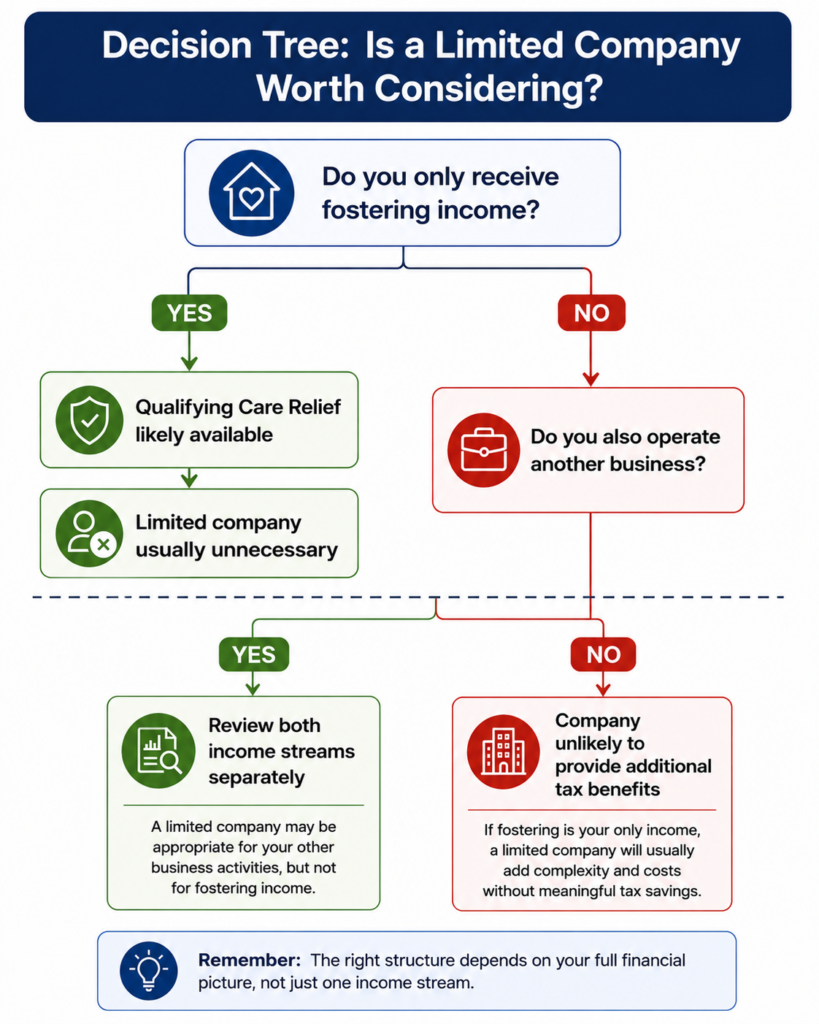
For most foster carers, probably not.
That’s because Qualifying Care Relief is designed to apply to individuals providing qualifying care, not to limited companies.
If your only income comes from fostering, setting up a company will often:
- create additional administration
- increase compliance requirements
- add accountancy costs
- and may remove the tax advantages you already receive under the Qualifying Care Relief rules.
That doesn’t mean a limited company is always the wrong choice.
If you also operate another business, own investment activities or have more complex financial affairs, a company could still play an important role.
The key is making sure the decision is based on your circumstances, not on generic tax advice.
Limited Companies Are Excellent for Many Businesses
This article isn’t intended to suggest that limited companies are a bad idea.
Far from it.
For many businesses, they offer significant advantages, including:
- limited liability protection
- flexible remuneration through salaries and dividends
- easier business succession planning
- improved credibility with customers and lenders
- potential corporation tax planning opportunities
At AccounTax Zone, we regularly help business owners decide when incorporation makes commercial and tax sense.
The important point is this:Foster care is different.
Why Foster Care Doesn’t Fit the Normal Business Model
Running a consultancy business and providing foster care might both involve receiving payments, but the tax systems behind them are fundamentally different.
A consultant generally calculates tax using:
- Income
- less business expenses
- equals taxable profit
A foster carer may instead qualify for the Qualifying Care Relief scheme, where taxable profit is calculated using a completely different statutory method.
That’s why the question isn’t: “Would a company save tax?”
It’s:“Would a company still allow me to benefit from the tax relief specifically designed for foster carers?”
Those are two very different questions.
AccounTax Zone Insight
One of the most common misconceptions we hear is: "Companies always pay less tax than individuals.
That can be true for some businesses.
However, foster carers already benefit from a specialist tax regime that many business owners simply don't have access to.
Comparing fostering with ordinary self-employment often leads to the wrong conclusion.
Why People Think a Limited Company Will Save Tax
This misconception doesn’t come from nowhere.
If you search online, you’ll find hundreds of articles explaining why incorporating can reduce tax.
Many of those articles are perfectly accurate, but they’re written for businesses operating under normal tax rules.
Typical reasons for incorporation include:
- lower corporation tax rates
- dividend planning
- retaining profits within the company
- extracting income gradually
- succession planning
These are genuine planning opportunities.
The problem is that they don’t automatically apply to fostering.
Why Generic Tax Advice Doesn’t Work for Foster Carers
Search engines can’t always distinguish between:
- a consultant
- a plumber
- an online retailer
- a graphic designer
- and a foster carer.
As a result, foster carers often end up reading articles written for ordinary businesses.
Those articles rarely mention:
- Qualifying Care Relief
- qualifying care receipts
- household allowances
- foster care legislation
- HMRC’s specialist treatment of foster carers
Without that context, it’s easy to assume incorporation is the logical next step.
What Makes Foster Carers Different?
This is where everything changes.
The UK tax system already recognises that foster carers operate differently from ordinary businesses.
Instead of relying solely on business expense deductions, HMRC introduced Qualifying Care Relief to simplify taxation and reflect the unique costs associated with providing care.
For many foster carers, this means:
- little or no taxable profit
- simplified tax calculations
- reduced record-keeping
- generous tax relief
These benefits already exist without needing to form a limited company.
The Question Isn’t “Can I Form a Company?”
Technically, many foster carers can own or operate a limited company.
The better question is:Should your fostering income go through one?
In many cases, the answer is no.
Because once fostering income is moved into a completely different legal and tax structure, the consequences become far more complex than many people expect.
Understanding those consequences before making a decision can save considerable time, money and unnecessary administration later.
AccounTax Zone Tip
Before spending money setting up a company, ask yourself one simple question:
"Am I trying to solve an actual tax problem, or am I assuming a limited company will automatically save tax?"
For foster carers, those are rarely the same thing.
The Hidden Cost of Choosing the Wrong Structure
The cost of forming an unnecessary company isn’t always measured in tax.
It can also include:
- annual Companies House filing obligations
- Corporation Tax returns
- bookkeeping requirements
- company accounts
- payroll administration
- additional accountancy fees
- extra compliance deadlines
If those additional responsibilities don’t provide a meaningful financial benefit, they simply become extra work.
For many foster carers, simplicity is often one of the biggest advantages of remaining within the existing Qualifying Care Relief framework.
Can a Limited Company Receive Foster Care Income?
This is one of the most common questions we hear from foster carers who are exploring ways to become more tax efficient.
The simple answer is:
Usually, no.
Fostering arrangements are generally established between the approved foster carer and the local authority or independent fostering agency.
The tax relief available to foster carers, known as Qualifying Care Relief (QCR), is designed for individuals providing qualifying care rather than limited companies.
While you may already own a company for another purpose, that doesn’t necessarily mean your fostering income should pass through it.
This distinction is often misunderstood because people assume that if a company can invoice for consultancy or contracting work, it can also receive fostering income in the same way.
Foster care operates under a completely different legal and tax framework.
AccounTax Zone Insight
We've occasionally spoken to foster carers who wanted to transfer all of their income into a company because they believed it would automatically reduce their tax bill.
In reality, the first question isn't "Can a company receive the income?" but rather "How does the fostering agreement treat the individual providing the care?"
Understanding that difference can prevent expensive mistakes before they happen.
Why a Limited Company May Cost More Than It Saves
Many people focus only on potential tax savings.
They overlook the additional responsibilities that come with operating a company.
Even if no tax saving is achieved, a company will usually still require:
- Annual accounts
- Corporation Tax returns
- Companies House confirmation statements
- Company bookkeeping
- Separate business bank records
- Ongoing compliance
- Professional accountancy support
These obligations continue every year regardless of whether the company generates a meaningful tax advantage.
For foster carers who already benefit from Qualifying Care Relief, these extra responsibilities often add complexity without delivering significant financial benefits.
The Hidden Costs of Incorporation
Before forming a company, consider the ongoing costs as well as the setup costs.
| Individual Foster Carer | Limited Company |
| Qualifying Care Relief available | Usually not available in the same way |
| Simple annual tax reporting | Multiple annual filing obligations |
| Lower administration | Increased administration |
| Fewer compliance deadlines | Companies House and HMRC deadlines |
| Lower professional costs | Higher ongoing accountancy costs |
Sometimes, the simplest structure is also the most efficient.
What Happens to Qualifying Care Relief?
This is where many online articles stop short.
Qualifying Care Relief is one of the biggest reasons why foster carers need specialist advice before considering incorporation.
The relief exists because HMRC recognises the unique nature of foster care.
Rather than taxing fostering income like ordinary business income, the legislation provides a specialist calculation that can significantly reduce or eliminate the taxable profit for many carers.
If you move away from the structure that Qualifying Care Relief was designed to support, you may also move away from the tax advantages that come with it.
That’s why incorporating should never be viewed purely as a tax-saving exercise.
AccounTax Zone Tip
Before making any structural changes, ask yourself: "Could I lose a valuable tax relief by changing the way my fostering income is treated?"
This single question often changes the conversation entirely.
The Biggest Mistake Foster Carers Make
Many foster carers compare themselves with:
- builders
- electricians
- consultants
- IT contractors
- online business owners
All of those businesses may legitimately benefit from trading through a company.
However, fostering isn’t simply another type of self-employment.
It operates within a specialist statutory framework that already includes generous tax reliefs.
Comparing yourself with businesses operating under completely different tax rules can easily lead to the wrong decision.
Case Study: Advice That Didn’t Fit
James had been fostering for several years and attended a networking event where another business owner explained how incorporating had significantly reduced their tax bill.
Encouraged by the conversation, James began researching how to form a limited company.
Before taking any action, he sought specialist advice.
After reviewing his circumstances, it became clear that his fostering income already benefited from Qualifying Care Relief and that incorporating was unlikely to improve his tax position. Instead, it would have introduced additional filing requirements and ongoing compliance costs.
The conversation saved him from making a decision based on advice that was appropriate for someone else’s business—but not for foster care.
When a Limited Company Does Make Sense
It’s important to recognise that many foster carers have more than one source of income.
For example, you might also run:
- a consultancy business
- an online retail business
- a property investment company
- a training business
- a family business
In these situations, a limited company may still be entirely appropriate—but for those business activities, not necessarily for your fostering income.
Each income stream should be reviewed on its own merits rather than assuming one structure fits everything.
AccounTax Zone Insight
One of the biggest differences between good tax planning and poor tax planning is understanding why a structure works.
A recommendation that's perfect for one taxpayer can be completely unsuitable for another.
That's why decisions about incorporation should always begin with your circumstances, your income sources and the tax rules that apply specifically to you.
Comparing the Two Approaches
Remaining as an Individual
For many foster carers, remaining as an individual offers:
- Access to Qualifying Care Relief.
- Simpler tax reporting.
- Lower administration.
- Fewer filing obligations.
- Lower ongoing compliance costs.
- A structure aligned with the existing foster care tax rules.
Operating Through a Limited Company
A company may offer advantages where appropriate, such as:
- Limited liability for commercial activities.
- Business succession planning.
- Separate trading operations.
- Commercial credibility.
However, those benefits need to be balanced against:
- additional compliance,
- higher administration,
- professional costs,
- and whether the structure is actually suitable for fostering income.
A Simple Rule of Thumb
If someone tells you: “Every foster carer should have a limited company because it saves tax.”
Treat that advice with caution.
There is no one-size-fits-all answer.
The right structure depends on:
- your income sources,
- your tax position,
- your future plans,
- and how the foster care tax rules apply to your circumstances.
Making a decision based on assumptions rather than specialist advice could leave you with more paperwork, higher costs and no meaningful tax benefit.
Real-Life Scenarios
Every foster carer’s circumstances are different, which is why there isn’t a universal answer to the limited company question.
Here are some common situations we see.
Scenario 1: Fostering Is Your Only Income
Sarah has been fostering for five years and receives all of her income through fostering placements.
After reading online that “limited companies save tax”, she considered incorporating.
After reviewing her circumstances, she realised she was already benefiting from Qualifying Care Relief and that incorporating would likely increase administration without providing any meaningful tax advantage.
Outcome: Remaining as an individual was the simpler and more tax-efficient option.
Scenario 2: Foster Carer and Consultant
Michael is a foster carer but also provides independent IT consultancy services.
His consultancy business generates significant profits, while his fostering income qualifies for Qualifying Care Relief.
Instead of trying to place everything into one structure, each income source was considered separately.
Outcome: A limited company may be appropriate for the consultancy business, while the fostering income continues to be treated under the existing foster care tax rules.
Scenario 3: Foster Carer With Rental Income
Emma receives fostering income alongside rental income from a buy-to-let property.
She assumed incorporating her fostering activities would simplify everything.
However, the two income sources are taxed under different rules and require separate consideration.
Outcome: Reviewing each income stream independently resulted in a clearer and more efficient tax position.
Scenario 4: Husband and Wife Foster Carers
David and Rachel foster together and were advised by a friend to form a company so they could “split the income.”
After reviewing the rules, they realised their household already benefited from Qualifying Care Relief and that the proposed structure offered no obvious advantage.
Outcome: Avoiding unnecessary incorporation reduced ongoing administration and professional costs.
AccounTax Zone Insight
One thing these scenarios have in common is that the answer isn't determined by the word "company", it's determined by the nature of the income.
Good tax planning starts with understanding what the income is, not simply choosing the structure that worked for someone else.
Common Myths About Limited Companies and Foster Care
The internet is full of well-meaning advice, but much of it isn’t written with foster carers in mind.
Let’s separate the myths from the facts.
| Myth | Reality |
| Every foster carer should form a limited company. | There is no one-size-fits-all answer. Many foster carers are better remaining as individuals. |
| A limited company always reduces tax. | Not necessarily. Foster carers may already benefit from Qualifying Care Relief, making incorporation less advantageous. |
| A company makes HMRC enquiries less likely. | Your legal structure doesn’t determine whether HMRC contacts you. Accurate reporting and good records are far more important. |
| If another foster carer incorporated, I should too. | Tax planning should always be based on your own circumstances. |
| A limited company automatically simplifies everything. | Companies usually introduce additional filing obligations and compliance responsibilities. |
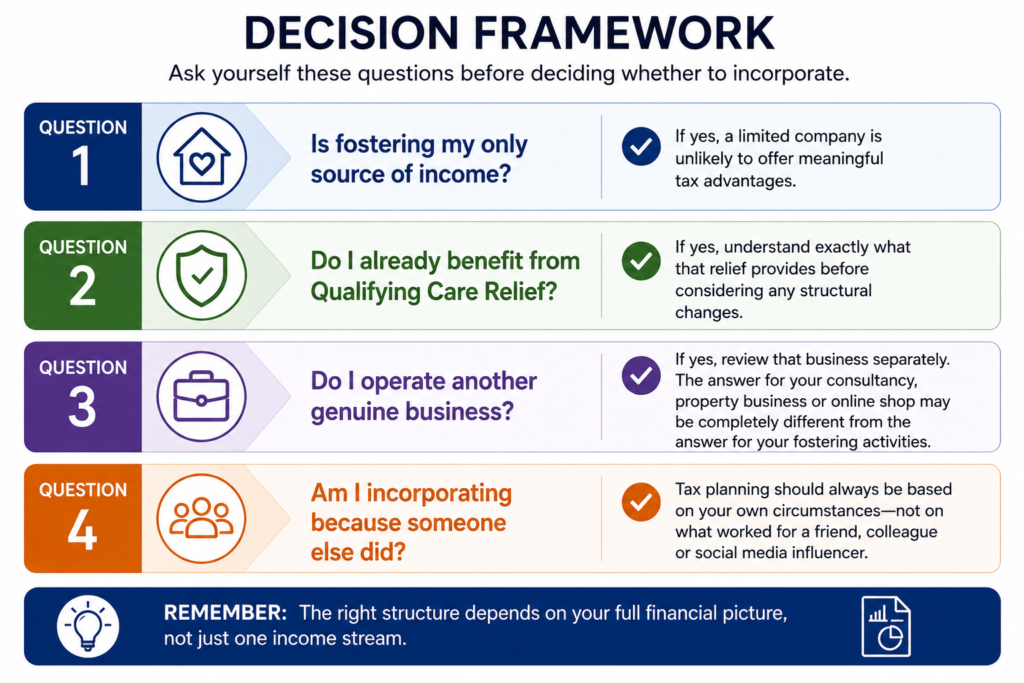
Before You Decide, Ask Yourself These Questions
Choosing the right structure shouldn’t be based on assumptions.
Work through these questions first.
- Is fostering my main or only source of income?
- Am I already benefiting from Qualifying Care Relief?
- Do I run another genuine business that might justify a company?
- Have I considered the ongoing compliance costs?
- Am I trying to solve an actual tax problem?
- Have I taken advice from someone who understands foster care taxation?
If you answered “No” to the final question, it’s worth seeking specialist advice before making a decision.
Decision Checklist
Use this simple checklist before deciding whether a limited company is likely to benefit you.
| Question | Yes | No |
| Is your only income from fostering? | ☐ | ☐ |
| Do you already qualify for Qualifying Care Relief? | ☐ | ☐ |
| Do you operate another separate business? | ☐ | ☐ |
| Have you compared the costs of running a company? | ☐ | ☐ |
| Have you reviewed your position with a specialist accountant? | ☐ | ☐ |
If most of your answers point towards fostering being your only income, a limited company may not provide the benefits you were expecting.
AccounTax Zone Tip
Many people focus on how much tax they might save but forget to calculate how much extra administration they'll create.
Before changing your business structure, compare:
- Annual accountancy costs
- Companies House obligations
- Corporation Tax compliance
- Additional bookkeeping
- Time spent managing the company
Sometimes the simplest structure is also the most cost-effective.
When Should You Consider Professional Advice?
There isn’t a single rule that applies to every foster carer.
However, it’s worth seeking advice if:
- you’re considering incorporating
- you already own a limited company
- you have multiple income sources
- you’re unsure how Qualifying Care Relief applies
- you’ve received conflicting advice
- you’ve received correspondence from HMRC
- you’re planning significant financial changes
A short review now could help you avoid unnecessary costs and administrative burdens later.
AccounTax Zone Insight
We've found that many foster carers seek advice after they've already started setting up a company.
In most cases, asking the question before making structural changes is far simpler, less expensive and gives you more options.
FAQs related to Limited Company Can Be Wrong for Foster Carers
In most cases, foster care arrangements are based on the individual providing the care rather than a limited company. Whether a company is appropriate depends on your specific circumstances.
Not necessarily.
Many foster carers already benefit from Qualifying Care Relief, meaning a company may provide little or no additional tax advantage.
Qualifying Care Relief is designed for individuals providing qualifying care. If you’re considering changing your structure, you should understand how that may affect your eligibility before making any decisions.
Yes.
Many foster carers also run separate businesses through limited companies.
The key point is that each income source should be reviewed independently rather than assuming the same structure is suitable for everything.
Not always.
While companies can provide tax planning opportunities in the right circumstances, they also introduce additional compliance obligations and ongoing professional costs.
Possibly.
However, restructuring after a company has already been formed can involve additional administration and costs.
Taking advice before incorporating is usually much simpler than correcting an unsuitable structure afterwards.
Don’t panic.
It doesn’t necessarily mean you’ve made a mistake.
The next step is to review your circumstances and understand how your existing structure interacts with your fostering activities before making any further changes.
Final Thoughts
Limited companies are excellent tools for many businesses.
But foster care is not an ordinary business.
The UK tax system already provides specialist relief through Qualifying Care Relief because it recognises the unique role foster carers play.
For many carers, trying to fit fostering into a standard business structure can create unnecessary complexity without improving the overall tax position.
The best decision isn’t the one that works for someone else.
It’s the one that’s based on your income, your circumstances and the tax rules that apply specifically to you.
Understanding those rules before making structural changes can save time, reduce costs and help you avoid expensive mistakes.
Speak to a Specialist Accountant Before You Incorporate
Thinking about setting up a limited company because you’ve heard it could save tax?
Before making a decision that could affect your tax position, let us review your circumstances.
At AccounTax Zone, we help foster carers across the UK understand how Qualifying Care Relief interacts with other income, assess whether a limited company is genuinely appropriate and ensure they’re using the most suitable structure for their situation.
We can help you:
- Review whether a limited company is appropriate.
- Explain how Qualifying Care Relief applies to your circumstances.
- Assess multiple income sources.
- Prepare and submit Self Assessment tax returns.
- Review previous tax returns.
- Provide clear, practical advice tailored to foster carers.
Book Your FREE 30-Minute Consultation
Call: 020 3740 7074
Email: info@accountaxzone.com
AccounTax Zone – Specialist Accountants for Foster Carers Across the UK.


