Cash Flow Management and Forecasting for UK Tech and SaaS Businesses
Running a growing technology business requires more than knowing how much money is currently in the bank.
A healthy balance today does not tell you:
- Whether payroll will be affordable in three months.
- How an upcoming VAT payment will affect available cash.
- Whether you can recruit another developer.
- What happens if a major customer pays late.
- How long your existing funding will last.
- Whether annual subscription receipts are creating a misleading impression of financial strength.
These questions can only be answered through reliable cash flow management and forecasting.
For SaaS companies, IT consultancies, software developers, digital platforms and other technology businesses, cash movement rarely follows a simple pattern. Customer payments, annual subscriptions, project milestones, cloud infrastructure, payroll, overseas contractors, VAT and investment spending can all occur at different times.
A cash flow forecast brings these movements together and shows what is likely to happen before the money arrives or leaves.
This guide explains how UK technology businesses can build a practical forecasting process, improve financial visibility and use cash information to make better growth decisions.
What Is Cash Flow Management?
Cash flow management is the process of monitoring, planning and controlling the money moving into and out of a business.
It involves more than checking the bank balance.
Effective cash flow management includes:
- Knowing what cash is currently available.
- Understanding which customer receipts are expected.
- Identifying upcoming supplier, payroll and tax payments.
- Monitoring delayed invoices.
- Planning large purchases and recruitment.
- Maintaining appropriate cash reserves.
- Reviewing whether the business is spending more cash than it generates.
- Acting before a forecast cash shortage becomes urgent.
Cash flow measures actual money movement. A business has positive cash flow when more cash enters than leaves during a particular period. It has negative cash flow when outgoings exceed incoming cash.
A profitable business can still experience serious cash pressure when customers pay after the business has already paid employees, contractors and suppliers.
What Is Cash Flow Forecasting?
Cash flow forecasting estimates how much money will enter and leave the business over a future period.
The basic calculation is:
Opening cash balance
expected cash receipts − expected cash payments = forecast closing cash balance
The forecast may be prepared weekly, monthly or over several years, depending on the decision being considered.
The key principle is that income should appear in the forecast when the money is expected to reach the bank, not simply when a sale is made or an invoice is issued. Payments should also be recorded when they are expected to leave the account.
A useful forecast does not need to predict the future perfectly. Its purpose is to identify likely outcomes early enough for management to respond.
Cash Flow Forecasting Is Not the Same as Budgeting
Cash flow forecasts, profit forecasts and budgets are connected, but they answer different questions.
Cash flow forecast
A cash flow forecast shows when money is expected to be received and paid.
It answers:
- Will enough cash be available?
- When might the bank balance fall below a safe level?
- Can the company meet payroll and tax payments?
- When could additional funding be required?
Profit forecast
A profit forecast estimates revenue, costs and accounting profit.
It answers:
- Is the business expected to be profitable?
- Are margins improving?
- Are operating costs increasing faster than revenue?
- Which services or customer groups are most profitable?
Budget
A budget sets out what management intends the business to achieve and spend.
It answers:
- What is the financial plan?
- How much has been allocated to each department?
- What sales target must be achieved?
- How much can be spent on recruitment, marketing or development?
A business may be ahead of its sales budget and profitable while still experiencing a cash shortage. This can happen when invoices remain unpaid, annual costs fall due or growth expenditure is incurred before customer receipts arrive.
Technology companies should therefore review profit, cash flow and budget performance together.
AccounTax Zone Insight
A business can meet its sales target and still run short of cash. This often happens when customers pay later than expected, annual costs fall due or the company recruits before additional revenue reaches the bank. Directors should therefore review profit, cash and budget performance together, not in isolation.
Why Forecasting Is Different for Technology Businesses
Technology businesses often face cash flow patterns that are not visible from conventional accounts alone.
Subscription and recurring revenue
SaaS businesses may receive customer payments:
- Monthly.
- Quarterly.
- Annually in advance.
- Based on usage.
- Through several subscription plans.
- In different currencies.
Recurring revenue can improve predictability, but MRR and ARR do not necessarily represent cash that will arrive in the same month.
A customer included in ARR may:
- Pay monthly rather than annually.
- Cancel at renewal.
- Fail a card payment.
- Receive a discount.
- Downgrade their subscription.
- Request a refund.
- Pay through a platform that settles funds later.
The cash forecast must therefore be based on expected collections rather than relying entirely on MRR or ARR.
Annual subscriptions paid in advance
An annual payment can produce a strong bank balance at the beginning of a contract.
However, that cash may need to fund service delivery for the following 12 months.
The accounting revenue may be recognised over the service period, while the cash is received upfront. This makes it important to keep revenue recognition and cash forecasting separate.
A large amount of deferred revenue does not automatically indicate a cash problem. It does, however, show that some cash already received relates to future service obligations.
Project and milestone billing
Software agencies and IT consultancies may invoice according to:
- Project milestones.
- Time spent.
- Monthly retainers.
- Completion stages.
- Support contracts.
- Acceptance of deliverables.
A contract value should not be included as immediate cash.
The forecast should consider:
- When work will be completed.
- When the invoice will be raised.
- The customer’s payment terms.
- The customer’s actual payment behaviour.
- Whether approval or acceptance could delay payment.
- Whether part of the invoice may be disputed.
High payroll and contractor costs
Technology businesses often carry significant people costs.
These may include:
- UK employees.
- Directors.
- Freelance developers.
- Personal service companies.
- Overseas contractors.
- Recruitment fees.
- Bonuses and commissions.
- Employer National Insurance.
- Pension contributions.
Payroll dates are usually fixed, while customer receipts may be uncertain. This mismatch makes accurate short-term forecasting particularly important.
Infrastructure and software costs
Cloud hosting and technology expenses may increase as customer usage grows.
Forecasts should consider:
- Cloud hosting.
- Data storage.
- API usage.
- Cybersecurity services.
- Software licences.
- Per-user subscriptions.
- Payment processing charges.
- Development tools.
- Domain, hosting and platform costs.
Some costs are predictable. Others vary with customer activity, transaction volume or foreign exchange rates.
International customers and suppliers
Tech companies frequently receive and make payments in several currencies.
Cash forecasts may therefore need to account for:
- Exchange-rate movements.
- Overseas payment charges.
- Platform conversion rates.
- Delayed international settlements.
- Foreign VAT or sales-tax payments.
- Overseas contractor payment dates.
A forecast prepared entirely in sterling should use clearly documented exchange-rate assumptions and update them when exposure becomes significant.
The Three Forecasts a Growing Tech Business May Need
One forecast will not answer every financial question.
1. Short-term weekly cash flow forecast
A weekly forecast is normally used to manage immediate liquidity.
A 13-week period is commonly used because it provides enough visibility to identify near-term risks while remaining detailed enough to update regularly.
It should include:
- Current bank balances.
- Expected customer receipts.
- Payroll.
- Contractor payments.
- Supplier payments.
- Software and hosting costs.
- VAT, PAYE and other tax payments.
- Loan repayments.
- One-off commitments.
- Forecast closing cash each week.
This forecast is particularly useful when:
- Cash reserves are limited.
- Customer payments are uncertain.
- The company is growing quickly.
- A funding round is approaching.
- A major tax payment is due.
- Management is considering cost reductions.
2. Rolling 12-month cash flow forecast
A monthly 12-month forecast supports broader planning.
UK government business guidance recommends a 12-month cash flow forecast when preparing for many funding applications.
It can help management decide:
- When to recruit.
- Whether to increase marketing expenditure.
- When annual renewals will affect cash.
- Whether a major software project is affordable.
- How much funding may be required.
- When the business may reach cash break-even.
- Whether the current cost base is sustainable.
The forecast should be rolled forward each month so that the business always maintains a forward-looking view.
3. Strategic scenario forecast
A strategic forecast looks further ahead and compares different possible outcomes.
For example:
- Base case: The outcome management currently considers most likely.
- Downside case: A more cautious scenario that may include slower sales, higher churn, delayed fundraising or increased costs.
- Upside case: A stronger scenario that may include faster customer growth, higher annual prepayments or improved retention.
Scenario planning helps directors understand not only what they expect to happen, but what they would do if assumptions change. ICAEW guidance recommends revisiting forecast inputs regularly and using forecasting tools to model different scenarios.
How to Build a Reliable Cash Flow Forecast
Step 1: Confirm the opening cash position
Start with the actual available cash held across the company’s bank and payment accounts.
This may include:
- Current accounts.
- Savings accounts.
- Foreign currency accounts.
- Stripe, PayPal or other platform balances awaiting settlement.
Do not include:
- Undrawn lending facilities as cash.
- Unpaid customer invoices.
- Pipeline opportunities.
- Credit limits.
- Funds that are legally restricted and unavailable for general use.
The opening balance should reconcile with current bank records.
Step 2: Map every source of incoming cash
Separate cash receipts into meaningful categories.
For a SaaS business, these may include:
- Monthly subscription collections.
- Annual renewals.
- Usage-based charges.
- Onboarding fees.
- Implementation services.
- Support income.
- Licence fees.
- Grants.
- Investment proceeds.
- Loan receipts.
- Tax repayments.
For an IT consultancy or software agency, they may include:
- Retainers.
- Project deposits.
- Milestone invoices.
- Time-based billing.
- Maintenance contracts.
- Support packages.
- Reimbursed expenses.
Each receipt should be placed in the period when payment is realistically expected.
Step 3: Separate contracted revenue from pipeline
One of the most common forecasting weaknesses is treating the sales pipeline as guaranteed income.
Cash inflows should be divided into categories such as:
- Cash already received.
- Invoiced and expected.
- Contracted but not yet invoiced.
- Renewal expected but not confirmed.
- Sales pipeline.
- Uncertain or exceptional receipts.
Management may apply probability assumptions to pipeline income for strategic forecasting. However, the short-term liquidity forecast should remain cautious.
A £100,000 opportunity in the CRM is not £100,000 of available cash.
Step 4: Use actual customer payment behaviour
Contractual payment terms do not always reflect reality.
An invoice may state 30 days, while a particular customer regularly pays after 45 or 60 days.
A reliable forecast should use:
- Historical payment patterns.
- Known customer approval processes.
- Current invoice disputes.
- Credit-control updates.
- Expected payment dates confirmed by customers.
- Payment-platform settlement periods.
Forecasting payment according to actual behaviour produces a more credible result than assuming every customer pays exactly on the due date.
AccounTax Zone Insight
We recommend forecasting customer receipts using real payment patterns rather than contractual terms alone. If a customer regularly pays a 30-day invoice after 50 days, the cash forecast should reflect 50 days until there is clear evidence that the behaviour has changed.
Step 5: Record committed cash outflows
Include all payments the business is already committed to making.
Typical outflows include:
- Salaries and director remuneration.
- Employer National Insurance and pensions.
- Contractors and freelancers.
- Rent and office costs.
- Cloud hosting.
- Software subscriptions.
- Insurance.
- Professional fees.
- Loan repayments and interest.
- Marketing commitments.
- Equipment purchases.
- VAT.
- PAYE.
- Corporation Tax.
- Dividends.
- Intercompany payments.
Annual and quarterly costs must be entered in the period when they fall due rather than spread evenly unless monthly payments have genuinely been arranged.
Step 6: Add planned growth expenditure separately
Planned expenditure should be clearly distinguished from committed expenditure.
Examples include:
- New employees.
- Additional contractors.
- Product development projects.
- New office space.
- International expansion.
- Marketing campaigns.
- Acquisitions.
- New systems or software.
- Hardware purchases.
This allows management to see the forecast both before and after the proposed decision.
For example, a company may remain cash-positive without a new hire but fall below its minimum cash reserve six months after recruiting.
Step 7: Include taxes properly
Tax payments are often among the largest forecast outflows.
The forecast may need to include:
- VAT.
- PAYE and National Insurance.
- Corporation Tax.
- Business rates.
- Overseas VAT or other indirect taxes.
- Personal tax payments where company drawings or director remuneration are being planned.
A separate bank account may help protect cash reserved for tax, but the liabilities should still appear in the main forecast.
Tax estimates should be updated when management accounts, VAT returns or corporation tax calculations become available.
Step 8: Calculate forecast closing cash
For each week or month:
Opening cash: total cash received − total cash paid = closing cash
The closing cash balance becomes the following period’s opening balance.
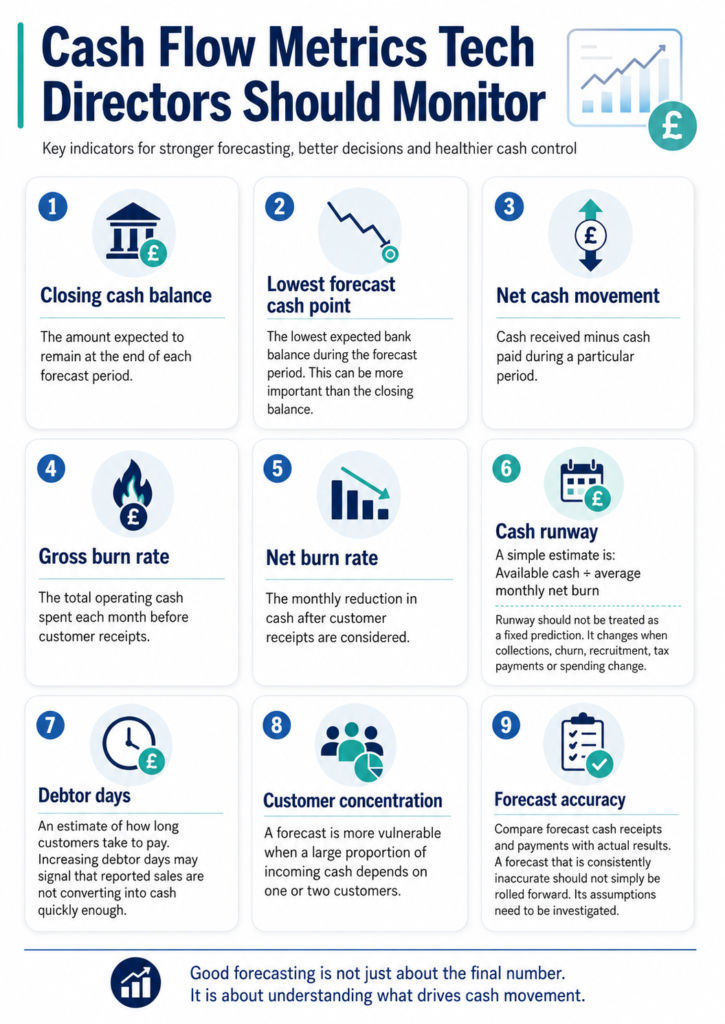
Management should pay attention to the lowest forecast cash point, not only the final balance.
A forecast may show £200,000 remaining after 12 months while revealing that cash falls to £15,000 during month six. That temporary low point may still prevent the business from meeting payroll or other commitments.
Step 9: Set a minimum cash threshold
The business should define the minimum cash balance it considers safe.
There is no universal figure suitable for every technology business.
The amount depends on:
- Monthly payroll.
- Reliability of customer receipts.
- Access to borrowing.
- Customer concentration.
- Stage of growth.
- Funding plans.
- Contract commitments.
- Management’s risk tolerance.
- How quickly costs can be reduced.
Forecast reports should clearly highlight any period in which cash falls below this level.
AccounTax Zone Insight
The minimum safe cash level should be agreed before a difficult decision arises. For many technology businesses, the right threshold is linked to payroll, tax commitments and essential operating costs. Setting it in advance reduces the risk of directors approving spending simply because the current bank balance looks healthy.
A Simple Cash Flow Forecasting Example
Consider a growing software company with:
- Opening cash of £180,000.
- Monthly customer collections of £95,000.
- Payroll and contractor costs of £70,000.
- Other operating payments of £25,000.
- A quarterly VAT payment of £30,000.
- A planned new hire costing £6,000 per month from month three.
In an ordinary month before the recruitment:
Cash received: £95,000
Cash paid: £95,000
Net cash movement: £0
The company may appear stable.
However, the month containing the VAT payment creates a £30,000 cash reduction. The new hire then increases monthly outgoings to £101,000, creating a recurring monthly cash reduction of £6,000 unless income grows or other costs fall.
The forecast makes the impact visible before the recruitment decision is finalised.
Management can then consider:
- Delaying the hire.
- Accelerating customer collections.
- Increasing annual subscriptions paid upfront.
- Reducing another cost.
- Securing funding.
- Recruiting only after a revenue milestone is achieved.
The forecast does not make the decision. It shows the financial consequences of each option.
Cash Flow Metrics Tech Directors Should Monitor
Forecast Versus Actual Analysis
A cash flow forecast is only useful if it is regularly tested against what actually happens.
At the end of each week or month, management should compare forecast cash movements with actual receipts and payments. This helps identify where assumptions were accurate, where they were not, and whether any recurring pattern is beginning to emerge.
Variances will generally fall into four categories:
Timing variances
The forecast amount was broadly correct, but the cash movement occurred earlier or later than expected.
For example, a customer payment forecast for week four may not be received until week five.
Timing variances are particularly important in businesses with long payment cycles or customers that do not consistently pay within agreed terms.
Value variances
The cash movement occurred as expected, but the actual amount differed from the forecast.
For example, monthly cloud infrastructure costs may have been forecast at £9,000 but ultimately reached £12,000 because of increased platform usage.
Repeated value variances may indicate that cost assumptions need to be revised.
Omitted cash movements
A receipt or payment may have been missed completely when the forecast was prepared.
Examples might include:
- an annual software renewal;
- an insurance premium;
- a one-off professional fee;
- a tax payment; or
- an expected customer receipt.
Recurring omissions usually point to weaknesses in the forecasting process or incomplete communication between finance and other areas of the business.
Assumption variances
Sometimes the underlying business assumption changes rather than the timing or amount of a transaction.
For example:
- a customer expected to renew may decide not to;
- recruitment may take place earlier than planned;
- a product launch may be delayed;
- customer growth may be slower than forecast; or
- a planned investment may be brought forward.
These variances are often the most important because they may indicate a wider change in the business rather than a simple forecasting error.
Use the variance to improve the next forecast
The objective of forecast-versus-actual analysis is not simply to explain why the numbers were different.
It is to improve the quality of future decisions.
Where significant or repeated variances arise, management should ask:
- Was the original assumption realistic?
- Is this a one-off difference or an emerging trend?
- Does the remaining forecast need to be revised?
- Will the change affect cash runway or the minimum cash threshold?
- Does management need to take action now?
Over time, this process turns cash flow forecasting from a static financial exercise into a more reliable management tool.
AccounTax Zone Insight:
A forecast should not be considered inaccurate simply because actual cash differs from the original projection. The more important question is whether management understands the reason for the variance and updates future assumptions accordingly. Repeated unexplained variances are usually a sign that the forecasting process, rather than the spreadsheet itself, needs attention.
How Frequently Should the Forecast Be Updated?
Weekly
A weekly review should normally cover:
- Current cash balances.
- Customer collections.
- Overdue invoices.
- Payroll and contractor payments.
- Major supplier commitments.
- Tax payments.
- Any change in the next 13 weeks.
Businesses experiencing cash pressure may need to update the forecast more frequently.
Monthly
The monthly process should:
- Reconcile the forecast with management accounts.
- Update subscription and renewal assumptions.
- Review churn and payment failures.
- Add new employees and contractors.
- Update VAT and tax estimates.
- Compare actual results against forecast.
- Roll the forecast forward by another month.
- Refresh base, downside and upside scenarios.
Quarterly
A wider quarterly review should consider:
- Pricing.
- Gross margin.
- Recruitment plans.
- Product investment.
- Fundraising.
- Customer concentration.
- International expansion.
- Longer-term cash requirements.
The most sophisticated forecasting software will not compensate for outdated assumptions. What matters most is the quality of the information entered and whether management reviews it consistently.
Common Cash Flow Forecasting Mistakes
Using invoice dates instead of payment dates
An invoice is not cash. Record the receipt when payment is realistically expected.
Including the entire sales pipeline
Pipeline income should be treated cautiously and separated from contracted or invoiced income.
Ignoring VAT within customer receipts
The full amount collected may not be available for operating expenditure where part of it represents VAT payable.
Confusing annual cash receipts with monthly revenue
Annual subscription cash can improve liquidity without changing the amount of revenue earned each month.
Forgetting annual and quarterly costs
Insurance, software renewals, VAT, Corporation Tax and bonuses can create significant forecast movements.
Assuming every subscription renews
Renewal forecasts should account for expected churn, failed payments, discounts and downgrades.
Excluding the balance sheet
Debtors, creditors, tax liabilities, loans and deferred revenue can all affect the cash position even when they are not obvious from the profit and loss account.
Producing one optimistic scenario
A forecast should show what happens when customer growth is slower, costs increase or funding is delayed.
Failing to compare forecast with actual results
Without variance analysis, the same forecasting errors are repeated every month.
Treating the forecast as an accountant-only document
Sales, operations, delivery, HR and management may all hold information needed to keep the forecast reliable.
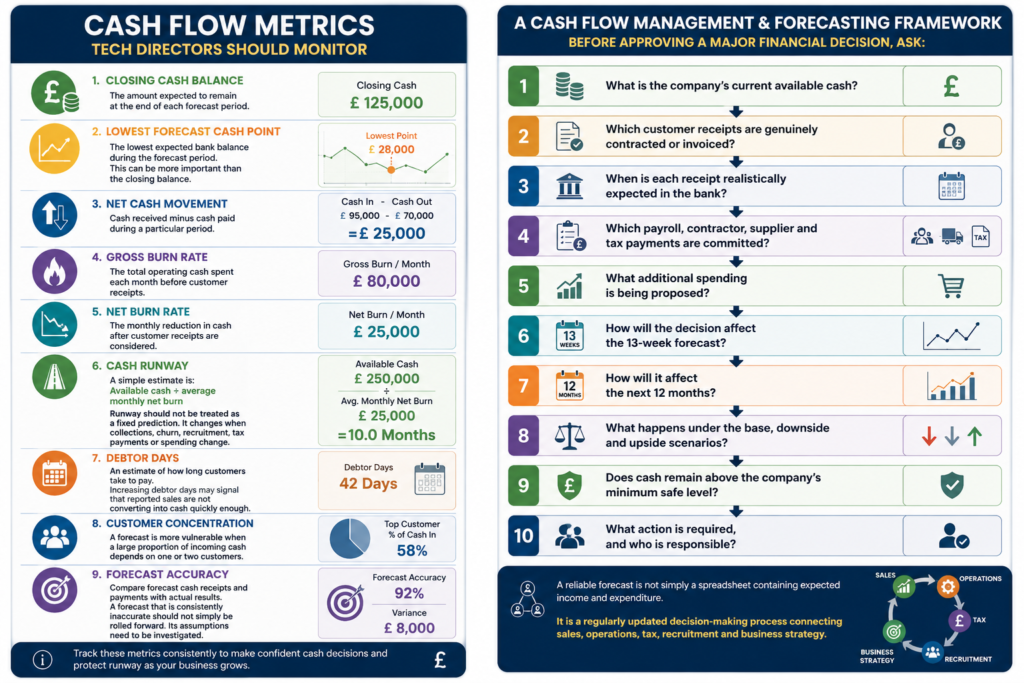
A Cash Flow Management and Forecasting Framework
How Cash Flow Forecasting Connects with Your Other Financial Systems
Cash forecasting should not operate separately from the rest of the finance function.
It should connect with:
Bookkeeping
Bank balances, supplier invoices and customer receipts must be accurate and up to date.
Management accounts
Management accounts explain profitability and financial performance. The forecast shows how these results are expected to convert into cash.
Revenue recognition
Subscription and project revenue must be recognised correctly, but the cash forecast should follow actual collection timing.
VAT management
VAT collected and payable should be reflected in forecast cash movements.
Payroll and IR35
Recruitment, employee costs, contractors and employment-status decisions can materially affect future cash requirements.
Sales systems
CRM opportunities, contract dates, renewals and customer payment terms should support—not automatically dictate, forecast inflows.
Board and investor reporting
Investors and directors need to understand cash runway, funding requirements and the assumptions supporting the forecast.
How AccounTax Zone Supports Tech Businesses
At AccounTax Zone, we help UK technology businesses turn financial records into practical forward-looking information.
Our support may include:
- Building 13-week cash flow forecasts.
- Preparing rolling 12-month forecasts.
- Reviewing burn rate and runway.
- Connecting Xero with payment and reporting systems.
- Modelling recruitment and investment decisions.
- Preparing base, downside and upside scenarios.
- Forecasting VAT, payroll and Corporation Tax payments.
- Producing monthly management accounts.
- Comparing actual cash performance with forecast.
- Preparing financial information for lenders and investors.
- Providing Virtual Finance Office and Virtual CFO support.
The objective is not to produce a forecast that is opened once and forgotten.
It is to give founders and directors a reliable process for deciding when to recruit, spend, raise funding, protect cash or change direction.
FAQs related to Cash Flow Management and Forecasting
Cash flow management is the process of monitoring and controlling money moving into and out of a business so that sufficient cash remains available to meet its commitments.
A cash flow forecast estimates future cash receipts, cash payments and closing bank balances over a defined period.
Many businesses benefit from combining a detailed 13-week weekly forecast with a rolling 12-month monthly forecast. Longer-term scenarios may also be required for fundraising or strategic planning.
No. Profit measures revenue less costs under accounting rules. Cash flow measures when money actually enters and leaves the business.
Possible reasons include delayed customer payments, high payroll, upfront development expenditure, tax payments, failed subscription collections or rapid growth that requires investment before additional cash is received.
Pipeline income can be included in scenario planning, but it should remain separate from contracted, invoiced or highly certain receipts. Short-term liquidity forecasts should use cautious assumptions.
Cash should be recorded when the customer is expected to pay. Revenue may still need to be recognised over the subscription period, so cash forecasting and revenue recognition should be maintained separately.
A short-term forecast should usually be reviewed weekly. A longer-term forecast should normally be updated at least monthly and whenever a significant change occurs.
Cash runway estimates how long available cash may last at the current net burn rate. It is a planning measure rather than a guaranteed timeframe.
Software can improve efficiency, but the result depends on the accuracy of the bookkeeping and the quality of the assumptions. Customer payment behaviour, pipeline probability, recruitment and strategic expenditure still require management judgement.
Yes. A specialist Tech Accountant can combine bookkeeping, management accounts, subscription data, tax estimates and growth plans to prepare forecasts relevant to SaaS and technology business models.
Gain Clearer Control Over Your Future Cash Position
A cash flow forecast should give you more than a projected bank balance.
It should help you understand:
- When cash pressure may arise.
- Which assumptions create the greatest risk.
- Whether planned recruitment is affordable.
- How long current funding may last.
- What happens if customer growth slows.
- When additional finance may be required.
- Which action should be taken now.
AccounTax Zone supports SaaS companies, IT consultancies, software businesses and growing technology companies across London and the UK.
Book a FREE 30-minute Cash Flow and Forecasting Review.
We will discuss:
- Your current cash position.
- Your forecasting process.
- Cash runway and burn rate.
- Customer collection assumptions.
- Upcoming tax and payroll commitments.
- Opportunities to improve financial visibility.
Call: 020 3740 7074
Email: info@accountaxzone.com


