A 5% or 6% franchise royalty can look like a relatively small cost when you first read a franchise agreement.
But 6% of turnover does not necessarily mean the royalty is costing you only 6% of your profit.
For some franchisees, the royalty can consume a surprisingly large proportion of the profit left after stock, wages, premises costs and other overheads have been paid.
That is why franchise owners should look beyond one question:
“What percentage royalty am I paying?”
The better questions are:
- What is the royalty calculated on?
- What other franchise charges sit alongside it?
- Does the franchisor’s sales figure reconcile with my accounts?
- How does the royalty affect cashflow?
- How should it be treated for tax?
- What percentage of my gross profit does it absorb?
- What percentage of operating profit goes to franchise charges?
- Is the franchise still providing an adequate return after those costs?
HMRC recognises that continuing franchise fees can be structured in different ways, including as a percentage of turnover, a mark-up on purchases or a regular fixed amount per outlet.
So understanding your franchise royalty fees is not simply about reading the percentage written in the agreement.
It is about understanding what remains for you, the franchisee, after paying them.
What Is a Franchise Royalty Fee?
A franchise royalty fee is an ongoing payment made by a franchisee to a franchisor under the franchise agreement, often in return for continuing access to the franchise system, brand and ongoing services or support.
The British Franchise Association notes that ongoing fees may be described as a management service fee or royalty and may be payable weekly, monthly or quarterly. The method of calculation depends on the agreement.
HMRC similarly describes continuing franchise fees as potentially being calculated through:
- A percentage of turnover
- A mark-up on purchases
- A regular fixed payment per outlet
HMRC also advises that the signed franchise agreement is important when determining the tax treatment of franchise payments.
This means there is no single royalty structure that applies to every UK franchise.
Your agreement controls what you are required to pay.
Franchise Fee vs Franchise Royalty: What Is the Difference?
These two costs should not automatically be treated as the same thing.
Initial Franchise Fee
The initial fee is normally paid when acquiring the franchise rights and entering the franchise network.
It may relate to areas such as:
- Access to the franchise system
- Initial rights
- Training
- Setup support
- Launch assistance
- Other items specified in the agreement
HMRC states that an initial payment by a franchisee is usually capital in nature, including where the predetermined amount is paid by instalments rather than as one lump sum. HMRC also notes that companies may instead fall within the Corporation Tax intangible-assets regime where applicable.
Ongoing Franchise Royalty
The royalty is generally a recurring fee arising during the operation of the franchise.
It may be linked to:
- Turnover
- Gross sales
- Purchases
- Each outlet
- A fixed period
- Another contractual measure
HMRC states that annual fees payable by a franchisee are generally allowable expenses when computing trading profits.
The distinction matters.
Simply coding every payment to the franchisor as “franchise fees” in your accounting software may make it harder to identify the correct accounting and tax treatment.
How Are Franchise Royalty Fees Calculated?
The exact calculation should be set out in the franchise agreement.
Several models are commonly possible.
1. Percentage of Turnover or Gross Sales
This is straightforward in principle.
Suppose the agreement requires: Royalty: 6% of qualifying sales
and monthly qualifying sales are: £100,000
The royalty would be: £100,000 × 6% = £6,000
The British Franchise Association notes that ongoing fees are often calculated as a percentage of gross sales, although other structures can apply.
The important word here is often “gross sales” or whatever equivalent term your agreement uses.
You need to know exactly how that term is defined.
2. Fixed Royalty Fee
Some agreements may require a fixed weekly or monthly amount.
For example: £2,500 every month
The advantage from a forecasting perspective is that the amount may be more predictable.
However, the commercial impact can become much greater when sales fall because the payment does not necessarily decline alongside turnover.
3. Percentage Subject to a Minimum Fee
An agreement might calculate the royalty as a percentage of sales but specify a minimum amount.
For example:5% of qualifying sales, subject to a minimum payment of £3,000 per month.
If qualifying sales are £100,000: 5% = £5,000
The royalty is £5,000.
But if sales fall to £40,000: 5% = £2,000
If the contract requires a £3,000 minimum, the franchisee may still pay £3,000.
The BFA notes that some ongoing fees may be structured as the higher of a minimum fixed amount or a percentage of gross sales.
4. Purchase-Based Charges
A franchise model may recover part of its ongoing income through a mark-up or other charge connected with purchases.
HMRC explicitly recognises a mark-up on purchases from the franchisor as one possible form of continuing franchise fee.
This can make the true franchise cost harder to see if you look only at the line called “royalty” in your accounts.
A 6% Royalty Does Not Mean It Costs You 6% of Your Profit
This is one of the most important concepts for a franchise owner to understand.
Suppose a franchise produces:
| Item | Monthly Amount |
| Revenue | £100,000 |
| Direct costs | (£40,000) |
| Gross profit | £60,000 |
| Payroll | (£28,000) |
| Premises and other overheads | (£17,000) |
| Profit before royalty | £15,000 |
| Royalty at 6% of sales | (£6,000) |
| Profit after royalty | £9,000 |
The royalty is: 6% of revenue
But compared with the £15,000 profit available immediately before the royalty in this simplified example, the £6,000 charge absorbs: 40% of that profit
That tells a very different story.
This does not mean the royalty is necessarily excessive.
The franchise brand, system and support may be helping generate the revenue in the first place.
But it demonstrates why a franchisee should not assess royalty costs only against turnover.
AccounTax Zone Tip: Track your royalty against turnover, gross profit and operating profit. A royalty that looks modest as a percentage of sales can have a much larger impact on the profit ultimately retained by the franchisee.
What Are You Receiving in Return for the Royalty?
A royalty should not automatically be viewed as money simply disappearing from the business.
A franchisee may receive significant value from being part of a franchise network.
Depending on the particular franchise agreement, ongoing support may include areas such as:
- Access to the operating system
- Continued use of the franchise model
- Training
- Technical support
- Conferences
- Supplier support
- Operational guidance
- Brand infrastructure
The BFA identifies several forms of ongoing support that may be included within a franchise arrangement, while stressing that the agreement should explain what support is provided.
Therefore, asking: “Is 7% too high?”
may not be the right question.
A better question is: “What financial return am I producing after paying the 7%?”
A franchise charging a higher royalty but producing stronger margins, better customer demand and better systems could potentially provide a better financial outcome than one with a lower royalty but weak economics.
The royalty percentage alone cannot tell you whether the franchise is a good investment.
Franchise Royalty vs Marketing Levy
A royalty and a marketing levy should not automatically be regarded as the same cost.
Suppose a franchise agreement includes:
- Royalty: 6%
- Marketing contribution: 2%
- Technology fee: £750 per month
- Other network charges: £250 per month
If sales are £100,000 per month, the franchisee might initially say:
“My franchise costs me 6%.”
But the real recurring network cost is considerably higher.
Example
Royalty: £6,000
Marketing levy: £2,000
Technology and other charges: £1,000
Total recurring franchise/network charges: £9,000
That represents: 9% of £100,000 turnover
before considering any other costs that may arise from the franchise arrangement.
This leads to a useful management KPI.
Total Franchise Cost Ratio
Recurring franchise and network charges ÷ relevant turnover × 100
This can provide a more realistic view of what the franchise relationship costs the individual business.
The calculation should be adapted to the actual terms of the franchise agreement rather than assuming every network charge is economically equivalent.
Understand What “Gross Sales” Means
A royalty of 6% sounds simple.
The difficult part can be deciding: 6% of what?
The franchise agreement should define the sales base used for calculating the royalty.
Depending on the agreement, questions may arise around:
- VAT
- Customer refunds
- Discounts
- Vouchers
- Delivery-platform sales
- Online orders
- Cancelled transactions
- Promotions
- Bad debts
- Delivery charges
- Intercompany transactions
- Other sales adjustments
The BFA notes that the ongoing fee calculation and payment obligations should be dealt with through the franchise agreement.
Do not assume your accounting software’s definition of sales automatically matches the contractual definition used by the franchisor.
That difference can be very important.
How Do Franchise Royalties Affect Cash Flow?
Royalties do not affect only profitability.
They also affect cashflow.
Suppose sales rise by £20,000.
The franchise owner may initially see: +£20,000 additional revenue
But increased sales can also create:
- Additional royalty payments
- Additional stock requirements
- Additional VAT exposure where applicable
- Higher card fees
- Higher staffing requirements
- Larger marketing contributions where linked to sales
So a £20,000 increase in turnover does not necessarily produce anything close to £20,000 of additional available cash.
For percentage-based royalties, your cashflow forecast should move the royalty expense when the sales forecast changes.
Example
Forecast sales: £120,000
Royalty: 6%
Forecast royalty: £7,200
If expected sales fall to: £90,000
the forecast royalty becomes: £5,400
assuming the agreement contains a straightforward 6% calculation and no minimum or other adjustment.
AccounTax Zone Tip: Put royalties and marketing levies on separate lines in your cashflow forecast. If they vary with sales, link them directly to forecast turnover so the cash impact adjusts whenever your sales assumptions change.
This connects royalty management directly with proper franchisee cash flow management.
Are Franchise Royalty Fees Tax Deductible in the UK?
Ongoing annual franchise fees are generally allowable when calculating the taxable profits of a trade, according to HMRC.
However, this should not be confused with the treatment of the initial franchise fee.
HMRC’s guidance states that:
- The initial franchise payment is usually capital
- Related legal costs are usually capital
- Paying the initial predetermined amount by instalments does not automatically turn it into a revenue expense
- In some cases an identifiable part of an initial fee may relate to a revenue item, but whether an apportionment is appropriate depends on the facts
- Annual franchise fees are generally allowable expenses when computing trading profit
- For companies, the Corporation Tax intangible-assets regime may apply and take precedence where relevant
This is why the question:
“Are franchise fees tax deductible?”
cannot always be answered with a simple yes or no.
You need to establish what the payment actually represents.
Initial Franchise Fee vs Ongoing Royalty for Tax
A simple way to understand the distinction is:
| Payment | Typical Nature | Tax Point to Review |
| Initial franchise payment | Usually capital | Capital / intangible asset treatment |
| Related initial legal costs | Usually capital | Consider with acquisition |
| Identifiable initial revenue services | Facts dependent | Possible apportionment |
| Ongoing annual franchise fee | Generally revenue | Usually deductible in computing trading profit |
This table is a general summary of HMRC’s franchise guidance and should not replace reviewing the actual agreement and circumstances.
For accounting purposes, franchise owners should therefore avoid putting every franchisor payment into one generic nominal code without considering what it represents.
What About VAT on Franchise Royalties?
VAT needs separate consideration from the Corporation Tax or Income Tax treatment of the royalty.
The VAT position can depend on matters including:
- What is being supplied
- Where the supplier belongs
- Where the franchisee belongs
- Whether the transaction is business-to-business
- Whether UK VAT applies
- Whether a reverse charge is relevant for services received from outside the UK
- Whether the franchisee can recover input tax
HMRC’s place-of-supply guidance states that the general rule for B2B services is that the supply takes place where the business customer belongs, subject to exceptions. Where a UK business receives relevant B2B services from an overseas supplier, the reverse charge may apply.
HMRC also states that under the reverse charge, input VAT can be recovered subject to the normal rules. Input-tax recovery can be restricted where costs relate to exempt or otherwise non-recoverable activities.
For this reason, a franchisee should not assume: “It’s a royalty, so the VAT treatment must always be X.”
The invoice, contract, supplier location and franchisee’s own VAT position should be reviewed.
This can become particularly important for franchises operating in sectors where the franchisee itself makes exempt, taxable or mixed supplies.
How Should Franchise Royalties Be Recorded in the Accounts?
Good franchise bookkeeping should make the royalty easy to identify and review.
Avoid burying everything paid to the franchisor inside a single miscellaneous expense category.
Where appropriate, your chart of accounts could distinguish between:
- Franchise royalties
- Marketing levies
- Technology charges
- Franchise support fees
- Initial franchise costs
- Training
- Software
- Other network charges
The exact accounts used will depend on the agreement and accounting treatment.
The objective is visibility.
A franchise owner should be able to look at the management accounts and quickly answer:
How much did we pay to the franchise network this month?
And then:
What percentage of our revenue and profit did that represent?
A Strong Franchise Royalty Reconciliation Process
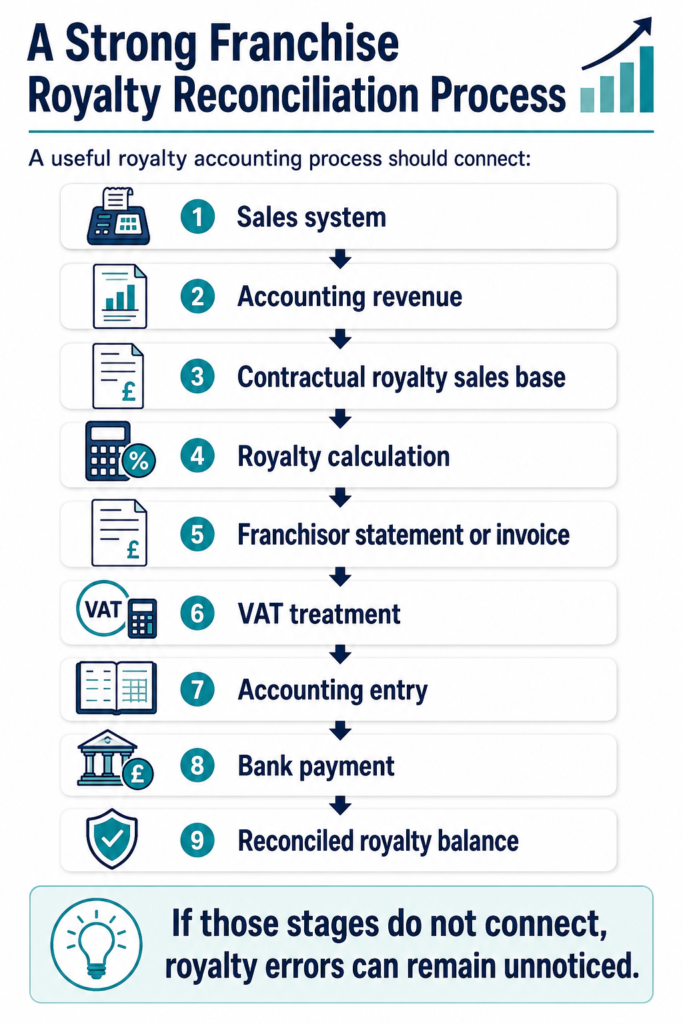
Reconcile the Franchisor’s Sales Figure With Your Accounts
Suppose your accounting software shows monthly revenue of: £109,800
But the franchisor’s statement calculates royalty using: £112,500
Difference: £2,700
That does not automatically mean either side is wrong.
The difference might arise because of:
- Timing
- VAT treatment
- Refunds
- Discounts
- Delivery sales
- Reporting cut-off
- Contractual definition of gross sales
- Accounting adjustments
But it should be understood.
If you simply allow the royalty payment to leave the bank each month without reconciling the underlying figure, small differences can continue for long periods.
AccounTax Zone Tip: Reconcile the sales figure used by the franchisor against your bookkeeping every month. Investigating a difference while transactions are recent is far easier than trying to reconstruct it at year end.
The objective is not to challenge every royalty calculation.
It is to ensure that your accounts, franchise reporting and contractual calculations tell a consistent story.
Why Franchise Royalties Should Be Reviewed Every Month
Consider what can happen during one year.
Month 1: Sales £80,000.
Month 6: Sales £100,000.
Month 12: Sales £125,000.
If the royalty is percentage based, the absolute cash cost has increased significantly.
But perhaps during the same period:
- Labour costs increased
- Supplier prices rose
- Rent increased
- Discounts became more frequent
- Gross margin fell
The franchisee may therefore celebrate substantial sales growth while actual profit improves only slightly, or potentially declines.
A useful monthly review should therefore examine both: Sales growth and Profit retained after franchise costs
That is where management accounts become far more useful than simply monitoring turnover.
Four Royalty KPIs Every Franchise Owner Should Understand
You do not need dozens of ratios.
But four measures can provide much better visibility.
1. Royalty as a Percentage of Turnover
Royalty ÷ relevant turnover × 100
This confirms the basic royalty burden against sales.
If the agreement states 6%, your management reporting should help you understand whether the actual figures broadly align once contractual definitions and adjustments are considered.
2. Total Franchise Charges as a Percentage of Turnover
Royalty + marketing + recurring network charges ÷ turnover × 100
This shows more than the headline royalty.
It answers:
How much of our revenue is going towards recurring franchise/network costs?
3. Royalty as a Percentage of Gross Profit
Royalty ÷ gross profit × 100
This becomes particularly useful when direct costs are increasing.
Two franchise locations can have identical sales and royalty percentages but very different gross margins.
4. Royalty as a Percentage of Operating Profit Before Royalty
This helps show how much of the remaining operating return is being absorbed by the fee.
It is a management metric rather than a statutory accounting requirement, but it can be extremely revealing when assessing franchise economics.
Example: The Royalty Percentage Stayed the Same but Profit Fell
Consider two periods.
Period A
Revenue: £100,000
Gross profit: £65,000
Royalty at 6%: £6,000
Other operating costs: £45,000
Profit after royalty: £14,000
Period B
Revenue: £120,000
Gross profit: £72,000
Royalty at 6%: £7,200
Other operating costs: £54,000
Profit after royalty: £10,800
Revenue has increased by:20%
But profit has fallen.
The royalty percentage did not change.
The problem is that the economics underneath the revenue changed.
That is why asking:
“What royalty percentage do I pay?”
is much less useful than:
“What is happening to the profit left after I pay it?”
What Happens to Royalties When Sales Fall?
The answer depends on how the royalty is structured.
Percentage-Based Royalty
If sales fall, the royalty may also fall.
But many other costs may not.
For example:
- Rent
- Salaried staff
- Loan payments
- Insurance
- Software
- Minimum supplier costs
So while the royalty reduces, overall profitability can still deteriorate quickly.
Fixed Royalty
A fixed royalty may stay unchanged even when turnover falls.
That makes its percentage impact on revenue higher during weaker periods.
Minimum Royalty
A minimum charge can create another problem.
Once turnover falls far enough, the royalty may stop declining because the minimum fee applies.
This is why franchise owners should stress-test the royalty arrangement before buying a franchise and during periods of changing sales.
Stress-Test the Franchise Royalty
Do not forecast only the expected outcome.
Model different scenarios.
For example:
Scenario 1: Expected trading
Sales: £100,000
Royalty: £6,000
Scenario 2: Sales fall 10%
Sales: £90,000
Recalculate royalty and operating profit.
Scenario 3: Sales fall 20%
Sales: £80,000
Recalculate again.
Scenario 4: Supplier costs rise 8%
Keep revenue unchanged but reduce gross margin.
Scenario 5: Payroll rises 10%
Measure what remains after royalty and staffing costs.
This reveals something far more important than the royalty rate:
How resilient is the franchisee's profit after paying it?
Multi-Unit Franchisees Should Track Royalties by Location
If you operate several franchise locations, consolidated reporting alone can hide important differences.
Suppose all three sites pay the same 6% royalty:
| KPI | Site A | Site B | Site C |
| Revenue | £150,000 | £110,000 | £90,000 |
| Royalty | £9,000 | £6,600 | £5,400 |
| Gross margin | 68% | 58% | 66% |
| Labour cost | 28% | 37% | 29% |
| Operating profit after royalty | £24,000 | £5,500 | £13,000 |
The royalty percentage is identical.
The financial outcome clearly is not.
Site B needs attention.
The problem might be:
- Lower margin
- Staffing
- Waste
- Premises costs
- Local sales mix
- Operational inefficiency
A group-level set of accounts could hide that.
AccounTax Zone Tip: For multi-unit franchises, track royalties and total recurring franchise charges by location alongside site profitability. Before opening another unit, understand which existing sites are genuinely producing the strongest return after franchise costs.
Before Buying a Franchise, Model the Royalty Properly
Prospective franchisees often focus heavily on:
Initial franchise fee
That is understandable because it is a visible upfront cost.
But an ongoing royalty can potentially represent a much larger cumulative payment during the life of the franchise.
Before signing, understand:
- The royalty percentage or fixed amount
- What the royalty is calculated on
- Definition of gross sales
- Whether VAT is included or excluded in the calculation
- Minimum royalty requirements
- Payment frequency
- Marketing contributions
- Technology charges
- Other network costs
- Whether fees can change
- Renewal-related charges
- What support is provided
- What happens during poor trading
The BFA recommends carefully reviewing the financial obligations contained within the franchise agreement, including the initial and ongoing fees and what the franchisee receives in return.
Your solicitor should advise on the legal wording and contractual obligations.
Your accountant should help you model what those obligations do to the numbers.
Model More Than the Franchisor’s Expected Sales
Suppose the franchise projection indicates: £500,000 annual sales
Do not model only £500,000.
Model:
Expected case: £500,000
Lower case: £400,000
Break-even case: What turnover covers all costs?
Then test:
- Royalty
- Marketing levy
- Gross margin
- Payroll
- Rent
- Finance costs
- Tax
- Owner remuneration
The question is not:
“Can the business generate £500,000 of sales?”
It is:
“What do I earn if sales reach £500,000, and what happens if they don’t?”
When Can a Higher Royalty Still Make Financial Sense?
A low royalty does not automatically make one franchise better than another.
Imagine:
Franchise A
Royalty: 4%
Profit after all costs: £50,000
Franchise B
Royalty: 7%
Profit after all costs: £90,000
If the assumptions are genuinely comparable and sustainable, Franchise B may provide the better financial outcome despite charging the higher percentage.
Why?
Potentially because the franchise provides stronger:
- Brand demand
- Systems
- Purchasing arrangements
- Customer acquisition
- Operational support
- Economics
This is why the correct measure is not: Lowest royalty wins.
It is: Which opportunity produces the strongest sustainable return after all costs?
Are You Paying for Growth or Just More Turnover?
This question becomes particularly important as a franchise expands.
Suppose turnover grows:
Year 1: £600,000
Year 2: £750,000
Year 3: £900,000
Excellent.
But what happened to:
- Gross profit percentage?
- Labour percentage?
- Franchise fees?
- Marketing charges?
- Operating profit?
- Cashflow?
- Owner return?
If royalty and costs continue increasing alongside turnover while profit remains almost unchanged, the franchisee may be building a bigger operation without creating proportionate economic value.
Growth should therefore be measured using both: Revenue and Return.
Warning Signs Your Franchise Royalty Costs Need Reviewing
You may need better royalty reporting if:
- You know the royalty percentage but not the actual annual amount
- You cannot explain what sales figure the royalty is based on
- Franchisor sales regularly differ from your accounting records
- Royalties and marketing charges are posted to one generic account
- You do not know whether VAT is being handled correctly
- You do not reconcile franchisor statements
- Profit is declining despite increasing sales
- Royalty payments regularly create cashflow pressure
- You do not know your total recurring franchise cost
- Different locations are not being tracked separately
- Initial franchise fees and recurring royalties have been treated identically
- You cannot calculate your profit after franchise charges
One issue does not necessarily mean something is wrong.
But several of these together can indicate that the franchise owner does not have enough financial visibility over the cost of the franchise relationship.
A Franchise Royalty Review Framework
Rather than simply checking whether the Direct Debit has left the bank, follow the royalty from the agreement to the final financial result.
- Read the royalty clause in the franchise agreement
- Identify exactly what the fee is calculated on
- Confirm the contractual royalty rate or fixed charge
- Separate royalty from marketing and other network fees
- Reconcile contractual sales with accounting sales
- Recalculate the expected royalty
- Compare it with the franchisor’s invoice or statement
- Check the VAT and accounting treatment
- Reconcile the payment
- Measure royalty against gross profit
- Measure total franchise charges against operating profit
- Decide whether the franchise economics are producing the return you expect
The objective is not simply to prove that the royalty calculation is mathematically correct.
It is to understand:What is left for the franchisee after paying it?
How Management Accounts Help Franchise Owners Control Royalty Costs
Annual accounts may tell you how much the business spent over the entire financial year.
But by then, much of the opportunity to influence performance has already passed.
Monthly management accounts can help franchisees monitor:
- Revenue
- Gross margin
- Payroll
- Royalties
- Marketing charges
- Site expenses
- Operating profit
- Cashflow
- Tax reserves
That allows the owner to identify trends.
For example:
Sales +12% but Gross margin - 3 percentage points and Payroll +16% and Royalty +12%
Result: Profit -8%
Now the owner knows where attention is required.
That is what financial reporting should do.
It should turn numbers into decisions.
FAQs related to Franchise Royalty Fee
A franchise royalty fee is an ongoing payment made by the franchisee to the franchisor under the franchise agreement.
It is commonly associated with continued participation in the franchise system and ongoing services or support. The amount and frequency depend on the agreement. The BFA notes that royalties may be payable weekly, monthly or quarterly and can be percentage-based, fixed or subject to a minimum.
Franchise royalties can be calculated as a percentage of turnover, a fixed payment, a mark-up on purchases or another contractual formula.
HMRC specifically recognises percentage-of-turnover, purchase mark-up and regular fixed-per-outlet approaches.
There is no single royalty percentage that applies to all franchises.
The fee depends on the particular franchise model and agreement. Prospective franchisees should therefore evaluate the actual royalty together with marketing fees, network charges, margins and expected profitability rather than relying on a generic industry percentage.
Many franchise royalty arrangements are based on sales or turnover rather than the franchisee’s profit, although other structures can apply.
The precise calculation must be checked against the franchise agreement.
HMRC states that annual franchise fees are generally allowable expenses when computing trading profits.
This differs from the initial franchise fee, which is normally capital in nature, subject to the specific facts and the Corporation Tax intangible-assets regime where applicable.
The initial franchise fee is normally associated with acquiring the franchise rights at the beginning of the relationship, whereas the royalty is an ongoing charge paid during operation of the franchise.
The accounting and tax treatment can therefore differ.
Not necessarily.
Some franchise agreements charge marketing contributions separately from the main royalty or management service fee. Franchisees should review the agreement and account for each type of charge according to what it actually represents.
Not always.
The BFA notes that ongoing franchise fees can be payable weekly, monthly or sometimes quarterly. The actual frequency is determined by the franchise agreement.
Royalties reduce the amount remaining after the franchise’s other costs and should therefore be considered when measuring operating profit and return on investment.
Where a royalty is based on turnover, it can increase as sales increase even if the franchisee’s underlying profit margin is being squeezed by other costs.
Recurring royalties should be clearly identifiable within the accounting records rather than being mixed indiscriminately with initial franchise costs or unrelated network charges.
The specific accounting treatment depends on the nature of the payment and circumstances, so the agreement and supporting invoices should be retained and reviewed.
The VAT treatment depends on the nature and place of supply and the circumstances of the parties.
For cross-border B2B services, UK franchisees may also need to consider the reverse-charge rules. HMRC’s VAT place-of-supply guidance should be applied to the particular transaction.
It depends on the royalty structure.
A percentage-of-sales royalty may decrease as sales fall, while a fixed royalty may remain unchanged. Where a minimum royalty applies, the payment may stop falling once that minimum is reached.
The answer depends on the franchise agreement and the contractual rights of the parties.
A franchisee considering the legal effect of a proposed fee change should review the agreement and obtain appropriate legal advice rather than relying solely on accounting guidance.
Multi-unit operators should normally be able to identify royalty and other franchise costs by location.
This allows the owner to compare sales, margin, labour costs, franchise charges and profitability across individual units instead of relying only on consolidated figures.
The Royalty Is Not the Most Important Number
A franchise owner naturally wants to know: “What percentage royalty am I paying?”
But that is only the beginning.
The questions that matter more are:
- How is the royalty calculated?
- What other franchise charges am I paying?
- Does the calculation reconcile with my accounts?
- What does the royalty represent as a percentage of gross profit?
- What remains after payroll and overheads?
- How does it affect cashflow?
- Which locations generate the strongest return after franchise costs?
- And ultimately, is the franchise producing enough profit for the capital and effort I have invested?
The franchisor’s royalty may be contractually fixed.
But the franchisee can still improve visibility over:
margin + payroll + costs + cashflow + profitability + return
That is where good franchise accounting becomes valuable.
Need to Understand What Your Franchise Is Really Making?
At AccounTax Zone, we help franchise owners look beyond turnover and understand what remains after royalties, payroll, VAT, tax and other operating costs.
We can support you with:
- Franchise royalty accounting
- Royalty and sales reconciliation
- Monthly management accounts
- Franchise profitability analysis
- Cashflow forecasting
- VAT
- Payroll
- Tax planning
- Multi-unit reporting
- Budgeting
- Buying a franchise
- Franchise expansion
- Exit planning
Whether you operate one location or several, our aim is to help you answer one fundamental question:
Is your franchise producing the financial return you expect?
Speak to a Specialist Franchise Accountant
If your sales are increasing but profit or cash does not seem to follow, your royalty and overall franchise cost structure may be worth reviewing.
Book a FREE 30-minute initial consultation with AccounTax Zone.
Call: 020 3740 7074
Email: info@accountaxzone.com


