Your franchise is busy.
Sales are coming in.
Customers are paying.
The franchisor’s dashboard may even show that your location is performing well.
So why does the bank account still feel tight?
This is one of the most important financial questions a franchise owner can ask.
A franchise can generate healthy sales and even report an accounting profit while still struggling to pay wages, suppliers, VAT, royalties, rent or other bills when they become due.
The problem is often not simply how much the franchise sells.
It is when money comes in, where it goes and how much of it is genuinely available to spend.
That is where effective franchisee cash flow management becomes essential.
For a franchise owner, managing cashflow means looking beyond turnover and understanding the timing of:
- Customer receipts
- VAT
- Payroll
- Stock and suppliers
- Franchise royalties
- Marketing levies
- Rent and premises costs
- Loan repayments
- Corporation Tax
- Equipment and refurbishment
- Owner withdrawals
- Future expansion
A good cashflow system should give you enough visibility to identify a shortage before the bank balance becomes the problem.
What Is Franchisee Cash Flow Management?
Franchisee cash flow management is the process of forecasting, monitoring and controlling the money entering and leaving a franchised business so that it has sufficient cash to meet its obligations when they fall due.
It involves much more than checking the bank balance.
A franchisee should be able to understand:
- What cash is expected to arrive
- When it is expected
- What payments are due
- Which payments are fixed
- Which costs increase with sales
- What money needs to be reserved for tax
- When the business is likely to reach its lowest cash position
- Whether additional funding may be required
UK government-backed business guidance describes a cashflow forecast as a way of showing how money is expected to move into and out of a business so that potential cash shortages or surplus funds can be identified in advance.
For a franchisee, that forecast needs to reflect the specific economics of the franchise model, including royalties, network charges and any contractual commitments to the franchisor.
Why Can a Profitable Franchise Run Out of Cash?
Because profit and cash are not the same thing.
Your profit and loss account measures financial performance over a period.
Your bank account shows the cash available at a particular moment.
A franchise can therefore show a profit but still experience a cash shortage.
Consider a simple example.
A franchise sells £100,000 during a month.
That sounds healthy.
But from the cash generated by those sales, the business may also need to fund:
- VAT
- Stock or direct costs
- Wages
- Employer payroll costs
- Franchise royalties
- Marketing levies
- Rent
- Business rates
- Utilities
- Insurance
- Software
- Loan repayments
- Equipment
- Corporation Tax
- Other operating expenses
Some of those payments may leave the bank account immediately.
Others may become payable weeks or months later.
That timing difference is where cashflow problems often begin.
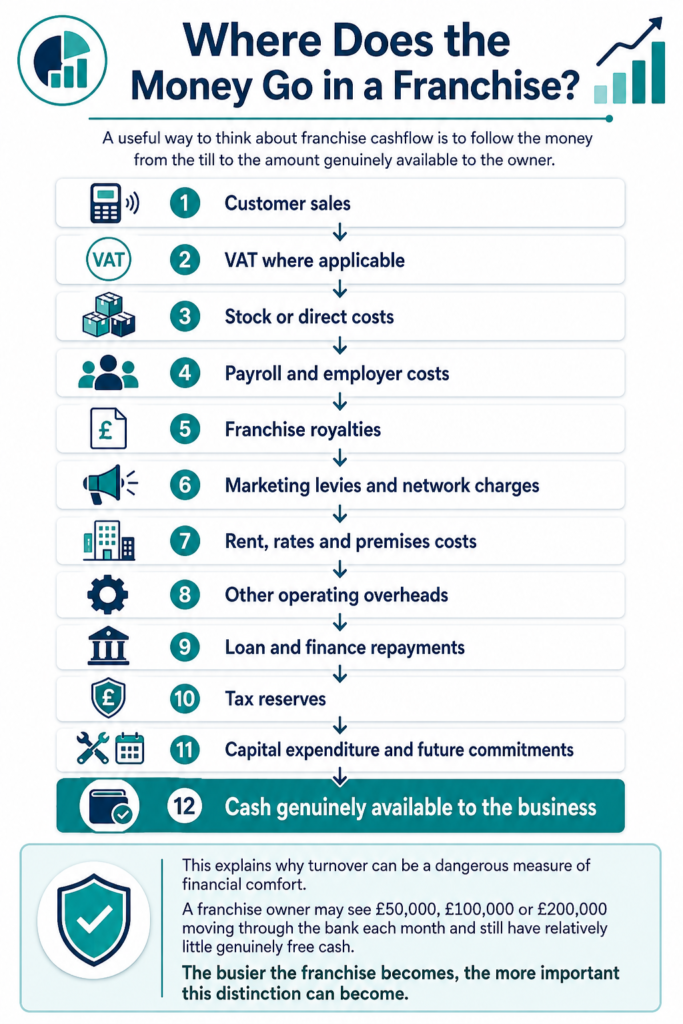
A franchisee sees £100,000 of sales.
But the real question is:
How much of that £100,000 is actually available after every existing and upcoming commitment has been recognised?
Where Does the Money Go in a Franchise?
Franchise Royalties Can Put Pressure on Cashflow
Royalties are one of the features that make franchise cashflow different from that of many independent businesses.
HMRC recognises that continuing franchise fees can be calculated in different ways, including as a percentage of turnover, through a mark-up on purchases or as a regular fixed payment per outlet.
The exact arrangement depends on the franchise agreement.
Where royalties are linked to turnover, increasing sales may also increase the amount payable to the franchisor.
For example:
Monthly sales increase from £80,000 to £100,000.
That is an additional £20,000 of revenue.
But the additional £20,000 is not necessarily an additional £20,000 of cash for the franchise owner.
You may also have:
- Additional VAT
- Higher stock purchases
- Higher staffing costs
- Increased royalty charges
- Increased card processing fees
- Other variable costs
The increase in cash retained by the business may therefore be considerably smaller than the increase in sales.
AccounTax Zone’s Tip for Franchisee: Before spending additional sales receipts, estimate how much is already committed to VAT, royalties, stock and other variable costs. Revenue growth and available cash rarely increase pound-for-pound.
This is also why royalty costs should be monitored against profit, not simply against turnover.
VAT Is Not the Same as Available Business Cash
VAT can create a significant cashflow trap.
A VAT-registered franchise may receive money from customers that includes VAT.
That money arrives in the business bank account.
But the VAT element is not necessarily profit or cash that can safely be spent.
For most businesses using standard VAT accounting periods, an online VAT return and payment are usually due one calendar month and seven days after the end of the VAT period, although different arrangements can apply in particular circumstances or under specific VAT schemes.
This creates a timing gap.
The business may receive the VAT today but pay the net liability to HMRC later.
If the entire bank balance is treated as available operating cash, the business can find itself struggling when the VAT payment becomes due.
This is particularly important for franchise sectors where VAT treatment can be more complicated, including businesses dealing with different types of supplies.
Good franchisee cash flow management therefore considers:
- Expected VAT liability
- VAT already collected
- Recoverable input VAT
- VAT payment dates
- Changes in sales mix
- Unusual purchases
- Capital expenditure
A strong turnover month can sometimes create a larger future VAT payment, so higher sales should be reflected in the cash forecast rather than viewed simply as extra available money.
Payroll Can Consume Cash Faster Than Sales Grow
For labour-intensive franchises, payroll is often one of the biggest cash outflows.
This can be particularly important for:
- Restaurants
- Takeaways
- Care businesses
- Cleaning franchises
- Fitness businesses
- Retail operations
- Education franchises
- Service businesses
Owners sometimes monitor gross wages but overlook the wider employment cost.
The actual cash requirement may include:
- Gross wages
- Employer National Insurance
- Employer pension contributions
- Overtime
- Bonuses
- Holiday cover
- Agency staff
- Temporary staff
- Statutory payments
- Other employment-related costs
PAYE payments to HMRC are generally due by the 22nd of the following tax month when paying electronically, with different arrangements applying in certain circumstances.
That creates another predictable cashflow date that should appear in the forecast.
Monitor Labour Cost as a Percentage of Revenue
One useful franchise KPI is: Total employment cost ÷ revenue × 100
Suppose sales increase by 10%.
That sounds positive.
But if total staffing cost increases by 18%, the additional revenue may not improve cash generation as much as expected.
AccounTax Zone’s Tip for Franchisee: Forecast payroll using the total expected employment cost, not just employees' headline gross wages. This gives you a much more realistic view of the cash needed for each payroll cycle.
The objective should not simply be to reduce staffing.
It should be to understand whether the staffing model remains commercially sustainable at the franchise’s current level of sales.
Stock Can Quietly Absorb Your Cash
Product-based franchises have another important cashflow challenge: inventory.
Cash can leave the bank long before stock is sold.
A franchise agreement may also restrict which suppliers franchisees use or how products are purchased.
This can create challenges involving:
- Minimum order quantities
- Supplier payment terms
- Seasonal stock
- Slow-moving products
- Food waste
- Damaged inventory
- Promotional stock
- New product launches
- Safety stock
- Supplier price increases
Imagine spending £30,000 on stock.
That stock may appear as an asset in the accounts.
But the £30,000 has still left the bank.
If the products take weeks or months to sell, cash has become tied up in inventory.
A franchisee should therefore monitor more than the value of stock.
Ask:
How quickly is stock turning back into cash?
For service-based franchises, the equivalent problem may instead be customers taking too long to pay.
Either way, the principle is the same:
The longer cash remains trapped in working capital, the less cash is available to operate the business.
What Is Working Capital in a Franchise?
Working capital is essentially the short-term financial capacity available to keep the business operating.
For a franchisee, working-capital pressure can arise because money leaves the business before enough cash has been received or retained.
Examples include:
- Buying stock before it is sold
- Paying staff before customers pay invoices
- Funding VAT before recovering customer debts
- Paying rent in advance
- Meeting royalty dates
- Funding seasonal demand
- Building inventory before a busy period
- Covering the first few months of a new franchise location
This is why the cost of buying a franchise should never be assessed using the initial franchise fee alone.
UK government franchise guidance similarly highlights that the financial picture extends beyond the headline franchise fee to areas including total investment, working-capital requirements, ongoing management fees and the time required to reach break-even.
A franchise that requires £80,000 to acquire but another £50,000 to survive its early trading period is not really an £80,000 commitment.
Build a 13-Week Franchise Cash Flow Forecast
For day-to-day control, we often recommend that franchise owners consider maintaining a rolling 13-week cash flow forecast alongside longer-term financial planning.
Why 13 weeks?
Because it gives enough visibility to see upcoming liabilities while remaining close enough to current operations for forecasts to be updated frequently.
The objective isn’t to predict every pound perfectly.
The objective is to see where pressure may appear early enough to do something about it.
A basic weekly franchise forecast might contain:
| Cash Flow Item | Week 1 | Week 2 | Week 3 | Week 4 |
| Opening cash | £30,000 | £27,000 | £34,000 | £25,000 |
| Customer receipts | £22,000 | £25,000 | £23,000 | £28,000 |
| Supplier payments | (£8,000) | (£7,000) | (£10,000) | (£8,000) |
| Payroll | – | (£12,000) | – | (£12,000) |
| Royalty | (£3,000) | – | – | (£3,000) |
| Rent/premises | (£4,000) | – | – | (£4,000) |
| VAT/PAYE/tax | – | – | (£15,000) | – |
| Other payments | (£10,000) | (£5,000) | (£7,000) | (£6,000) |
| Closing cash | £27,000 | £28,000 | £25,000 | £20,000 |
The exact categories should reflect your franchise.
Government guidance similarly recommends factoring expected revenue, outgoing expenditure and expected payment dates into a cashflow forecast so potential funding gaps can be identified.
The Most Important Number in Your Cash Flow Forecast
It isn’t necessarily your closing balance at the end of the year.
It is often your: Lowest Forecast Cash Point
Suppose your forecast shows:
January: £45,000
February: £37,000
March: £22,000
April: £9,000
May: £18,000
June: £31,000
Your attention should immediately go to April.
Then ask: Why does cash fall to £9,000?
Perhaps:
- VAT is due
- Insurance renews
- A royalty payment falls due
- Annual software costs are collected
- Stock must be purchased
- Corporation Tax is payable
- Equipment is being replaced
Once the cause is understood, the franchisee can act before April arrives.
That might mean:
- Preserving more cash
- Delaying non-essential expenditure
- Improving customer collection
- Reducing stock
- Reviewing staffing
- Negotiating supplier terms
- Arranging finance in advance
That is what makes a forecast useful.
It should drive decisions.
How Much Cash Reserve Should a Franchisee Keep?
There is no single amount that is appropriate for every franchise.
A restaurant franchise with weekly payroll, high stock purchases and significant premises costs has a very different risk profile from a home-based consultancy franchise.
Rather than selecting an arbitrary number, consider your actual commitments.
Ask:
What costs must be paid even if sales temporarily fall?
For example:
- Payroll
- Rent
- Franchise charges
- Loan repayments
- Insurance
- Software
- Minimum supplier commitments
When are major tax payments due?
This could include VAT, PAYE and Corporation Tax.
For companies outside the Corporation Tax instalment-payment regime, Corporation Tax is normally due nine months and one day after the end of the accounting period. Larger companies can be subject to different instalment payment rules.
How seasonal is the franchise?
Would three weaker months materially affect cash?
How quickly could costs be reduced?
Some franchise costs are contractually fixed.
How reliable are customer receipts?
This matters particularly where customers pay on credit rather than immediately.
What is the lowest balance shown in your forecast?
This is a much more useful starting point for deciding what cash buffer the business may require.
AccounTax Zone’s Tip for Franchisee: Build your minimum cash reserve around your actual fixed commitments and lowest forecast cash point, rather than relying on a generic rule based on turnover.
Cash Flow Forecast vs Profit and Loss: What’s the Difference?
Both reports are valuable, but they answer different questions.
- Profit and Loss Account: This helps answer: Is the franchise profitable? It measures income and expenses over a period.
- Cash Flow Forecast: This helps answer: Will the franchise have enough cash to meet upcoming payments? The difference matters. A franchise may report £100,000 of annual profit but still experience a cash shortage because:
- Customers have not yet paid
- Stock has been purchased
- Debt is being repaid
- Equipment has been bought
- VAT is becoming due
- Corporation Tax is approaching
- Dividends have been extracted
- Another location is being funded
You need both perspectives.
Profitability tells you whether the economic model is working.
Cashflow tells you whether the business can keep operating while it does.
Your Bank Balance Is Not a Cash Flow Forecast
Opening online banking every morning can tell you how much money is available today.
It does not tell you what will happen next month.
Imagine the bank account shows: £75,000
That might look comfortable.
But perhaps:
- £18,000 is required for VAT.
- £16,000 is needed for payroll.
- £7,000 relates to PAYE and other employment costs.
- £6,000 is due to the franchisor.
- £12,000 is owed to suppliers.
- £5,000 is due for rent and premises costs.
Suddenly the apparently healthy £75,000 looks very different.
A better question is: What will remain after the commitments already attached to this cash are recognised?
That is financial visibility.
Why Accurate Bookkeeping Matters for Cash Flow Management
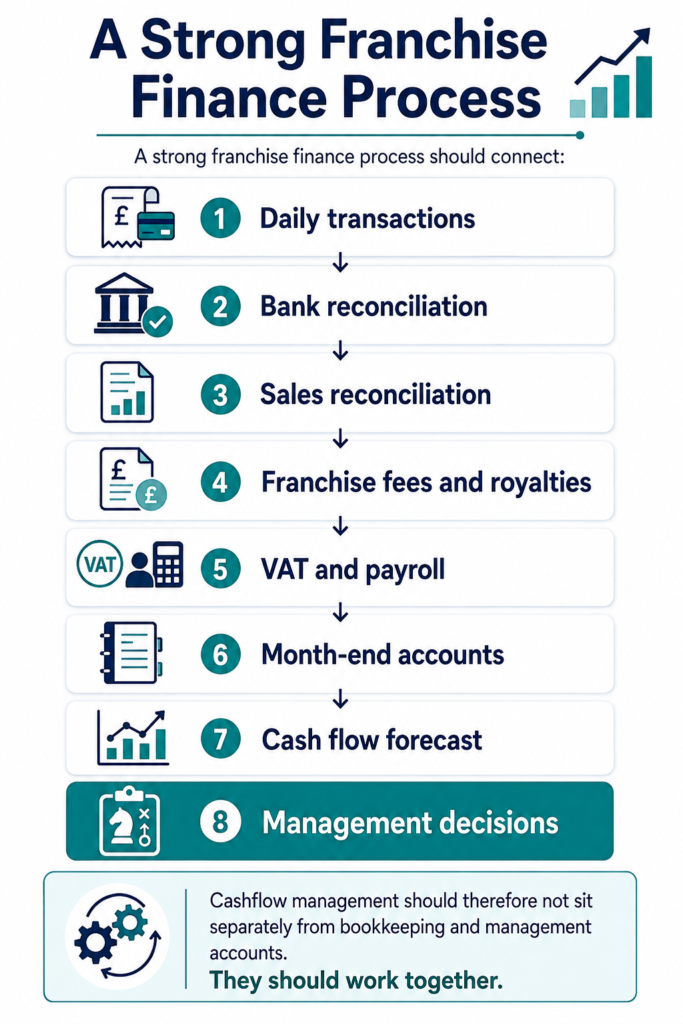
A forecast is only as reliable as the information behind it.
If bookkeeping is weeks behind, you may not know:
- What suppliers are owed
- Which customers owe money
- Whether royalties have been recorded
- What the VAT position is
- Whether payroll costs are fully reflected
- What payments are already committed
That makes forecasting significantly harder.
Franchisor Reports Are Useful, But They Do Not Replace Your Cash Forecast
Your franchisor may provide excellent reporting.
You might receive:
- Sales dashboards
- Weekly performance reports
- Network rankings
- Product analysis
- Customer statistics
- Labour data
- Operational KPIs
Those reports can be extremely useful for running the franchise.
But they may not answer:
- How much cash will I have in six weeks?
- Can I afford the next VAT bill?
- Can I take £20,000 out of the company?
- Can this business afford another employee?
- Can I finance a second location?
- What happens if sales fall 15%?
That requires financial reporting focused on the franchisee’s business, not simply network performance.
Stress-Test Your Franchise Cash Flow
A forecast based only on everything going to plan can create false confidence.
Franchise owners should consider testing scenarios such as:
- What if sales fall by 10%?
Would you still meet payroll and royalties? - What if wages rise?
How much margin remains? - What if a supplier increases prices?
Can you pass the cost on? - What if VAT is higher than expected?
Is sufficient cash reserved? - What if equipment fails?
Could the business fund an urgent replacement? - What if a new location takes six months longer to break even?
Can the existing business support it?
A forecast becomes much more powerful when it shows not only the expected result but also what happens when expectations are wrong.
Seasonal Franchise Businesses Need Different Cash Planning
Cashflow patterns differ between franchise sectors.
Food and Hospitality Franchises
They may face:
- Seasonal sales
- Stock purchasing
- Food waste
- Variable staffing
- Utility costs
- Holiday trading
Education Franchises
Revenue may be affected by:
- School terms
- Holidays
- Student enrolment cycles
- Advance payments
Fitness Franchises
They may experience:
- Strong January demand
- Membership churn
- Promotional periods
- Equipment investment
Retail Franchises
They may need to fund:
- Seasonal inventory
- Christmas stock
- Promotional purchases
- Stock clearance
Care Franchises
Cashflow may be affected by:
- Payroll intensity
- Timing of customer or commissioner receipts
- Recruitment
- Agency staffing
Service Franchises
They may need to manage:
- Customer payment terms
- Debtors
- Staff or contractor costs
- Lower levels of inventory
This is why a good franchise cashflow forecast cannot simply be copied from another business.
It needs to reflect how your particular franchise earns and spends money.
Multi-Unit Franchisees Need Site-Level Cash Visibility
Cashflow becomes more difficult to understand when a franchisee operates several locations.
Suppose you operate three sites:
Site A generates strong cash.
Site B is approximately break-even.
Site C regularly requires funding.
If all three locations use the same bank account or reporting structure without adequate site-level analysis, Site A can hide the underlying weakness of Site C.
At group level, everything might appear acceptable.
But one location may be destroying value.
Multi-unit franchisees should consider monitoring:
- Revenue by site
- Gross margin by site
- Payroll percentage
- Royalties
- Site overheads
- Operating profit
- Working capital
- Cash generation
- Capital invested
You should know not only: “Is my franchise group profitable?”
but also: “Which locations are producing the cash?”
Expanding Your Franchise? Forecast the Cash Before Opening the Next Unit
Opening another location can be an exciting milestone.
It can also create one of the biggest cashflow risks in the life of a franchise business.
A new location may require:
- Initial franchise fee
- Property deposit
- Fit-out
- Professional fees
- Equipment
- Technology
- Recruitment
- Training
- Initial payroll
- Opening stock
- Marketing
- VAT funding
- Working capital
The location may then operate below break-even during its early months.
This means your established franchise could end up funding the new operation for longer than expected.
AccounTax Zone’s Tip for Franchisee: Model the existing business and proposed location separately before combining them. Identify how much cash the new unit requires and how low the existing business's cash could fall while supporting it.
More units do not automatically mean a stronger business.
Expansion should strengthen overall profitability and cash generation, not simply increase turnover.
Should You Borrow Money to Fix a Franchise Cash Flow Problem?
Sometimes finance is appropriate.
Sometimes it simply delays the real problem.
The first question should be:
Why is cash short?
There is an important difference between a timing problem and a profitability problem.
Timing Problem
For example:
- Customers pay in 60 days
- Payroll is due earlier
- Seasonal stock must be purchased
- A VAT payment creates a temporary low point
Short-term finance may potentially help bridge a genuine timing gap, subject to affordability and appropriate advice.
Structural Problem
For example:
- Gross margins are consistently too low
- Payroll costs are unsustainable
- The location never reaches break-even
- Royalties and fixed overheads consume too much of the margin
- Sales are persistently insufficient
Borrowing does not correct those problems.
It may simply give an unprofitable operation more time to lose money.
Before taking finance, understand whether the business needs: more cash or whether it first needs: a better underlying financial model.
Warning Signs Your Franchise May Have a Cash Flow Problem
Cashflow problems rarely arrive without warning.
Look for signs such as:
- Using VAT money to fund wages
- Regularly delaying supplier payments
- Increasing reliance on an overdraft
- Repeatedly injecting personal money into the business
- Strong sales but very little cash
- Difficulty funding PAYE
- Corporation Tax approaching with no reserve
- Royalty payments creating monthly pressure
- Taking new borrowing to meet ordinary operating costs
- One franchise location repeatedly funding another
- Supplier balances increasing every month
- Directors postponing their own pay
- Unexpected Direct Debit failures
- Unable to explain where the month’s cash went
One of these signs in isolation does not necessarily mean the franchise is in financial difficulty.
Several appearing repeatedly deserve investigation.
The earlier the cause is identified, the more options the business may have.
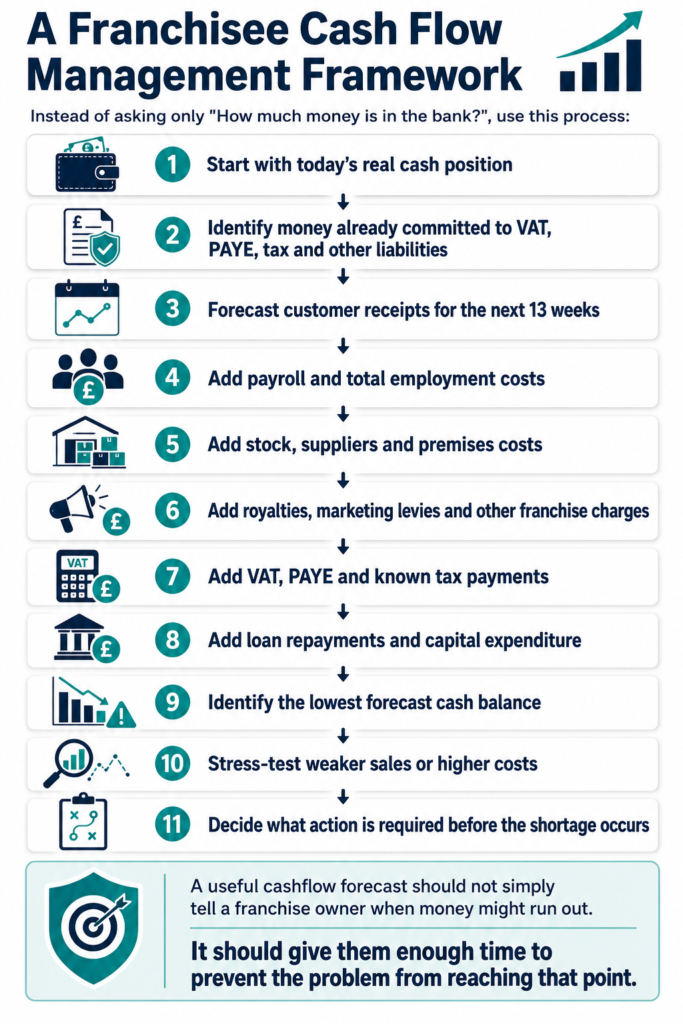
A Franchisee Cash Flow Management Framework
How Management Accounts Improve Franchise Cash Flow Decisions
Cashflow forecasting becomes significantly more useful when combined with timely management accounts.
Good monthly management information can show:
- Revenue
- Gross profit
- Labour cost
- Royalty costs
- Operating expenses
- Profitability
- Debtors
- Creditors
- Tax liabilities
- Cash movement
That helps the franchise owner understand why cash changed, not simply that it changed.
For example:
Sales rose 12%.
But gross margin dropped.
Payroll rose 17%.
Stock increased.
Royalties increased.
VAT liability increased.
The owner can now see why more sales did not produce more available cash.
This is much more useful than discovering the issue when annual accounts are prepared many months later.
What Should a Franchise Owner Review Every Month?
You do not need dozens of reports.
But you should be able to answer some basic questions confidently:
- How much did we sell?
- What gross profit did we make?
- What percentage of revenue went on labour?
- How much did we pay in royalties and franchise charges?
- What is owed to suppliers?
- What tax is currently building up?
- How much cash is genuinely available?
- What is our expected lowest cash point over the next 13 weeks?
- Are we above or below break-even?
- What major payments are coming next?
If you operate several locations: Which locations are generating cash, and which are using it?
If your accounting system cannot answer those questions quickly, improving financial visibility should become a priority.
How Can a Franchisee Improve Cash Flow?
There is no single fix because the cause matters.
Depending on the business, improvement could involve:
- Better cashflow forecasting
- Faster customer collection
- More disciplined tax reserves
- Reviewing staffing against demand
- Controlling stock
- Reducing waste
- Reviewing supplier payment terms
- Planning royalty payments
- Delaying non-essential capital expenditure
- Monitoring margins
- Improving pricing where the franchise model allows
- Reviewing underperforming locations
- Better timing of owner withdrawals
- Arranging appropriate working-capital finance before a shortage becomes urgent
The objective should not be simply to preserve as much cash as possible.
A business needs to invest.
The objective is to know: what cash is available, what is already committed and what the business can safely afford to do next.
When Should a Franchisee Speak to an Accountant About Cash Flow?
Do not wait until the business cannot make a payment.
Consider obtaining support when:
- You cannot explain why profit is not turning into cash
- VAT payments repeatedly create pressure
- You are regularly using an overdraft
- Royalties are reducing available cash more than expected
- Payroll is increasing faster than revenue
- You do not have a cashflow forecast
- Your bookkeeping is behind
- You are opening another franchise
- You operate multiple locations
- You are considering borrowing
- You are regularly injecting personal funds
- You cannot confidently calculate how much cash is safe to withdraw
An accountant should be able to do more than tell you what happened last year.
They should help you understand what is likely to happen next.
FAQs related to Franchisee Cash Flow Management
Franchisee cash flow management is the process of forecasting and controlling the cash entering and leaving a franchised business. It helps franchise owners make sure sufficient cash is available for payroll, suppliers, royalties, VAT, tax, premises costs and other financial commitments.
Yes. A franchise can be profitable but still experience a cash shortage.
This can happen because of payment timing, stock purchases, tax liabilities, debt repayments, expansion costs, owner withdrawals or money being tied up in working capital.
High turnover does not mean all sales receipts are available to spend. Cash may already be required for VAT, stock, payroll, royalties, marketing levies, rent, suppliers, finance repayments and tax. The first step is to reconcile profit with actual cash movement.
A 13-week cash flow forecast estimates expected cash receipts and payments for each of the next 13 weeks.
It can help a franchise owner identify potential cash shortages early enough to take corrective action.
Yes. Expected franchise royalties and other recurring network charges should normally be reflected in the forecast. Where the charge varies with turnover, the forecast should also adjust the expected royalty when projected sales change.
There is no universal amount suitable for every franchise.
The appropriate buffer should reflect fixed costs, payroll, tax dates, royalty payments, seasonality, debt commitments, working-capital requirements and the business’s lowest forecast cash position.
A franchisee should forecast expected VAT liabilities and avoid assuming that the whole bank balance is available business cash. The precise VAT position depends on the supplies made, input VAT, accounting arrangements and the circumstances of the business.
Payroll can create significant recurring cash demands, particularly in labour-intensive franchises. Owners should forecast the total employment cost rather than looking only at basic wages.
Profit measures financial performance over a period, while cashflow measures the movement and availability of money. A business can therefore be profitable while still lacking enough cash to meet a payment on a particular date.
Finance may help with a temporary and understood working-capital gap, but it does not fix an underlying loss-making business model. The cause of the shortage should be identified before deciding whether borrowing is appropriate.
Multi-unit franchisees should monitor both overall cash and individual site performance. This helps identify whether one location is generating cash while another is continually consuming it.
Strong Sales Are Only Valuable if They Turn Into Cash
A successful franchise should do more than generate impressive turnover.
It needs to generate enough cash to:
- Pay employees
- Pay suppliers
- Meet VAT and tax obligations
- Pay franchise fees
- Service borrowing
- Fund future investment
- Reward the owner
Your franchisor may provide the brand, operating system and performance benchmarks.
But the franchisee still needs to understand what is happening inside their own bank account and accounts.
The key questions are not simply: How much did we sell?
Or: How much money is in the bank today?
The better questions are:
- How much cash are we actually generating?
- What part of that cash is already committed?
- Where will our cash position be in 13 weeks?
- What happens if sales fall or costs rise?
- Can the business fund its next move without creating unnecessary pressure?
That is effective franchisee cash flow management.
Need Better Visibility Over Your Franchise Cash Flow?
At AccounTax Zone, we help franchise owners move beyond year-end accounts and understand what their numbers are telling them throughout the year.
We can support you with:
- Cashflow forecasting
- Monthly management accounts
- Bookkeeping
- VAT
- Payroll
- Franchise fee and royalty accounting
- Tax planning
- Working-capital reviews
- Multi-unit reporting
- Budgeting and forecasting
- Expansion planning
- Virtual finance support
Whether you operate one franchise location or several, our aim is to give you clearer visibility over profit, cash and the decisions ahead.
Speak to a Specialist Franchisee Accountant
If your franchise is generating sales but cash always seems tighter than expected, it may be worth reviewing what is happening underneath the headline turnover.
Book a FREE 30-minute initial consultation with AccounTax Zone.
Book Your Free Initial Consultation
Call: 020 3740 7074
Email: info@accountaxzone.com


