Buying a franchise can give you an established brand, a proven business model and access to systems that would take years to build independently.
But there is one distinction every franchise owner needs to understand from the beginning:
The franchisor gives you the system. You are still responsible for making your business work.
That distinction affects everything from staff and suppliers to tax, VAT, royalty payments, cashflow and profitability.
A franchisee may operate under somebody else’s brand, follow prescribed procedures and report performance back to the franchisor, but that does not normally make the franchisee an employee or simply another branch of the franchisor.
HMRC describes a franchise as an arrangement in which an established business gives another person the right to distribute products or provide services using its business system. In return, the franchisee will commonly pay an initial fee and continuing fees.
So, what is the difference between a franchisee and franchisor, and who is responsible for what?
Let’s look at the relationship from the perspective that matters most to a franchise owner: control, money, responsibility and risk.
What Is the Difference Between a Franchisee and a Franchisor?
A franchisor owns or controls the brand, business model, systems and intellectual property that form the franchise network.
A franchisee is the individual or business that obtains the right to operate using that brand and system, usually for an agreed period and in return for initial and ongoing fees.
The franchisor provides the framework.
The franchisee operates the individual business.
HMRC’s guidance also notes that a franchisee will normally be the proprietor of the franchised business and responsible for areas such as employing staff, purchasing goods or materials and providing goods or services to customers.
That difference matters because joining a franchise does not remove the normal financial responsibilities of running a business.
You may receive the branding, processes, training and commercial model.
You still need to make the numbers work.
Franchisee vs Franchisor at a Glance
| Area | Franchisor | Franchisee |
| Brand | Owns or controls the brand | Operates under the brand |
| Business model | Develops the franchise system | Follows and implements it |
| Intellectual property | Usually owns or controls it | Receives permission to use it |
| Initial investment | Develops the franchise network | Funds the individual franchise operation |
| Franchise fee | Receives it | Pays it |
| Royalties | Usually receives them | Usually pays them |
| Staff | Supports standards and procedures | Normally employs and pays local staff |
| Local sales | Provides the model and brand | Responsible for generating local revenue |
| Suppliers | May specify approved suppliers | Purchases within franchise requirements |
| Bookkeeping | May set reporting requirements | Maintains the business’s accounting records |
| VAT | Responsible for its own VAT position | Responsible for its own VAT position where applicable |
| PAYE and pensions | Responsible for own employees | Normally responsible for franchisee employees |
| Business tax | Responsible for own tax affairs | Responsible for franchisee business tax affairs |
| Profitability | Develops the commercial model | Must make the individual business financially viable |
| Business risk | Carries network-level risk | Carries the commercial risk of the individual franchise |
The exact responsibilities always depend on the franchise agreement and the way the particular franchise operates.
This is why two franchises operating in the same sector can have very different financial arrangements.
What Does a Franchisor Do?
The franchisor creates or develops the business system that franchisees are allowed to use.
Depending on the franchise, this may include:
- Brand and trademarks
- Operating procedures
- Training
- Marketing materials
- Technology and software
- Product or service standards
- Approved supplier arrangements
- Pricing guidance or controls
- Territory rights
- Business support
- Performance monitoring
- National marketing campaigns
The franchisor’s objective is normally to create a consistent experience across the network.
That consistency is important. Customers should generally recognise the same brand and expect a similar standard whether they visit one franchise location or another.
However, a strong brand does not automatically guarantee that every franchisee will be profitable.
The franchisor can provide the model.
The economics of your individual operation still need to work.
What Does a Franchisee Do?
The franchisee puts the system into practice.
For many franchise owners, that means being responsible for:
- Financing the initial investment
- Paying franchise fees
- Finding or funding premises
- Hiring employees
- Running payroll
- Purchasing stock or supplies
- Managing local operations
- Generating sales
- Controlling costs
- Maintaining accounting records
- Paying suppliers
- Managing VAT where applicable
- Meeting tax obligations
- Submitting financial information required by the franchisor
- Managing cashflow
- Maintaining franchise standards
The British Franchise Association’s Code of Ethics describes franchisees as independent entrepreneurs and recognises that they operate their businesses at their own risk while following the franchisor’s system.
This is perhaps the most important distinction for a franchise owner.
You are buying access to a business system. You are not transferring your financial responsibility to the franchisor.
Who Controls the Franchise Business?
This is where the franchisee and franchisor relationship becomes more interesting.
A franchisee owns or operates their business, but they may not have the same freedom as the owner of an entirely independent company.
The franchise agreement may control or influence areas such as:
- Products and services
- Branding
- Opening hours
- Approved suppliers
- Quality standards
- Premises and fit-out
- Technology
- Marketing
- Promotions
- Reporting
- Staff presentation
- Territory
- Pricing or pricing strategy
At the same time, the franchisee may carry much of the financial consequence if those decisions do not produce sufficient profit.
That creates a particular challenge:
A franchisee can have less commercial freedom than an independent business owner while still carrying significant financial risk.
It is therefore important to understand the numbers behind the franchise, not simply follow the operational model.
What Is the Franchise Agreement?
The franchise agreement is one of the most important documents in the franchisee-franchisor relationship.
It defines the rights and obligations of both sides.
The British Franchise Association’s Code states that a franchise agreement should clearly set out the respective rights and obligations of the parties and material terms of their relationship. These can include payment terms, duration, renewal, transfer and termination provisions.
From a financial perspective, a franchisee should understand at least:
- What initial fees must be paid
- How royalties are calculated
- Whether there is a marketing levy
- What other recurring charges apply
- When payments become due
- Whether minimum payments apply
- Who pays for technology
- Who funds refurbishments
- Whether approved suppliers must be used
- What financial information must be reported
- What happens on renewal
- What happens if the franchise is sold
- What happens if the agreement terminates
Your solicitor should review the legal consequences of the agreement.
Your accountant should help you understand what those obligations mean financially.
A clause requiring a percentage of turnover may appear straightforward until you model its effect on your profit margin and cashflow.
What Fees Does a Franchisee Pay a Franchisor?
Franchise charges vary considerably.
HMRC notes that franchise arrangements commonly involve an initial fee together with continuing fees. Continuing fees may, for example, be calculated as a percentage of turnover, through a mark-up on purchases, or as a regular fixed amount per outlet.
Depending on the agreement, a franchisee may encounter:
Initial franchise fee
This is generally the payment made to obtain access to the franchise system and associated rights.
Ongoing royalty or management fee
This may be calculated as:
- A percentage of turnover
- A fixed periodic payment
- A combination of fixed and variable charges
- Another method specified in the agreement
Marketing levy
Some franchisors require franchisees to contribute towards national or network marketing.
Technology fees
Franchisees may be required to use specified booking, till, CRM, ordering or management systems.
Training charges
Some training may be included within the initial package, while additional training may attract separate charges.
Renewal fees
A further payment may become due when the franchise agreement is renewed.
Other network charges
These can include software, audits, compliance visits, conferences, equipment, refurbishment requirements and other franchise-specific costs.
The important question isn’t simply: “How much is the royalty?”
It is: “What percentage of my gross profit is left after every franchise-related cost has been paid?”
AccounTax Zone’s Tip for Franchisee: Don’t assess royalty fees only as a percentage of turnover. Model what they represent as a percentage of your actual operating profit too… that is where the real impact becomes clear.
Is a 5% Franchise Royalty Really Only 5% of Your Profit?
Not necessarily.
This is an area franchise owners can easily misunderstand.
Imagine your franchise generates:
£100,000 of monthly sales
and the agreement requires a:
5% royalty based on turnover
The royalty would be £5,000 under that simplified example.
But suppose the business only produces £15,000 before the royalty after paying stock, wages, premises and other operating costs.
That £5,000 royalty isn’t consuming 5% of the £15,000.
It is consuming one-third of it.
This is why franchise fees should not be analysed only as a percentage of sales.
They should be measured against:
- Gross profit
- Operating profit
- Cash generation
- Break-even turnover
- Owner return
A business can generate impressive sales and still provide a poor return to its franchisee.
Who Is Responsible for Tax: Franchisee or Franchisor?
Usually, each business remains responsible for its own tax affairs, although the exact position depends on the structure and arrangements involved.
For a franchisee, this may include:
- Corporation Tax where the business operates through a company
- Income Tax where an individual or partnership operates the business
- VAT where applicable
- PAYE
- National Insurance
- Workplace pension obligations
- Self Assessment where relevant
- Tax on salary, dividends or other profit extraction
The fact that a franchisor receives information about your turnover does not normally mean the franchisor is preparing or submitting your tax returns.
Similarly, paying royalties does not remove your obligation to maintain proper accounting records.
Your franchisor may tell you how the franchise should operate.
Your accountant should tell you how your business is performing, what taxes it faces and whether the financial position is sustainable.
AccounTax Zone's Tip for Franchisee: Keep money for VAT, PAYE and Corporation Tax separate from day-to-day operating cash. A healthy bank balance can be misleading if part of it already belongs to HMRC.
Are Franchise Fees Tax Deductible?
This question requires more care than a simple yes or no.
HMRC states that an initial payment by a franchisee is usually capital in nature, as are related legal fees. For companies, however, HMRC also notes that where a company acquires or sells a franchise, the Corporation Tax intangible-assets regime can apply and takes precedence where relevant.
HMRC also states that annual fees payable by a franchisee are generally allowable when computing trading profits.
There can also be situations where part of an initial payment relates to a separately identifiable revenue service, such as certain training, but the facts and wording of the agreement matter.
This is precisely why every payment described in your bookkeeping as “franchise fee” should not automatically receive identical accounting or tax treatment.
Your accountant may need to review:
- What the payment actually relates to
- Whether it is an initial or recurring charge
- The legal structure of the franchisee
- The wording of the franchise agreement
- Whether separate services are included
- The applicable accounting and tax treatment
The label on the bank transaction does not determine the tax result.
Who Is Responsible for VAT in a Franchise?
A franchisee must consider the VAT position of their own business.
That includes questions such as:
- Is the business required to register for VAT?
- What VAT rates apply to its sales?
- Are there different VAT treatments across different products or services?
- Is VAT being accounted for correctly through the till or accounting system?
- Is recoverable input VAT being captured correctly?
- How should VAT on charges from the franchisor be treated?
- Are VAT returns reconciling with actual sales?
This becomes particularly important in sectors such as:
- Food and hospitality
- Care
- Education
- Health and wellbeing
- Retail
- Businesses making different types of supplies
A franchisor may provide a standard till system or coding structure, but the franchisee should not assume that this removes their responsibility for their own VAT position.
A system can process a VAT code. It cannot decide whether the VAT treatment is correct in your particular circumstances.
Who Employs the Staff: Franchisee or Franchisor?
HMRC’s guidance notes that a franchisee will normally be responsible for employing staff in the franchised business.
For many franchisees, this means responsibility for:
- Payroll
- PAYE
- National Insurance
- Workplace pensions
- Holiday pay
- Statutory payments
- Employee records
- Payroll deadlines
Payroll deserves particular attention because it is often one of the largest costs in a franchise.
Restaurants, care providers, gyms, cleaning franchises, education businesses and other labour-intensive franchises can quickly lose margin if staffing costs are not monitored.
The better question isn’t simply: “Was payroll processed correctly?”
It is also: “Is payroll consuming the right percentage of revenue for this location?”
The Franchisor May Know Your Sales. Do You Know Your Profit?
Many franchise networks collect substantial amounts of operational data.
A franchisor may know:
- Your weekly sales
- Number of customers
- Average transaction value
- Products sold
- Conversion rates
- Network ranking
- Labour statistics
- Customer reviews
That information is useful.
But it does not necessarily tell you what you, as the franchisee, are actually earning.
A franchisee also needs to understand:
- Gross margin: How much remains after direct costs?
- Labour percentage: How much of your revenue is being consumed by staffing?
- Royalty burden: What do franchise charges represent as a percentage of revenue and profit?
- Occupancy cost: Are rent, rates and premises costs sustainable?
- Break-even turnover: How much must you sell before the location starts making money?
- Operating profit: What remains after the actual costs of running the business?
- Cash generation: Is accounting profit converting into money in the bank?
- Tax reserve: Has enough cash been set aside for VAT, Corporation Tax and other liabilities?
- Owner return: After the investment, time and risk involved, what return are you actually receiving? This is where management accounts become much more valuable than simply waiting for annual accounts.
Why Can a Profitable Franchise Still Run Out of Cash?
Profit and cash are not the same thing.
Consider a simplified franchise generating £100,000 of monthly sales.
From that money, the business may need to cover:
- VAT
- Stock or direct costs
- Employee wages
- Employer costs
- Royalty payments
- Marketing levies
- Rent
- Business rates
- Utilities
- Loan repayments
- Equipment
- Software
- Insurance
- Other operating costs
- Tax
There can also be timing differences.
Customers may pay today while VAT becomes payable later.
A supplier invoice may be due next week.
Payroll might fall before a royalty debit.
Corporation Tax may become payable months after the profit was generated.
This means a healthy bank balance can give a franchise owner a false sense of available cash.
Good franchise accounting should therefore answer:
What belongs to the business, and what is already committed?
Franchisor Reporting Is Not the Same as Management Accounts
Franchise owners sometimes assume that because the franchisor provides a dashboard, they already have management information.
The two are not necessarily the same.
Your franchisor’s reporting system may be designed primarily to answer:
“How is this location performing within our network?”
Your management accounts should answer:
“How is this investment performing for me?”
Those are different questions.
A franchisor dashboard may show that sales increased by 12%.
Your accounts might show that wages increased by 18%, gross margin fell and your actual profit declined.
Sales growth is good only when the economics behind that growth also make sense.
For a multi-unit franchisee, reporting should ideally go further and allow you to compare locations.
For example:
| KPI | Site A | Site B | Site C |
| Revenue | £120,000 | £105,000 | £95,000 |
| Gross margin | 66% | 61% | 68% |
| Labour % | 29% | 37% | 27% |
| Royalty % | 6% | 6% | 6% |
| Operating profit | £18,000 | £7,000 | £17,000 |
Site B may appear successful based on £105,000 of sales.
But something is clearly going wrong underneath.
That’s where useful accounting begins.
AccounTax Zone's Tip for Franchisee: Reconcile the sales figures reported to your franchisor with your accounting records every month. Differences are much easier to investigate now than at year end.
Who Bears the Risk if the Franchise Underperforms?
A common misconception is that buying into an established franchise removes much of the business risk.
It can reduce certain risks.
You may benefit from:
- An established brand
- Existing operating processes
- Training
- Supplier relationships
- Marketing
- Experience from other locations
- A tested business format
But commercial risk remains.
If revenue is below expectations, wages rise, local competition increases or a location becomes uneconomic, the franchisee can still suffer financially.
The BFA’s Code specifically recognises franchisees as independent business operators running their businesses at their own risk.
That is why projected turnover alone should never be the basis for deciding whether a franchise is financially attractive.
Considering Buying a Franchise? Test the Numbers Before Signing
If you are not yet a franchisee, the most valuable accounting work may happen before you sign the agreement.
Don’t ask only: “How much can the franchise turn over?”
Ask:
- How much capital will I actually need? Include the franchise fee, fit-out, deposits, equipment, stock, recruitment, training and opening working capital.
- How much working capital is required? A new franchise may take months to become cash-positive.
- What sales level produces break-even? Understand the minimum monthly sales required to cover your fixed and variable costs.
- What happens if sales are 20% below projection? Good financial modelling should include downside scenarios.
- How are royalties calculated? A turnover-based royalty continues to apply even when your profit is under pressure.
- How much do I need personally? If the business needs to support your household, include the required owner income in your planning.
- What additional investment might be required later? Refurbishments, equipment replacement, technology changes or renewal costs can materially change the return.
Before making a significant financial commitment, having the figures independently reviewed can reveal risks that are difficult to see from headline sales projections.
Already a Franchisee? Watch These Numbers
Once your franchise is trading, there are several figures worth monitoring consistently.
- Revenue: Is turnover growing, stable or falling?
- Gross profit percentage: Are input costs or discounting reducing your margin?
- Labour percentage: Are staffing levels appropriate for your turnover?
- Royalty and franchise costs: What proportion of revenue and profit goes back to the network?
- Premises costs: How much revenue is consumed by rent, rates and utilities?
- Operating profit: What does the business actually earn before financing and tax?
- Cashflow: Can the business meet payroll, suppliers and tax as they fall due?
- Tax liabilities: How much has been reserved rather than spent?
- Owner return: What are you receiving for your investment and involvement?
- Site-level performance: For multi-unit franchisees, which locations are creating value and which are absorbing it?
These numbers turn accounting from a compliance exercise into a business-management tool.
AccounTax Zone's Tip for Franchisee: Know your break-even turnover. If you cannot say roughly how much your franchise must sell each month before it starts making money, this should be one of the first figures you calculate.
Franchisee vs Franchisor: What Happens When You Want to Grow?
A successful franchisee may eventually consider:
- Opening another territory
- Buying an existing franchise location
- Acquiring multiple units
- Bringing in investors
- Borrowing for expansion
- Creating a group structure
- Building a management team
At this point, the financial relationship with the franchisor becomes even more important.
A second location does not simply mean twice the revenue.
You need to consider:
- Additional franchise fees
- Additional working capital
- New borrowing
- Management costs
- Central overhead
- New payroll requirements
- VAT and tax
- Group structure
- Intercompany transactions
- Site-level profitability
Expansion should be driven by return on capital, not just the excitement of owning more locations.
What Happens When a Franchisee Wants to Sell?
Selling a franchise can be different from selling an unrestricted independent business.
The franchise agreement may affect:
- Whether the franchise can be transferred
- Franchisor approval of the buyer
- Renewal terms
- Transfer fees
- The remaining term of the agreement
- Required refurbishment
- Rights connected with the franchise
- The value attributable to the business and its assets
The BFA Code identifies transfer and renewal terms among the matters a franchise agreement should address.
HMRC also distinguishes the franchise rights from any goodwill that may exist in the franchisee’s own business, which can become relevant on disposal.
If an exit is likely, tax and financial planning should therefore start well before a buyer is found.
When Should a Franchisee Use Their Own Accountant?
Ideally, before buying the franchise.
An accountant working for you can provide a different perspective from the franchisor.
The franchisor understands the network.
Your accountant should understand your financial position.
Specialist advice can be particularly valuable when:
- Reviewing franchise projections
- Deciding on a business structure
- Arranging funding
- Understanding franchise fees
- Setting up bookkeeping
- Registering and accounting for VAT
- Running payroll
- Preparing management accounts
- Controlling cashflow
- Planning Corporation Tax
- Extracting profits
- Opening additional units
- Selling the business
The accountant should not replace your solicitor’s legal review of the franchise agreement.
But the accountant should help translate the agreement and business model into real numbers.
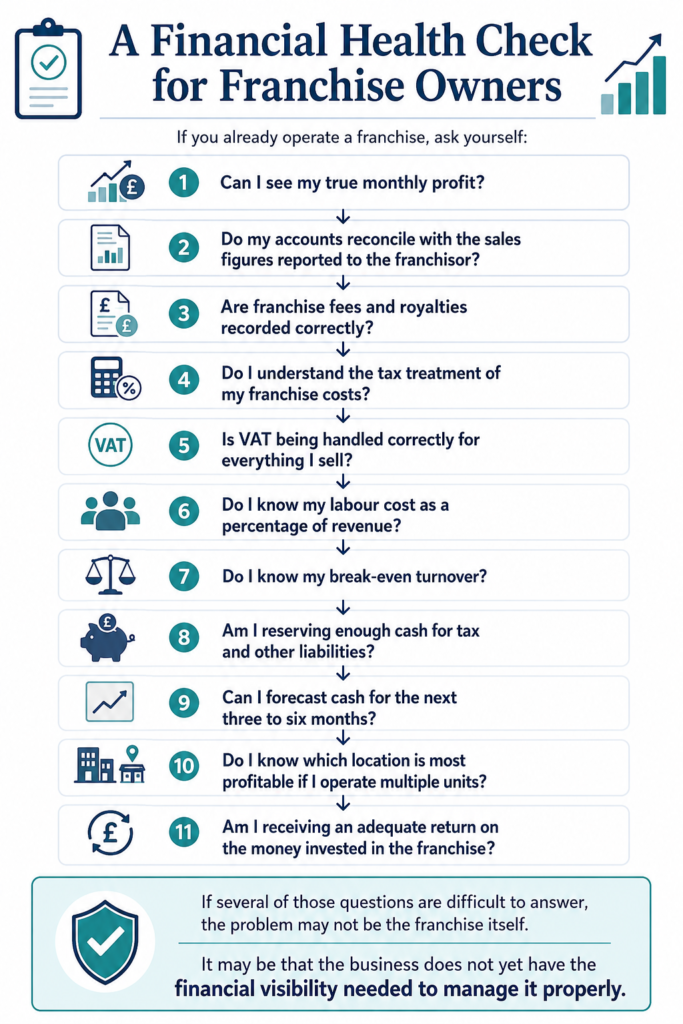
A Financial Health Check for Franchise Owners
FAQs related to Franchisee vs Franchisor
Usually, the franchisee owns or operates their individual franchised business while obtaining rights to use the franchisor’s brand and system. HMRC describes the franchisee as normally being the proprietor of the franchised business. The precise legal position depends on the structure and franchise agreement.
A genuine franchisee is generally an independent business operator rather than an employee simply because they operate under the franchisor’s brand. The BFA Code emphasises the independence of franchisees while recognising that they must operate in accordance with the franchisor’s system.
The franchisee is normally responsible for the tax obligations of their own business. Which taxes apply depends on whether the franchise is operated through a limited company, sole trade, partnership or another structure.
The franchisee needs to establish and manage the VAT position of their own business where applicable. The VAT treatment will depend on what the business sells and its particular circumstances.
The franchisee will normally employ the staff working in their franchised business. HMRC specifically identifies employment of staff as one of the responsibilities normally belonging to the franchisee.
A franchisee commonly pays an initial franchise fee and ongoing charges. Ongoing charges may be based on turnover, purchases, a fixed amount or another calculation determined by the franchise agreement.
It depends on the type of fee, business structure and circumstances. HMRC says an initial franchise payment is usually capital in nature, while annual franchise fees are generally allowable when computing trading profits. Companies may also need to consider the Corporation Tax intangible-assets regime.
Yes, and independent accounting advice can be particularly valuable because the accountant works for the franchisee rather than the franchise network. A franchise accountant can help with tax, VAT, payroll, bookkeeping, management accounts, cashflow, expansion and eventual exit.
The franchisor may impose reporting requirements and commercial controls, but the franchisee normally remains responsible for managing the finances of their own business. The exact balance of control depends on the franchise agreement.
The franchisee normally bears the commercial risk of their individual franchised business. This is why prospective franchisees should independently test forecasts and understand break-even, working capital and downside scenarios before committing.
Yes, where the franchisor and franchise agreement permit multi-unit ownership. However, opening additional locations creates additional funding, reporting, tax, staffing and cashflow considerations.
Franchisee and Franchisor: The Relationship Works Only if the Numbers Work
A good franchisor can give you something incredibly valuable:
A system that has already been built.
But operating under a recognised brand does not remove the fundamentals of running a successful business.
You still need enough margin.
You still need enough cash.
You still need to control payroll.
You still need to manage VAT and tax.
You still need to understand what the franchise fees are costing you.
And ultimately, you still need the business to produce an adequate return for you.
Your franchisor can show you how to operate the franchise.
Your financial reporting should show you whether operating it is worthwhile.
Need More Financial Clarity From Your Franchise?
At AccounTax Zone, we work with franchisees who want more than year-end accounts.
We can help you understand:
- Your true franchise profitability
- Franchise fees and royalty accounting
- VAT
- Payroll and staff costs
- Cashflow
- Corporation Tax
- Monthly management accounts
- Multi-unit performance
- Buying another franchise
- Business structure
- Tax planning
- Franchise resale and exit planning
Whether you’re considering your first franchise, already operating one location or building a multi-unit business, the objective is the same:
Know where the money is going, know what you’re earning and make financial decisions with confidence.
Speak to a Specialist Franchisee Accountant
If you would like an independent review of your franchise finances, book a FREE 30-minute initial consultation with AccounTax Zone.
Book Your Free Initial Consultation
Call: 020 3740 7074
Email: info@accountaxzone.com


