Qualifying Care Relief Rules (UK Guide 2026): Everything Foster Carers Need to Know
Imagine discovering you’ve paid tax for several years when, under HMRC’s own rules, you may not have needed to pay anything at all.
It happens more often than most people realise.
Not because foster carers deliberately do anything wrong, but because the Qualifying Care Relief (QCR) rules are unlike almost any other part of the UK tax system. They don’t follow the same principles as employment income, self-employment income or rental income, which means many carers, and even some accountants, misunderstand how they work.
Some foster carers assume every fostering payment is completely tax-free. Others believe they must pay tax on every payment they receive. In reality, neither assumption is always correct.
The Qualifying Care Relief scheme is designed to ensure that foster carers are not taxed unfairly while providing an essential service to society. However, understanding who qualifies, how the relief is calculated and when tax still becomes payable requires more than simply reading a page on HMRC’s website.
This guide explains the rules in plain English, using practical examples and real-life scenarios to help you understand your position with confidence.
Whether you’re new to fostering, have been caring for children for many years, or have recently received a letter from HMRC, you’ll find clear answers here.
What Are the Qualifying Care Relief Rules?
Qualifying Care Relief is a special tax regime created by HMRC for people who provide qualifying care, including foster carers.
Rather than calculating taxable profit using the traditional approach of:
Income − Expenses = Taxable Profit
HMRC allows qualifying carers to calculate their taxable income using a simplified system based on fixed tax-free allowances.
The purpose is simple:
To recognise that foster carers incur substantial costs while providing care and to reduce unnecessary administrative burdens.
Instead of keeping every receipt and calculating hundreds of individual expenses, many foster carers can simply apply the Qualifying Care Relief rules.
For a large proportion of foster carers across the UK, this means their fostering income is fully covered by the available relief, resulting in no income tax on their fostering activities.
That doesn’t mean every foster carer has exactly the same tax position, but it explains why Qualifying Care Relief is one of the most valuable tax reliefs available.
Why Were These Rules Introduced?
Looking after vulnerable children isn’t comparable to running a conventional business.
Foster carers often receive payments that cover:
- Daily living costs
- Clothing
- Food
- Transport
- Activities
- Household expenses
- Professional care responsibilities
Treating every payment as ordinary taxable income would ignore the real costs involved in providing care.
The Qualifying Care Relief rules were therefore introduced to create a fairer system that reflects the unique nature of fostering.
Instead of requiring carers to justify every pound spent, HMRC provides a generous statutory allowance that simplifies the entire process.
AccounTax Zone Insight:
One of the biggest misconceptions we hear is:
"If my fostering allowance covers food, clothing and activities, surely none of it counts as income?"
In reality, fostering payments are still considered income for tax purposes. The difference is that the Qualifying Care Relief rules often reduce the taxable amount to nil.
Understanding that distinction helps avoid confusion when completing a Self Assessment tax return or responding to HMRC.
Who Can Claim Qualifying Care Relief?
The relief isn’t available to everyone who works with children.
It only applies to individuals providing qualifying care under HMRC’s legislation.
This generally includes:
| Type of Care | Usually Eligible? |
| Local authority foster carers | Yes |
| Independent fostering agency carers | Yes |
| Shared Lives carers | Yes |
| Adult placement carers | Yes |
| Staying Put arrangements (where conditions are met) | Often |
| Childminders | No |
| Nannies | No |
| Nursery workers | No |
| Residential care employees | No |
The key point is that the relief applies because of the legal framework under which the care is provided, not simply because someone works with children.
How HMRC Calculates Qualifying Care Relief
Many foster carers assume there is one single allowance.
There isn’t.
The calculation has two separate components.
Step One: Annual Household Allowance
Each qualifying household receives a fixed annual allowance.
For example:
| Tax Year | Annual Household Allowance |
| 2025/26 | £19,690 |
| 2026/27 | £20,440 |
This allowance is available once per household, not once per foster carer.
This distinction is particularly important where two people foster together.
Step Two: Weekly Qualifying Amount
On top of the annual allowance, HMRC adds a weekly amount for every qualifying placement.
For 2026/27:
| Child’s Age | Weekly Allowance |
| Under 11 | £435 |
| Age 11 or over | £515 |
The total weekly allowance depends on:
- the number of children placed,
- their ages,
- and how long they remain in your care during the tax year.
The longer the placement, the greater the available relief.
Bringing the Two Together
Imagine you cared for one child aged 13 throughout the entire tax year.
Your relief would consist of:
- Annual household allowance
- Weekly allowance for 52 qualifying weeks
Those two figures combine to create your total Qualifying Care Relief threshold.
HMRC then compares that threshold with your total fostering receipts to determine whether any taxable profit remains.
For many foster carers, the threshold is significantly higher than the income received.
That is why so many carers legally pay little or no income tax on fostering income.
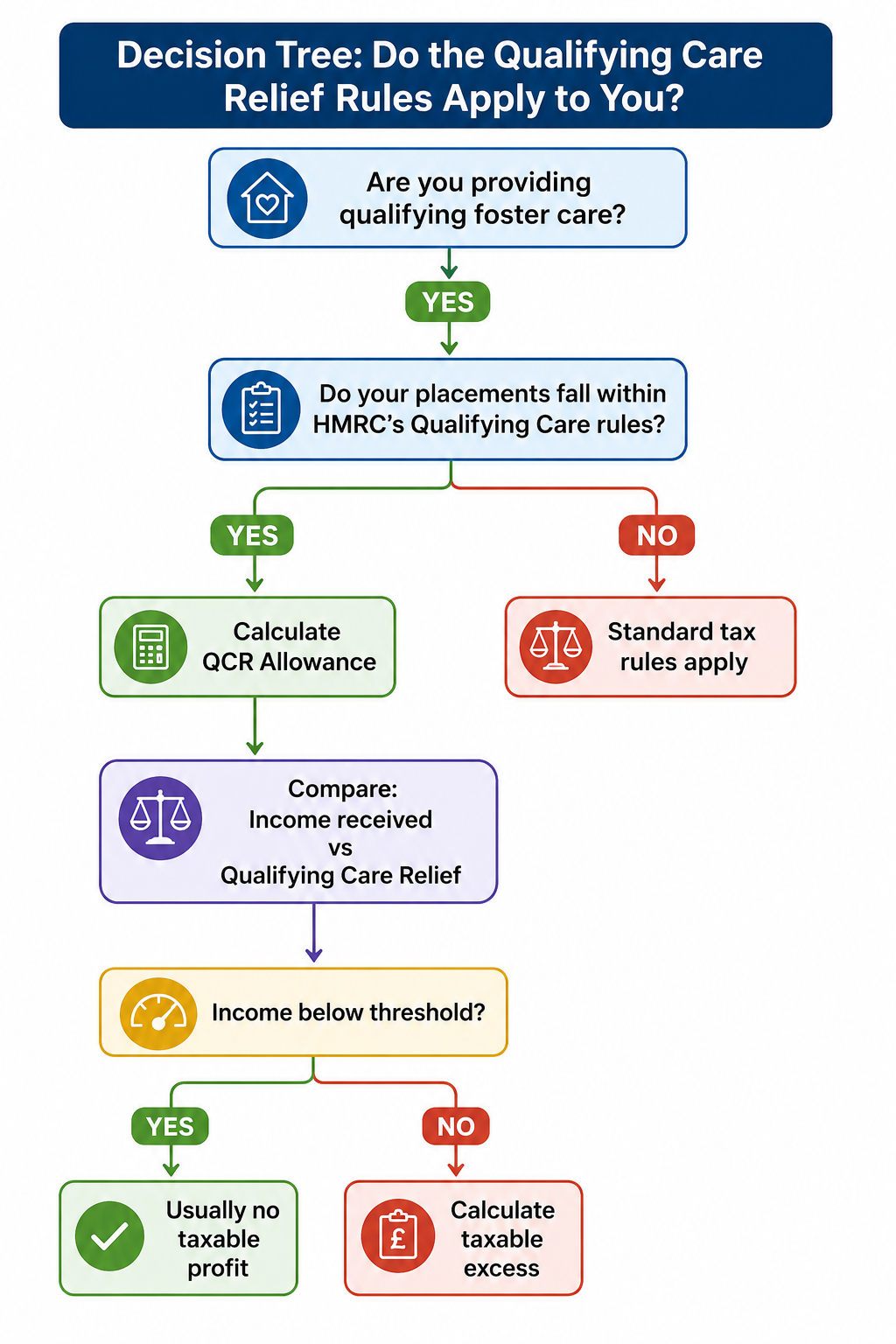
Decision Tree: Do the Qualifying Care Relief Rules Apply to You?
Does Every Foster Carer Automatically Pay No Tax?
No.
This is probably the biggest misunderstanding surrounding Qualifying Care Relief.
The relief can reduce taxable income dramatically, but that doesn’t mean every foster carer will always have no tax liability.
Tax may still arise where:
- fostering income exceeds the available relief,
- you choose an alternative calculation method,
- or you have other taxable income, such as employment, self-employment or rental profits.
Each situation needs to be considered individually.
AccounTax Zone Tip
Many foster carers only think about tax when the Self Assessment deadline approaches.
Instead, spend five minutes at the end of each month recording:
- Placement start dates
- Placement end dates
- Child's age
- Payments received
- Agency payment statements
Keeping these records throughout the year makes it much easier to calculate your Qualifying Care Relief accurately and reduces the risk of errors if HMRC ever asks questions.
Why These Rules Are Often Misunderstood
Despite being one of the most valuable tax reliefs available, Qualifying Care Relief remains poorly understood.
There are several reasons.
HMRC Guidance Is Written for Technical Accuracy
Official guidance is necessarily detailed and precise, but it isn’t always easy to interpret if you’re unfamiliar with tax legislation.
Online Advice Is Often Incomplete
Many websites explain only the allowance amounts without explaining:
- who qualifies,
- how calculations work,
- when a tax return is still required,
- or what happens if you also have other income.
Generic Accountants May Rarely Encounter Foster Carer Tax
Most accountants deal with companies, landlords and self-employed businesses every day.
Foster care taxation is a much more specialist area.
Without a detailed understanding of the Qualifying Care Relief rules, it’s surprisingly easy to make incorrect assumptions that could lead to unnecessary tax or incorrect reporting.
What Counts as Qualifying Care Income?
One of the biggest misunderstandings surrounding the Qualifying Care Relief (QCR) rules is knowing which payments actually fall within the scheme.
Many foster carers assume every payment they receive from a fostering agency is automatically covered by Qualifying Care Relief.
That’s not always the case.
The first step is understanding exactly what HMRC considers to be qualifying care receipts.
Generally, qualifying receipts include payments you receive for providing approved foster care or other qualifying care arrangements covered by the legislation.
These commonly include:
- Weekly fostering allowances
- Professional fostering fees
- Maintenance payments
- Skills payments (where paid as part of the fostering arrangement)
- Respite care payments
- Staying Put payments (where the qualifying conditions are met)
- Payments received through approved Independent Fostering Agencies (IFAs)
- Local authority fostering payments
These payments are normally included when calculating your total qualifying care receipts before applying Qualifying Care Relief.
Payments That May Need Separate Consideration
Not every payment connected with fostering automatically falls within the Qualifying Care Relief calculation.
Depending on the circumstances, separate consideration may be needed for:
- Employment income from another role
- Self-employment income
- Rental income
- Pension income
- Investment income
- Benefits not directly linked to qualifying care
- Other taxable reimbursements
Each of these follows its own tax rules and should not automatically be mixed with your fostering income.
AccounTax Zone Insight
One issue we regularly encounter is foster carers combining every source of household income into a single figure when preparing their tax information.
HMRC doesn't assess your tax position that way.
Fostering income, employment income and rental income each follow different rules. Separating them from the outset usually makes the tax return much easier to prepare and significantly reduces the risk of errors.
What Happens If You Foster for Only Part of the Tax Year?
Not every foster carer provides care throughout an entire tax year.
Some people:
- become approved halfway through the year
- stop fostering because of retirement
- take an extended break
- change agencies
- have gaps between placements
The good news is that Qualifying Care Relief still applies.
Your available relief depends on your actual qualifying placements during the tax year rather than whether you fostered continuously.
That means your calculation should always reflect your individual circumstances.
Example
Emma became an approved foster carer in September.
She assumed she had “missed out” because she hadn’t fostered from April.
In reality, her Qualifying Care Relief calculation was based on the qualifying weeks during which she actually cared for children.
She was still entitled to substantial tax relief despite only fostering for part of the year.
What If a Placement Ends Early?
Another common question is what happens when a placement ends unexpectedly.
Children may leave foster care because they:
- return to family
- move to adoptive parents
- transfer to another placement
- reach adulthood
- move into independent accommodation
Fortunately, Qualifying Care Relief is designed to deal with changing placements.
The weekly element of the calculation simply reflects the qualifying weeks during which care was provided.
AccounTax Zone Tip
Don't rely on memory.
Keep a simple placement diary showing:
- child's initials
- age
- placement start date
- placement end date
It takes minutes to maintain but makes your annual calculation far more accurate.
Can Foster Carers Choose Between Qualifying Care Relief and Actual Expenses?
This is one of the least understood parts of the legislation.
Many foster carers believe Qualifying Care Relief is compulsory.
In reality, where your receipts exceed the Qualifying Care Relief threshold, you may be able to choose between:
Method 1
Using the simplified Qualifying Care Relief calculation.
OR
Method 2
Calculating your taxable profit using actual income and allowable expenses.
The better option depends entirely on your own circumstances.
Simple Comparison
| Qualifying Care Relief | Actual Profit Method |
| Simple calculation | More detailed calculation |
| No need to analyse every expense | Requires accurate expense records |
| Suitable for many foster carers | May benefit some higher-income carers |
| Lower administration | Higher administration |
The right choice isn’t the same for everyone.
AccounTax Zone Insight
Many foster carers assume the simplified method will always produce the best tax result.
Sometimes it does.
Sometimes it doesn't.
Where receipts exceed the Qualifying Care Relief threshold, comparing both methods can occasionally produce a better outcome.
That's why calculations should never be based on assumptions.
Do Couples Get Double the Relief?
This question causes confusion every year.
The answer is:
No.
The annual Qualifying Care Relief allowance applies per household, not per individual.
If two people foster together, they do not each receive a separate fixed annual allowance.
However, the weekly qualifying amounts still depend on the number of qualifying placements.
Example
Sarah and James jointly foster three children.
Although there are two foster carers, the fixed annual allowance applies once to the household.
The weekly qualifying amounts are then calculated according to the placements.
Understanding this distinction prevents one of the most common calculation errors.
What Happens If Only One Partner Is the Registered Foster Carer?
Every fostering arrangement is different.
Sometimes:
- one partner is the approved foster carer
- both partners are approved
- one partner works full-time elsewhere
- responsibilities are shared differently
The tax implications depend on the legal and contractual arrangements with the fostering organisation.
This is an area where professional advice is particularly valuable because household circumstances vary considerably.
What Records Should You Keep?
Although Qualifying Care Relief reduces record-keeping requirements compared with ordinary self-employment, HMRC still expects foster carers to maintain reasonable records.
A simple file should normally include:
- Annual payment summaries
- Agency payment statements
- Placement start dates
- Placement end dates
- Child age information
- HMRC correspondence
- Previous tax returns
- Self Assessment calculations
Keeping these together makes dealing with HMRC much easier if questions arise.
Foster Carer Record-Keeping Checklist
- Agency payment summaries
- Local authority statements
- Placement records
- HMRC letters
- Government Gateway login details
- Previous Self Assessment submissions
- UTR reference
- Notes explaining unusual payments
Common Mistakes We See Every Year
After supporting foster carers across the UK, several themes appear repeatedly.
Mistake 1: Assuming Every Payment Is Automatically Tax-Free
Many carers stop reading after hearing:
“Fostering income is tax-free.”
In reality, the rules are more nuanced than that.
Qualifying Care Relief often removes the tax liability, but only after the calculation has been carried out correctly.
Mistake 2: Forgetting Other Income
Someone may have:
- employment income
- rental income
- dividends
- self-employment income
These still need to be considered separately.
Ignoring them can lead to unexpected tax bills.
Mistake 3: Using the Wrong Figures
We’ve seen foster carers calculate their income using:
- bank statements
- estimated figures
- monthly averages
instead of their official fostering payment summaries.
Small differences can create unnecessary complications later.
Mistake 4: Leaving Everything Until January
January becomes stressful because people are trying to:
- reconstruct placements
- locate missing statements
- remember dates
- understand HMRC rules
Good record-keeping throughout the year avoids this entirely.
Mistake 5: Assuming Generic Tax Advice Applies
Most online tax advice is written for:
- sole traders
- freelancers
- contractors
Foster care follows a specialist tax regime.
Applying general advice can sometimes create more problems than it solves.
AccounTax Zone Insight
One of the easiest ways to identify whether advice is genuinely written for foster carers is to see whether it explains the interaction between Qualifying Care Relief, Self Assessment and household allowances.
If an article simply says "claim your expenses like any self-employed person," it's probably not dealing with foster care correctly.
When HMRC May Ask Questions
Receiving an HMRC letter doesn’t automatically mean you’ve done something wrong.
HMRC may simply want clarification about:
- your calculations
- your income
- your tax return
- missing information
Responding promptly and with accurate information usually resolves matters quickly.
The key is not to ignore correspondence.
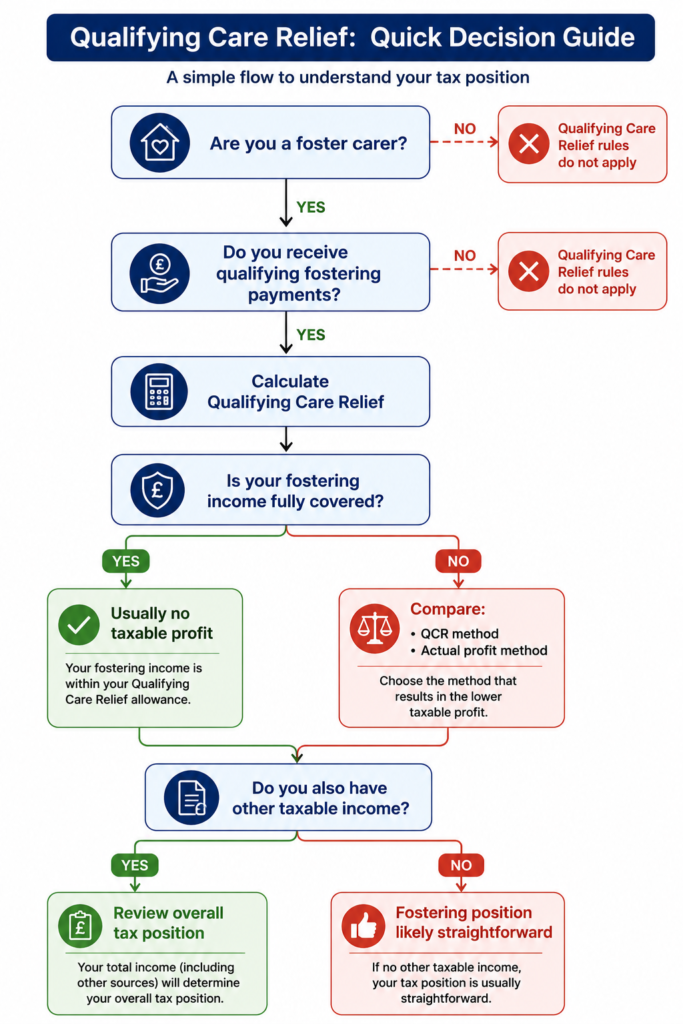
Decision Framework: Which Situation Best Matches Yours?
Why Understanding the Rules Saves More Than Tax
Many people think Qualifying Care Relief is simply about paying less tax.
In reality, understanding the rules also helps you:
- complete your Self Assessment correctly
- respond confidently to HMRC
- avoid unnecessary penalties
- understand your household finances
- make informed financial decisions
For many foster carers, that peace of mind is just as valuable as the tax savings themselves.
Frequently Overlooked Qualifying Care Relief Rules
Once foster carers understand the basics of Qualifying Care Relief (QCR), the next challenge is recognising the situations that aren’t always covered in standard guidance.
These are the questions that often arise after you’ve started fostering, received an HMRC letter or spoken to another foster carer whose circumstances seem different from yours.
Let’s look at some of the most commonly misunderstood rules.
Rule 1: Qualifying Care Relief Doesn’t Automatically Remove Your HMRC Responsibilities
One of the biggest misconceptions is:
“If my fostering income isn’t taxable, I don’t need to think about tax.”
Unfortunately, it isn’t always that simple.
Depending on your circumstances, HMRC may still expect you to:
- register for Self Assessment
- submit annual tax returns
- keep appropriate records
- respond to HMRC correspondence
Qualifying Care Relief affects how your tax is calculated, not necessarily whether you have reporting obligations.
Rule 2: Your Tax Position Can Change Every Year
Many foster carers assume that once they’ve established their tax position, it stays the same.
In reality, your position may change because of:
- different placements
- children of different ages
- changes in household income
- additional employment
- self-employment
- rental income
- retirement
- changes in HMRC thresholds
Reviewing your position annually helps ensure you’re still using the most appropriate approach.
AccounTax Zone Insight
We've spoken to foster carers who hadn't reviewed their tax position for several years because "nothing had changed."
When we looked more closely, several things had changed:
- additional employment
- new placements
- updated Qualifying Care Relief thresholds
- different household circumstances
A short annual review can prevent small changes becoming bigger issues later.
Common Myths About Qualifying Care Relief
The internet contains a huge amount of conflicting information about foster carer tax.
Let’s separate fact from fiction.
| Myth | Reality |
| All fostering income is automatically tax-free. | Qualifying Care Relief often removes the tax liability, but calculations still need to be performed correctly. |
| Every foster carer pays no tax. | Many do not, but each situation is different. |
| Couples receive double the annual allowance. | The fixed allowance applies per household. |
| You never need to complete a tax return. | HMRC may still require one depending on your circumstances. |
| General self-employed tax advice applies to foster carers. | Foster carers operate under a specialist tax regime with its own rules. |
A Practical Checklist for Every Foster Carer
Rather than waiting until January each year, use this checklist throughout the tax year.
Monthly
- Check your fostering payment statement.
- Record new placements.
- Record placements that have ended.
- Save agency correspondence.
- File payment summaries electronically.
Every Tax Year
- Review your Qualifying Care Relief calculation.
- Check whether your circumstances have changed.
- Consider whether you have any additional taxable income.
- Review HMRC deadlines.
- Keep copies of submitted tax returns.
If HMRC Contacts You
- Read the letter carefully.
- Don’t ignore the deadline.
- Gather the requested information.
- Seek professional advice if you’re unsure.
AccounTax Zone Tip
Create one folder called: "Foster Care Tax 2026/27"
Keep everything in it:
- payment summaries
- HMRC letters
- agency statements
- tax returns
- calculations
You'll save yourself hours every January.
Real-Life Scenarios
The following examples illustrate how the rules work in practice.
Scenario 1
New Foster Carer
Laura became an approved foster carer in November.
She worried she’d registered “too late” to qualify for Qualifying Care Relief.
The reality?
The relief simply reflected her qualifying placements during the tax year.
She didn’t lose the benefit because she started later in the year.
Scenario 2
Foster Carer With Employment Income
Ahmed works three days each week while fostering.
His employment income and fostering income are taxed differently.
Qualifying Care Relief may reduce or eliminate the taxable profit from fostering, but his salary remains subject to the normal PAYE rules.
Understanding the difference prevented unnecessary confusion when completing his Self Assessment return.
Scenario 3
Foster Carer Couple
Rachel and David jointly foster children.
Initially they believed each person received the annual Qualifying Care Relief allowance.
After reviewing the rules, they realised the allowance applies once per household.
Correcting the calculation ensured their tax return accurately reflected HMRC guidance.
Scenario 4
Foster Carer With Rental Income
Michael also owns a buy-to-let property.
His fostering income and rental income are reported separately.
Understanding this distinction helped him calculate his overall tax position correctly while still benefiting from Qualifying Care Relief.
When Should You Speak to an Accountant?
Not every foster carer needs ongoing accountancy support.
However, professional advice can be particularly valuable if:
- you’re fostering for the first time
- you’ve received an HMRC letter
- you have employment income
- you’re self-employed as well as fostering
- you receive rental income
- you foster jointly
- you’ve exceeded the Qualifying Care Relief threshold
- you’re unsure whether previous tax returns were correct
- you’re planning to stop fostering or retire
Getting advice early is often quicker, simpler and less expensive than correcting mistakes later.
AccounTax Zone Insight
Most enquiries we receive from foster carers aren't because they've done something wrong.
They're because they're unsure.
A short conversation is often enough to explain the rules, confirm whether their tax position is correct and give them peace of mind.
Why Specialist Advice Makes a Difference
Qualifying Care Relief is one of the more specialised areas of UK personal taxation.
Although the legislation is well established, applying it correctly requires an understanding of:
- qualifying care receipts
- Self Assessment requirements
- household allowances
- mixed-income households
- HMRC reporting obligations
- record-keeping expectations
A specialist accountant doesn’t just complete tax returns.
They help you understand your position, identify potential issues before they arise and ensure the relief is applied correctly.
FAQs related to Qualifying Care Relief Rules
Qualifying Care Relief is a UK tax scheme that allows eligible foster carers and certain other qualifying carers to reduce or eliminate taxable profit by applying a fixed annual allowance together with weekly qualifying amounts.
The scheme generally applies to approved foster carers, Shared Lives carers and certain adult placement carers who meet HMRC’s qualifying conditions.
Not necessarily.
Many foster carers pay little or no tax because of the generous relief available, but tax may still arise if your fostering income exceeds the available threshold or you have other taxable income.
Possibly.
Whether you need to file depends on your individual circumstances and whether HMRC has issued you with a notice to file.
Where your receipts exceed the Qualifying Care Relief threshold, you may be able to compare the simplified Qualifying Care Relief calculation with the actual profit method.
The most suitable approach depends on your circumstances.
No.
The fixed Qualifying Care Relief allowance applies once per household.
The simplified Qualifying Care Relief method reduces the need for detailed expense records, but you should still keep appropriate records of:
- fostering payments
- placements
- HMRC correspondence
- tax returns
- supporting documents
Don’t ignore the letter.
Many HMRC enquiries simply request additional information or clarification.
Respond promptly and seek professional advice if you’re unsure what HMRC is asking for.
Often, yes.
Depending on your circumstances, it may be possible to amend previous tax returns or correct errors.
The sooner issues are identified, the easier they are generally to resolve.
Final Thoughts
The Qualifying Care Relief rules were introduced to make the UK tax system fairer for foster carers.
Yet they’re still one of the least understood areas of personal taxation.
Understanding:
- who qualifies,
- how the calculation works,
- what records to keep,
- when HMRC still expects a tax return,
- and when professional advice is worthwhile,
can help you avoid unnecessary stress, reduce the risk of mistakes and ensure you’re not paying more tax than the law requires.
For many foster carers, the greatest benefit isn’t simply paying less tax—it’s having confidence that everything has been done correctly.
Speak to a Specialist Accountant for Foster Carers
Whether you’re just starting your fostering journey or you’ve been fostering for many years, having specialist advice can make navigating the tax rules much easier.
At AccounTax Zone, we support foster carers across the UK with practical, straightforward advice tailored to their individual circumstances.
We can help you:
- Understand the Qualifying Care Relief rules.
- Calculate your available relief accurately.
- Prepare and submit Self Assessment tax returns where required.
- Respond to HMRC enquiries.
- Review previous tax returns.
- Ensure you’re claiming all available tax reliefs correctly.
If you’re unsure about your tax position or simply want reassurance that everything has been handled correctly, we’re here to help.
Book Your FREE 30-Minute Consultation
Call: 020 3740 7074
Email: info@accountaxzone.com
AccounTax Zone – Specialist Accountants for Foster Carers Across the UK.


