Here’s How Successful Restaurants Build High-Performing Teams
Staff Management Restaurants – Introduction
Saturday night.
Every table is booked.
The kitchen is working flat out.
Orders are arriving faster than expected.
One chef has called in sick.
A new waiter is struggling with the ordering system.
Another employee forgot to tell the kitchen about a customer’s allergy.
The manager is trying to greet guests, answer supplier calls, approve timesheets and solve staffing issues, all at the same time.
By the end of the evening, the restaurant has generated impressive sales.
Yet the atmosphere behind the scenes tells a different story.
Staff are exhausted.
Customers have waited longer than expected.
Food has been wasted.
Service has slowed.
Mistakes have increased.
The next morning, two employees hand in their notice.
Many restaurant owners assume these are staffing problems.
In reality, they’re management problems.
The difference between an average restaurant and a highly profitable one isn’t always the quality of the food or the size of the menu.
More often, it’s the ability to recruit, develop and manage a team that consistently delivers excellent service while controlling labour costs.
Great staff management improves far more than employee satisfaction.
It influences:
- Customer experience
- Labour costs
- Payroll accuracy
- Staff retention
- Productivity
- Food waste
- Cash flow
- Profitability
- Long-term business growth
Whether you operate an independent café, a busy takeaway or a growing restaurant group, effective staff management is one of the biggest competitive advantages your business can develop.
In this guide, you’ll learn:
- Why staff management has such a significant impact on restaurant profitability.
- The biggest people management mistakes restaurant owners make.
- How to recruit, retain and motivate great employees.
- How to schedule staff more effectively.
- The relationship between staffing, payroll and labour costs.
- Practical ways to build a stronger restaurant team.
Why Staff Management Is One of the Biggest Drivers of Restaurant Profitability
Restaurant owners often focus on increasing sales.
More customers.
More tables.
More orders.
More marketing.
But many overlook one of the biggest factors affecting profit:
How effectively the team performs.
Even a busy restaurant can struggle financially if staff aren’t managed well.
Poor communication, inefficient scheduling and high employee turnover create costs that don’t always appear immediately on a Profit & Loss report.
For example, poor staff management can lead to:
- Higher payroll costs
- Increased overtime
- More food waste
- Slower table turnover
- Customer complaints
- Lower online reviews
- Increased recruitment costs
- Reduced employee morale
- Higher staff turnover
Each issue may seem relatively small on its own.
Together, they can significantly reduce profitability.
AccounTax Zone Insight: Many restaurant owners concentrate on reducing food costs while overlooking labour efficiency. In our experience, improving team performance often delivers a greater long-term return than making small savings on supplier prices.
The Hidden Cost of High Staff Turnover
Staff turnover is one of the biggest challenges facing the hospitality industry.
Replacing employees isn’t simply about advertising another vacancy.
Every new employee requires:
- Recruitment
- Interviews
- Training
- Supervision
- Uniforms
- Payroll setup
- Time to become productive
Meanwhile, experienced employees are spending less time serving customers because they’re helping train new team members.
The financial cost quickly adds up.
Restaurants with high staff turnover often experience:
- Lower productivity
- More operational mistakes
- Inconsistent customer service
- Increased recruitment costs
- Higher payroll administration
- Reduced team morale
Retaining experienced employees is almost always more cost-effective than constantly recruiting replacements.
Restaurant Success Habit: Schedule regular one-to-one conversations with your team, not just when there's a problem. Employees who feel listened to are often more engaged, more productive and less likely to leave.
Recruitment: Hiring the Right People, Not Just Filling Vacancies
When a restaurant is short-staffed, it’s tempting to hire the first suitable applicant.
Unfortunately, poor recruitment decisions often create bigger problems later.
Technical skills can usually be taught.
Attitude, reliability and customer service are much harder to develop.
Successful restaurants recruit people who:
- Communicate well
- Enjoy working with others
- Stay calm under pressure
- Learn quickly
- Take responsibility
- Care about customer experience
Finding the right people from the beginning often reduces staff turnover and improves long-term performance.
Great Restaurants Invest in Training
Many owners view training as an expense.
Successful restaurant operators view it as an investment.
Well-trained employees:
- Make fewer mistakes.
- Work more efficiently.
- Deliver better customer service.
- Require less supervision.
- Adapt more quickly during busy periods.
Training should extend beyond food preparation and service standards.
Employees also benefit from understanding:
- Health and safety procedures
- Allergen awareness
- Customer communication
- Upselling techniques
- Teamwork
- Company values
Investing in people often produces measurable improvements in both customer satisfaction and profitability.
AccounTax Zone Insight: One poorly trained employee can unintentionally create hundreds of pounds of wasted food, unnecessary refunds and dissatisfied customers. Training isn't simply about improving service—it's also about protecting profit.
Why Communication Matters During Every Service
Restaurant teams operate in fast-moving environments where clear communication is essential.
Small misunderstandings can quickly become expensive mistakes.
Examples include:
- Incorrect food orders.
- Missed allergy requests.
- Duplicate meals.
- Delayed service.
- Customer complaints.
- Food waste.
Building simple communication routines helps reduce these problems.
Many successful restaurants begin every shift with a short team briefing covering:
- Bookings
- Daily specials
- Staff responsibilities
- Large group reservations
- Allergies
- Expected busy periods
These brief meetings often prevent far bigger problems later in the day.
Restaurant Success Habit: A 10-minute pre-service briefing is one of the highest-return activities a restaurant can introduce. It aligns the entire team before the first customer arrives and significantly improves communication during busy service.
Scheduling Staff Efficiently
One of the biggest challenges in restaurant management is having the right number of employees available at the right time.
Too few staff can result in:
- Slow service
- Longer waiting times
- Stressed employees
- Poor customer reviews
- Lost sales
Too many staff can increase payroll costs unnecessarily and reduce profitability.
Effective scheduling requires balancing customer demand with labour efficiency.
Good scheduling takes into account:
- Historical sales
- Seasonal demand
- Weather
- Local events
- Holidays
- Employee availability
- Peak trading hours
Rather than relying solely on intuition, successful restaurants use historical data to create smarter rotas.
AccounTax Zone Insight: We often see restaurant owners preparing staff rotas before reviewing expected sales. Reversing this process—forecasting demand first and scheduling second, usually leads to better labour efficiency.
Staff Management Directly Affects Payroll
Many restaurant owners treat staff management and payroll as two separate processes.
In reality, they’re closely connected.
Poor staff management often leads to:
- More overtime
- Payroll corrections
- Incorrect timesheets
- Holiday pay disputes
- Higher labour costs
- Payroll administration issues
Strong management reduces many of these problems before payroll is even processed.
Accurate scheduling, reliable timekeeping and clear communication all contribute to smoother payroll and better financial reporting.
Happy Employees Usually Create Happy Customers
Customers often remember how they were treated long after they’ve forgotten what they ordered.
Friendly, motivated employees create experiences that encourage repeat visits and positive online reviews.
By contrast, stressed teams are more likely to make mistakes, communicate poorly and provide inconsistent service.
Restaurant owners who invest in their people often improve customer satisfaction without spending additional money on marketing.
After all, your employees interact with every customer who walks through the door.
Building a High-Performing Restaurant Team
Successful restaurants don’t rely on luck when it comes to their employees.
They build systems that help people perform consistently.
While every restaurant is different, the highest-performing teams usually have three things in common:
- Clear expectations
- Strong leadership
- Consistent accountability
Employees perform best when they understand what’s expected of them and receive the support they need to succeed.
Without structure, even talented teams can become inconsistent.
Setting Clear Expectations From Day One
Good staff management starts long before an employee serves their first customer.
A structured onboarding process helps new team members understand:
- Their responsibilities
- Service standards
- Company values
- Customer expectations
- Health and safety procedures
- Food hygiene requirements
- Team communication
Restaurants that invest time in onboarding often experience fewer mistakes, faster learning and stronger employee confidence.
Rather than expecting new employees to “pick things up as they go”, successful businesses provide clear guidance from the beginning.
Restaurant Success Habit: Create a simple onboarding checklist for every new employee. Consistency during the first week often determines how quickly new team members become productive and whether they stay with your business long term.
Performance Management Should Be Continuous
Many restaurant owners only speak to employees when something goes wrong.
Unfortunately, this often creates a culture where feedback is associated with criticism.
Instead, performance management should become part of everyday leadership.
Regular conversations help employees understand:
- What they’re doing well
- Where they can improve
- Business expectations
- Future development opportunities
Positive feedback is just as important as constructive feedback.
Recognising good performance encourages employees to maintain high standards and contributes to stronger team morale.
Managing Labour Costs Without Compromising Customer Service
Labour is one of the largest expenses for most restaurants.
The obvious solution might seem to be reducing staffing levels.
However, cutting labour costs too aggressively often creates bigger problems.
Insufficient staffing can result in:
- Slower service
- Longer waiting times
- More customer complaints
- Increased employee stress
- Lower table turnover
- Reduced repeat business
The objective isn’t to spend less on payroll.
It’s to spend payroll more efficiently.
Restaurant owners should regularly review:
- Labour Cost Percentage
- Sales per labour hour
- Peak trading periods
- Staffing requirements
- Department productivity
These measures provide far better insight than simply looking at total payroll costs.
AccounTax Zone Insight: The cheapest rota isn't always the most profitable. One additional experienced employee during your busiest service may generate significantly more revenue than their wage cost by improving service speed and increasing table turnover.
Creating Smarter Staff Rotas
A well-planned rota benefits both the business and its employees.
It helps ensure:
- Busy periods are adequately staffed.
- Labour costs remain under control.
- Employees have predictable working patterns.
- Managers spend less time dealing with last-minute changes.
Effective rota planning should consider:
- Historical sales data
- Seasonal trends
- Local events
- Weather forecasts
- Annual leave
- Staff availability
- Employee skills and experience
Scheduling should be based on expected demand rather than simply repeating last week’s rota.
Managing Overtime Effectively
Occasional overtime is often unavoidable in hospitality.
However, regular overtime may indicate deeper operational issues.
Common causes include:
- Poor scheduling
- Staff shortages
- High employee turnover
- Inefficient kitchen processes
- Inaccurate sales forecasting
Monitoring overtime each week helps identify these trends before labour costs begin affecting profitability.
Rather than asking why payroll has increased, ask why overtime became necessary in the first place.
Developing Future Leaders Within Your Restaurant
As restaurants grow, owners cannot oversee every shift personally.
Developing supervisors and managers becomes essential.
Strong team leaders help:
- Maintain service standards
- Resolve customer issues
- Train new employees
- Support junior staff
- Improve communication
- Reduce pressure on owners
Leadership development should be viewed as a long-term investment rather than an optional expense.
Restaurants that promote capable employees internally often retain valuable knowledge while strengthening employee loyalty.
Restaurant Success Habit: Identify one employee with leadership potential each year and invest in their development. Building future managers internally is often more successful, and more cost-effective, than recruiting externally.
Handling Conflict Professionally
Disagreements are inevitable in busy restaurant environments.
Long shifts, demanding customers and fast-paced service can all create pressure.
The goal isn’t to eliminate conflict completely.
It’s to manage it professionally.
Good managers:
- Listen before reacting.
- Address issues promptly.
- Remain objective.
- Focus on solutions.
- Apply policies consistently.
- Encourage respectful communication.
Ignoring small disagreements often allows them to become larger problems affecting the entire team.
Retaining Great Employees
Recruitment is expensive.
Training takes time.
Replacing experienced employees disrupts operations.
This is why employee retention should be a strategic priority.
Restaurants with lower staff turnover often benefit from:
- Better customer relationships
- Greater operational consistency
- Lower recruitment costs
- Stronger teamwork
- Higher productivity
Retention isn’t always about paying the highest wages.
Employees also value:
- Respect
- Recognition
- Career progression
- Fair scheduling
- Good communication
- Positive workplace culture
Small improvements in these areas often have a significant impact on employee loyalty.
AccounTax Zone Insight: Exit interviews can be one of the most valuable management tools available. They often reveal recurring issues that current employees may be reluctant to discuss openly.
Using KPIs to Measure Staff Performance
Managing people becomes much easier when decisions are supported by data rather than assumptions.
Useful workforce KPIs include:
- Labour Cost Percentage
- Sales per Employee
- Staff Turnover Rate
- Employee Retention Rate
- Overtime Hours
- Sickness Absence
- Average Training Hours
- Customer Satisfaction Scores
- Online Review Ratings
- Average Service Time
Monitoring these indicators regularly helps restaurant owners identify trends early and make informed operational decisions.
Common Staff Management Mistakes Restaurants Make
Even successful restaurants occasionally make people management mistakes.
Some of the most common include:
- Recruiting too quickly to fill vacancies.
- Providing little or no structured onboarding.
- Giving feedback only when problems occur.
- Building rotas without forecasting customer demand.
- Measuring payroll costs without considering productivity.
- Ignoring employee development.
- Promoting excellent employees into management without leadership training.
- Failing to recognise good performance.
- Delaying difficult conversations.
- Treating staff management as an HR responsibility rather than a business strategy.
Many of these issues don’t create immediate problems.
Instead, they gradually reduce employee engagement, increase turnover and affect long-term profitability.
Restaurant Staff Management Health Check
Ask yourself the following questions:
Recruitment
- Do you have a structured recruitment process?
- Are new employees onboarded consistently?
- Are job roles clearly defined?
Leadership
- Do managers hold regular one-to-one meetings?
- Are employees given constructive feedback?
- Are high performers recognised?
Scheduling
- Are rotas based on expected demand?
- Is overtime monitored weekly?
- Are labour costs reviewed alongside sales?
Employee Development
- Do employees receive ongoing training?
- Are future managers being developed?
- Is staff turnover monitored regularly?
Business Performance
- Can you measure Labour Cost Percentage?
- Do payroll reports support management decisions?
- Are customer satisfaction and employee performance reviewed together?
If you answered “No” to several of these questions, improving your staff management processes could significantly strengthen both your team and your restaurant’s financial performance.
Using Technology to Improve Restaurant Staff Management
Managing a restaurant becomes significantly easier when the right technology supports your team.
Modern restaurant management systems don’t replace good leadership—they provide the information needed to make better decisions.
Technology can help restaurant owners:
- Build smarter rotas
- Track employee attendance
- Monitor labour costs
- Improve communication
- Reduce payroll errors
- Forecast staffing requirements
- Measure team performance
Instead of reacting to staffing problems, managers can identify trends early and make proactive decisions.
Workforce Scheduling Software
Scheduling software allows managers to create rotas based on expected demand rather than guesswork.
Many systems allow you to:
- View employee availability
- Manage annual leave requests
- Allocate shifts fairly
- Track overtime
- Notify employees of rota changes instantly
Better scheduling improves both employee satisfaction and labour efficiency.
Time & Attendance Systems
Digital clock-in systems reduce manual errors while providing more accurate payroll information.
They also help restaurants:
- Record actual hours worked
- Monitor lateness
- Track overtime
- Produce reliable payroll records
- Reduce disputes over working hours
Accurate attendance data supports better payroll, better management reporting and improved compliance.
AccounTax Zone Insight: Time and attendance systems don't just save administrative time. They provide valuable operational data that helps managers understand staffing patterns and improve future scheduling decisions.
Team Communication Tools
Poor communication is one of the biggest causes of operational mistakes in restaurants.
Digital communication platforms can help managers:
- Share rota updates
- Notify staff of menu changes
- Communicate daily specials
- Send training material
- Update operational procedures
Keeping everyone informed helps reduce misunderstandings and improves consistency across the team.
Creating a Positive Workplace Culture
Culture isn’t created through posters on a staff room wall.
It’s created through everyday leadership.
Employees notice:
- How managers communicate.
- How mistakes are handled.
- Whether good work is recognised.
- Whether everyone is treated fairly.
- Whether leaders set the right example.
Positive workplace cultures usually experience:
- Lower staff turnover
- Better teamwork
- Higher productivity
- Better customer service
- Improved online reviews
Culture becomes a competitive advantage because customers can often sense when employees genuinely enjoy working together.
Restaurant Success Habit: Celebrate small wins regularly. Recognising excellent customer service, teamwork or problem-solving creates positive habits that gradually become part of your restaurant's culture.
Staff Management Is Closely Linked to Financial Performance
Many restaurant owners think of staff management as an HR responsibility.
Successful operators see it differently.
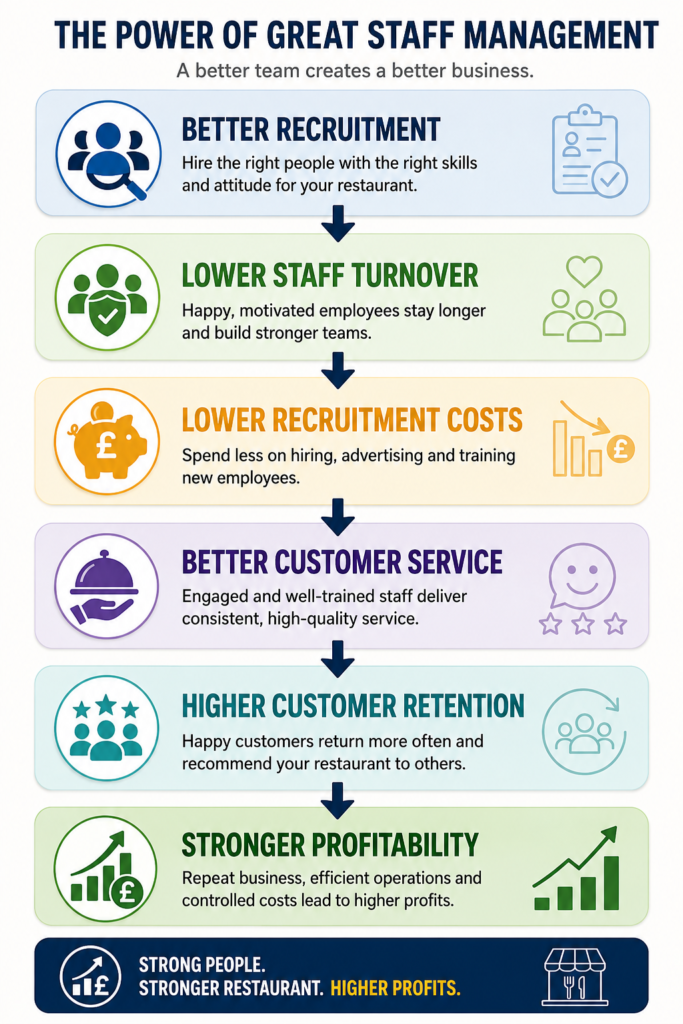
Every staffing decision has financial consequences.
For example:
Likewise:
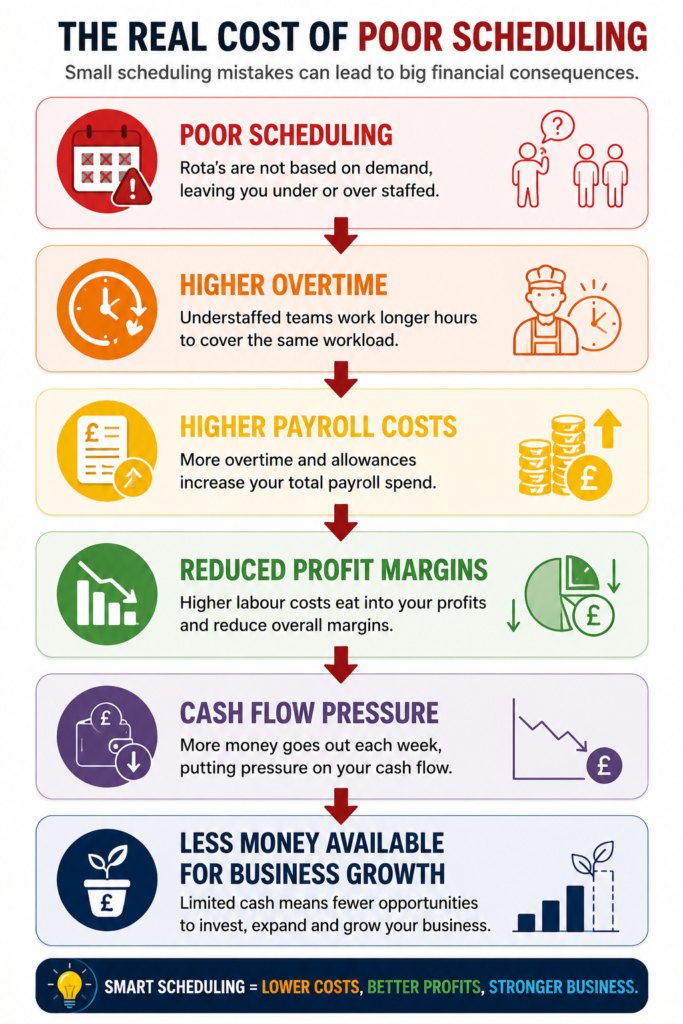
This is why labour management should be reviewed alongside financial performance, not separately.
AccounTax Zone Insight: The most profitable restaurants don't necessarily employ fewer people. They simply make better use of the people they already have.
How Specialist Restaurant Accountants Can Help
People management isn’t usually the first thing restaurant owners discuss with their accountant.
Yet many staffing decisions have a direct financial impact.
At AccounTax Zone, we help restaurant owners understand how labour costs, payroll, staffing efficiency and financial performance work together.
Our support goes beyond preparing payroll.
We help you make informed business decisions by providing meaningful financial information that supports long-term growth.
Our services include:
Labour Cost Reporting
Understand how staffing costs compare with sales and identify opportunities to improve efficiency.
Payroll Management
Accurate payroll processing, pension administration and PAYE compliance help ensure employees are paid correctly while reducing administrative pressure.
Management Accounts
Monthly management reports allow restaurant owners to monitor:
- Labour Cost Percentage
- Gross Profit
- Cash Flow
- Food Costs
- Overall business performance
Rather than waiting until year-end, you receive information while there is still time to act.
Business Performance Advice
As your restaurant grows, staffing decisions become increasingly important.
Whether you’re opening another location, expanding your team or improving operational efficiency, we provide practical financial advice to support sustainable growth.
Why Restaurant Owners Choose AccounTax Zone
Restaurant owners need advisers who understand both hospitality operations and financial performance.
At AccounTax Zone, we work with restaurants, cafés, takeaways and hospitality businesses across London and the UK, helping them improve financial performance through better reporting, payroll, bookkeeping and strategic advice.
Clients choose us because we provide:
- Specialist restaurant accounting expertise
- Payroll and labour cost reporting
- Cash flow forecasting
- Management accounts
- Restaurant bookkeeping
- VAT support
- Business performance advice
- Dedicated accountant
- Fixed monthly fees
- Unlimited support
Our goal isn’t simply to keep your business compliant.
It’s to help you build a stronger, more profitable restaurant.
FAQs related to Staff Management Restaurants
Effective staff management improves customer service, reduces employee turnover, controls labour costs and supports long-term profitability. A well-managed team is more productive, more engaged and better equipped to deliver a consistent customer experience.
Improving recruitment, providing structured onboarding, recognising good performance, offering development opportunities and maintaining open communication all contribute to stronger employee retention.
Rotas should be reviewed regularly and adjusted based on expected customer demand, seasonal trends, staff availability and business performance.
Labour Cost Percentage measures payroll costs as a proportion of sales. It’s one of the most important financial KPIs for restaurant owners because it helps assess staffing efficiency and profitability.
Accurate scheduling, timekeeping and employee records reduce payroll errors, improve compliance and provide more meaningful labour cost reporting.
Yes. Better recruitment, lower staff turnover, efficient scheduling and improved employee performance all contribute to stronger financial results over time.
Many restaurants use workforce scheduling, time and attendance, payroll and communication software to improve efficiency and reduce administrative work.
Many growing restaurants choose to outsource payroll because it improves accuracy, reduces compliance risk and frees owners to focus on running the business.
Final Thoughts
Your people are one of your restaurant’s greatest assets.
The quality of your food may attract customers for the first visit, but it’s your team that encourages them to return.
Effective staff management isn’t about controlling employees—it’s about creating an environment where people can perform at their best.
When employees are well-trained, motivated and supported, the benefits extend far beyond the kitchen or dining area. Customer service improves, mistakes reduce, labour costs become easier to manage and profitability often follows.
The strongest restaurant businesses understand that investing in their team isn’t simply an operational decision.
It’s a financial one.
Building a high-performing team takes time, consistency and good leadership—but the long-term rewards for both your employees and your business are well worth the effort.
Ready to Build a Stronger, More Profitable Restaurant?
If you’re finding it difficult to control labour costs, improve staff retention or understand how staffing decisions are affecting your profitability, the right financial insight can make a significant difference.
At AccounTax Zone, we help restaurant owners go beyond compliance by connecting payroll, labour costs, management accounts reporting and business performance into one clear financial picture.
Book Your FREE Restaurant Performance Review
During your consultation, we’ll discuss:
- Labour Cost Percentage
- Payroll efficiency
- Staff-related financial reporting
- Cash flow and profitability
- Management accounts
- Practical opportunities to improve business performance
There’s no obligation, just practical advice from accountants who understand the financial realities of running a restaurant.
Related Reading
- Accountant for Restaurant
- Cash Flow for a Restaurant: The Complete Guide to Improving Financial Stability and Profitability
- VAT for Restaurants in UK Mistakes Could Be Costing You Thousands – The Complete UK Guide
- Poor Bookkeeping Is Hiding Your Restaurant’s True Profit
- Is Your Restaurant Holding Too Much Stock?
- Restaurant Payroll Mistakes Could Cost You Thousands


