Tax Relief for Healthcare Providers: What UK Healthcare Businesses Can Claim in 2026/27
A private clinic spends £80,000 on diagnostic equipment.
A care provider employs 40 members of staff.
A medical technology company invests heavily in developing a new patient-monitoring system.
All three businesses may qualify for tax relief, but not necessarily under the same rules.
The clinic may be able to claim capital allowances. The care provider may qualify for Employment Allowance. The technology company may have a valid Research and Development tax relief claim.
The problem is that many healthcare businesses treat tax relief as an end-of-year exercise. Receipts are sent to the accountant, accounts are prepared and whatever relief happens to be available is claimed.
That approach can miss valuable opportunities.
Some tax reliefs depend on:
- When expenditure is incurred
- Who purchases the asset
- Whether the business is a company, partnership or sole trader
- How equipment or premises are used
- Whether professional costs are business-related
- How staff and directors are paid
- Whether the business performs genuine research and development
- Whether elections or additional forms are submitted on time
Tax planning should therefore happen before significant expenditure and business decisions, not only after the financial year has ended.
This guide explains the main tax reliefs potentially available to private clinics, GP practices, dental practices, pharmacies, care providers, medical consultants, therapy businesses, healthtech companies and other UK healthcare organisations.
This guide reflects UK tax rules and HMRC guidance available on 29 July 2026. Eligibility depends on the facts of each business and transaction.
What Is Tax Relief?
Tax relief reduces the amount of tax a business or individual must pay.
It can work in several ways.
A relief may:
- Deduct an expense from taxable profit
- Allow the cost of equipment to be deducted through capital allowances
- Reduce an employer’s National Insurance bill
- Turn qualifying expenditure into a tax credit
- Allow business losses to offset other taxable profits
- Apply a lower Corporation Tax rate to qualifying patent income
- Reduce the business rates payable on qualifying premises
Tax relief does not always mean that HMRC sends money directly to the business.
For example, if a company spends £20,000 on an allowable expense, it does not normally receive £20,000 back. Instead, the expense reduces the profit on which Corporation Tax is calculated.
The financial benefit depends on:
- The amount spent
- The applicable tax rate
- Whether the business has sufficient taxable profit
- Whether the relief is immediate or spread over several years
- Whether the business satisfies all qualifying conditions
Tax Relief Is Not the Same as VAT Exemption
Healthcare providers often confuse tax relief with VAT exemption.
They are different.
A healthcare service may be exempt from VAT because it satisfies the healthcare exemption conditions. This determines whether VAT is charged and whether related input VAT can be recovered.
Tax relief determines how business expenditure, investments, losses and other items affect Income Tax, Corporation Tax, National Insurance or business rates.
A private clinic may therefore:
- Make VAT-exempt clinical supplies
- Be unable to recover VAT on some equipment
- Still claim capital allowances on the cost of that equipment
The VAT treatment and direct-tax treatment must be considered separately.
1. Allowable Business Expenses for Healthcare Providers
Most healthcare businesses can deduct revenue expenses that are incurred wholly and exclusively for the purposes of the business.
For sole traders and partnerships, allowable expenses reduce taxable trading profit.
For limited companies, qualifying business costs generally reduce the profit subject to Corporation Tax.
Common potentially allowable costs include:
- Employee wages
- Employer National Insurance
- Workplace pension contributions
- Locum and contractor fees
- Agency staffing
- Rent and service charges
- Utilities
- Clinical consumables
- Medical indemnity insurance
- Public liability and employer’s liability insurance
- Software subscriptions
- Telephone and internet costs
- Accountancy and legal fees
- Marketing
- Business travel
- Professional subscriptions
- Repairs and maintenance
- Staff training
- Cleaning and infection-control costs
- CQC and other regulatory fees
- Printing, stationery and postage
HMRC’s general guidance allows self-employed businesses to deduct costs such as office expenses, travel, staff costs, financial costs, premises expenses, marketing and professional fees where the relevant conditions are met.
The Expense Must Be Business-Related
An expense does not become deductible merely because it has been paid from the business bank account.
The business should establish:
- Who incurred the cost
- Why it was incurred
- Whether it relates to the healthcare trade
- Whether there is any personal element
- Whether it is revenue or capital expenditure
- Whether another tax rule restricts the deduction
- Whether supporting evidence has been retained
Mixed Business and Personal Expenses
Where an expense has both business and private use, only the identifiable business portion may be deductible.
Examples include:
- A mobile phone used personally and professionally
- A vehicle used for clinic visits and private travel
- Home internet used partly for business
- A room at home used as an office
- A conference trip combined with a holiday
- Professional equipment also used privately
The allocation should be reasonable and supported by evidence.
2. Professional Registration, Subscriptions and Indemnity
Professional costs can be substantial for healthcare practitioners.
Depending on the circumstances, deductible costs may include:
- GMC registration
- GDC registration
- NMC registration
- HCPC registration
- GPhC registration
- Professional-body subscriptions
- Medical defence organisation fees
- Professional indemnity insurance
- Revalidation-related costs
- Practising certificates
For self-employed doctors, HMRC specifically accepts that costs incurred in achieving GMC revalidation can be allowable because they maintain the professional knowledge required for the existing trade.
Where the Business Pays
A healthcare business may normally claim a deduction where it pays a genuine business cost for an employee or director, subject to the general tax and benefit rules.
The business should confirm whether the payment:
- Is required for the employee’s role
- Relates to an approved professional organisation
- Is reimbursing an employee
- Creates a taxable benefit
- Has already been claimed personally by the employee
The same expense cannot be relieved twice.
Where the Employee Pays Personally
An employee may be able to claim tax relief for:
- Professional membership fees required for their job
- Annual subscriptions to an HMRC-approved professional body or learned society relevant to their employment
The employee cannot claim where the employer has already paid or reimbursed the cost. HMRC allows qualifying claims for the current tax year and the previous four tax years.
AccounTax Zone Insight
Maintain a professional-cost register showing:
- Employee or director
- Professional organisation
- Renewal date
- Amount
- Who paid
- Business purpose
- Tax treatmentThis prevents missed renewals, duplicated claims and inconsistent payroll treatment.
3. Tax Relief for Healthcare Training
Healthcare organisations frequently pay for:
- Continuing professional development
- Clinical updates
- Safeguarding training
- Infection-control training
- Medication training
- First aid
- Leadership training
- Regulatory compliance
- Software training
- Conferences
- Professional examinations
- Revalidation support
For self-employed individuals, HMRC allows training costs where the training improves or updates skills used in the existing business, develops knowledge connected with changes in the industry or supports the current business.
Training That May Be Allowable
Examples could include:
- A dentist updating existing clinical techniques
- A care-home owner completing updated safeguarding training
- A physiotherapist learning to use new treatment technology within their existing practice
- A clinic director completing management training
- A pharmacist updating knowledge of changing regulations
- A practice owner learning to use new accounting or patient-management software
Training That Requires More Care
Costs may not be deductible where the course creates an entirely new profession or trade rather than updating the existing one.
Examples could include:
- A clinic administrator training to become a doctor
- A general business owner obtaining their initial physiotherapy qualification
- A dentist training for an unrelated profession
- A care provider paying for a director’s course with no real connection to the business
The distinction is whether the training supports the existing trade or creates a new one.
Employee Training
Where an employer pays for work-related training, the employer may generally deduct the genuine business cost. The employee benefit position should also be checked, particularly where the course has a substantial personal or non-business purpose.
4. Capital Allowances on Medical and Healthcare Equipment
Accounting depreciation is not normally deductible when calculating taxable profits.
Instead, businesses may claim capital allowances on qualifying capital expenditure.
Capital allowances can apply to plant and machinery such as:
- Diagnostic equipment
- Dental chairs and treatment units
- Examination couches
- Scanners
- Pharmacy equipment
- Care-monitoring systems
- Computers and servers
- Telephone systems
- Office furniture
- Security systems
- Specialist lighting
- Air-conditioning systems
- Lifts and certain building systems
- Vans and qualifying vehicles
- Electric vehicle charging equipment
HMRC describes capital allowances as a tax relief allowing businesses to deduct some or all of the value of qualifying equipment, machinery and business vehicles from taxable profits.
The correct allowance depends on:
- The type of asset
- Whether it is new or second-hand
- The business structure
- When it was purchased
- Whether it is a car
- Whether the business owns the asset
- Whether private use exists
- Whether the Annual Investment Allowance has already been used
5. Annual Investment Allowance
The Annual Investment Allowance generally provides a 100% deduction for qualifying plant and machinery expenditure, up to the available annual limit.
The current standard AIA limit is £1 million. It can provide full tax relief in the period of purchase for qualifying expenditure up to that limit.
Example
A private clinic buys:
- Diagnostic equipment: £60,000
- Computers: £8,000
- Treatment furniture: £12,000
Total qualifying investment: £80,000
If the expenditure qualifies for AIA and the full allowance is available, the clinic may be able to deduct the entire £80,000 when calculating taxable profit for the relevant period.
This does not mean the business receives £80,000 from HMRC. The tax benefit depends on the entity’s taxable profits and tax rate.
AIA Planning Issues
The business should review:
- The invoice date
- When the obligation to pay became unconditional
- The accounting period
- Whether assets were purchased on hire purchase
- Whether the business is connected with other companies
- Whether the accounting period is shorter than 12 months
- Whether the asset is excluded
- Whether the business has sufficient taxable profit
The AIA limit may be reduced for short accounting periods and can be shared between certain connected businesses.
Cars
Cars do not normally qualify for AIA, although vans and vehicles that are not treated as cars may qualify.
Separate allowances apply to business cars, based partly on emissions and the date of purchase.
6. Full Expensing and First-Year Allowances
Limited companies may have additional options for qualifying capital expenditure.
Full Expensing
Companies can claim full expensing on qualifying new and unused plant and machinery.
Full expensing provides a 100% deduction from taxable profit in the year the qualifying asset is purchased. It is available only to companies and does not apply to cars.
Healthcare examples may include new:
- Diagnostic machinery
- Computer systems
- Laboratory equipment
- Pharmacy automation
- Medical manufacturing equipment
- Security and access equipment
- Office equipment
50% First-Year Allowance
Companies may claim a 50% first-year allowance on certain new and unused special-rate plant and machinery. The remaining balance is normally relieved through writing-down allowances.
Special-rate assets can include certain integral building features and long-life assets.
New 40% First-Year Allowance
A 40% first-year allowance applies to qualifying new and unused main-rate plant or machinery purchased on or after 1 January 2026.
The asset must not be a car. Writing-down allowances may be available on the remaining 60% in later periods.
This allowance may be relevant where:
- AIA is unavailable or has been used
- Full expensing is unavailable
- The expenditure is incurred by a non-company business
- The asset is used for leasing
- Another restriction prevents a 100% claim
Which Capital Allowance Is Best?
The largest percentage is not always automatically the best claim.
The business should consider:
- Current taxable profit
- Expected future profits
- The type of asset
- Future sale plans
- Cash-flow needs
- Available losses
- Connected-company rules
- Whether the asset will be leased
- Whether the asset is new or second-hand
A claim may sometimes be restricted or deferred as part of wider tax planning.
7. Tax Relief on Clinic Construction and Refurbishment
Healthcare premises often require substantial expenditure on:
- Treatment rooms
- Consultation rooms
- Accessibility
- Clinical storage
- Ventilation
- Electrical systems
- Plumbing
- Reception areas
- Staff facilities
- Laboratories
- Decontamination rooms
- Security
- Structural alterations
Not every part of a refurbishment receives the same tax treatment.
Expenditure may fall into:
- Revenue repairs
- Plant and machinery
- Integral features
- Structures and Buildings Allowance
- Non-qualifying capital expenditure
Repairs Versus Improvements
A genuine repair that restores an existing asset may be deductible as a revenue expense.
A major improvement, extension or creation of a new asset is more likely to be capital expenditure.
The distinction depends on the nature of the work rather than how the invoice is described.
Structures and Buildings Allowance
Qualifying expenditure on constructing, renovating or converting non-residential structures and buildings may qualify for the Structures and Buildings Allowance.
The standard allowance is generally 3% of qualifying expenditure per year on a straight-line basis.
SBA may be relevant to:
- New clinics
- Dental practices
- Pharmacies
- Laboratories
- Care facilities
- Healthcare offices
- Medical manufacturing premises
An allowance statement and detailed cost information may be required to support the claim.
Cost Segregation Matters
A contractor may issue one invoice for an entire clinic fit-out.
Within that invoice, different elements may qualify for:
- Immediate revenue deductions
- AIA
- Full expensing
- Special-rate allowances
- Structures and Buildings Allowance
- No immediate relief
The invoice should therefore be analysed rather than posted entirely to “premises improvements”.
AccounTax Zone Insight
Before beginning a significant refurbishment, ask the contractor or quantity surveyor to provide a detailed cost breakdown.
A single line stating “clinic refurbishment, £300,000” makes it much harder to identify the most effective tax treatment.
8. Zero-Emission Cars and Charging Points
Qualifying new electric cars and cars with zero carbon dioxide emissions can receive a 100% first-year capital allowance where purchased within the qualifying period.
The relief is currently available for qualifying expenditure incurred before:
- 1 April 2027 for Corporation Tax
- 6 April 2027 for Income Tax
Qualifying electric vehicle chargepoint equipment can also benefit from a 100% first-year allowance within the applicable period.
Healthcare businesses may consider electric vehicles for:
- Community visits
- Domiciliary care supervision
- Multi-site management
- Mobile healthcare services
- Collection and delivery
- Clinical outreach
However, the business must also consider:
- Employee benefit-in-kind tax
- Private use
- Insurance
- Charging arrangements
- Ownership
- Leasing versus buying
- Whether the vehicle is a car or van
- VAT recovery
A 100% capital allowance does not make the vehicle free, and it does not remove the need to consider the tax position of the driver.
9. Employment Allowance for Healthcare Employers
Employment Allowance can reduce an eligible employer’s secondary Class 1 National Insurance liability.
The maximum allowance for 2026/27 is £10,500. It must be claimed through payroll and renewed each tax year.
Healthcare Eligibility Requires Care
A business or public body can generally qualify where it performs less than half of its work in the public sector.
This is particularly relevant to healthcare providers receiving substantial income from:
- NHS contracts
- Local authorities
- Other public bodies
HMRC states that a business can claim where it performs less than half its work in the public sector. Separate provisions can allow claims by charities and employers of care or support workers in qualifying circumstances.
Example: Mixed Private and NHS Clinic
A private clinic generates:
- 70% of its work from private patients and insurers
- 30% from NHS contracts
It may satisfy the “less than half public-sector work” condition, subject to the full eligibility rules.
Example: Mainly NHS-Funded Provider
A provider carries out 80% of its work through NHS contracts.
It should not assume that it qualifies merely because it is a private limited company. The public-sector restriction must be reviewed.
Other Restrictions
Healthcare employers should also check:
- Whether the company has only one director
- Whether that director is the only employee attracting employer National Insurance
- Whether the business is connected with other companies
- Which group company will claim
- Whether workers fall under off-payroll rules
- Whether there is more than one payroll
Only one company in a connected group can generally claim Employment Allowance.
10. Employer Pension Contributions
Employer contributions to a registered pension scheme can generally be deductible when calculating business profits, provided they are incurred wholly and exclusively for the purposes of the trade.
HMRC states that tax relief is normally given by deducting qualifying employer pension contributions when calculating taxable business profits.
This can be relevant for:
- Employees
- Clinical directors
- Practice owners operating through companies
- Senior management
- Staff retention packages
- Salary-sacrifice arrangements
Why Employer Contributions Can Be Tax-Efficient
A company contribution may:
- Reduce taxable company profit
- Avoid the need for the director to extract the same amount personally first
- Support retirement planning
- Form part of a competitive remuneration package
However, the business must consider:
- The individual’s annual allowance
- Carry-forward availability
- Existing pension inputs
- NHS Pension Scheme membership
- Tapered annual allowance
- Lifetime retirement plans
- Cash flow
- Whether the contribution is commercially justifiable
- Whether tax relief must be spread
Large or unusual contributions should be reviewed before payment.
NHS Pension Considerations
Doctors, dentists and other professionals with NHS pension membership may have more complex retirement planning needs.
A company pension contribution should not be made without understanding:
- Existing NHS pension growth
- Other personal pension contributions
- Available annual allowance
- Potential tax charges
- The individual’s wider income
Business tax relief and the individual’s pension tax position are separate calculations.
11. Research and Development Tax Relief for Healthcare
R&D tax relief is not limited to laboratories and pharmaceutical companies.
Healthcare and healthtech companies may qualify where they undertake projects seeking an advance in science or technology and must overcome genuine scientific or technological uncertainty.
Only companies within the charge to UK Corporation Tax can claim R&D tax relief. The project must seek an advance in science or technology rather than merely improving the business commercially.
Potential Healthcare R&D Projects
Depending on the facts, qualifying projects could involve:
- Developing medical devices
- Creating diagnostic technology
- Improving laboratory processes
- Developing healthcare software where genuine technological uncertainty exists
- Clinical decision-support systems
- New pharmaceutical formulations
- Patient-monitoring technology
- Digital therapeutics
- Robotics
- New manufacturing methods for medical products
- Secure healthcare-data systems
- Advanced care-monitoring solutions
What Usually Does Not Qualify by Itself
The following would not normally qualify merely because they are new to the business:
- Buying standard clinic software
- Implementing an existing patient-management system
- Opening a new location
- Introducing a new service already commonly available
- Carrying out routine clinical work
- Redesigning a website
- Improving administration
- Purchasing new equipment
- General market research
- Routine compliance work
The project must involve an advance in science or technology and uncertainty that a competent professional could not readily resolve.
The Current R&D Schemes
For accounting periods beginning on or after 1 April 2024, the previous SME and RDEC schemes were replaced by:
- The merged R&D expenditure credit scheme
- Enhanced R&D Intensive Support
Merged R&D Expenditure Credit
The merged scheme provides a taxable expenditure credit calculated at 20% of qualifying R&D expenditure.
It is available to companies carrying on a trade, subject to Corporation Tax and undertaking qualifying R&D.
Because the credit is taxable, the net financial benefit is lower than 20%.
Enhanced R&D Intensive Support
ERIS is available to qualifying loss-making R&D-intensive SMEs.
A qualifying company can:
- Claim an additional deduction equal to 86% of qualifying expenditure
- Potentially surrender qualifying losses for a payable credit at up to 14.5%
The company must normally satisfy the R&D intensity condition. Relevant R&D expenditure must generally equal at least 30% of total relevant expenditure, including connected-company expenditure where applicable.
R&D Claims Require Evidence
A robust claim should identify:
- The scientific or technological field
- The advance being sought
- Existing knowledge or capability
- The uncertainty encountered
- Why the solution was not readily deducible
- Work performed to resolve the uncertainty
- Competent professionals involved
- Qualifying costs
- Project timelines
- Failed and successful approaches
A list of software-development invoices is not an R&D report.
Additional Compliance
R&D claims now involve additional reporting requirements and restrictions, including rules concerning overseas subcontractors and externally provided workers.
Claims should be assessed before the Corporation Tax Return is filed rather than added as a last-minute adjustment.
AccounTax Zone Insight
In healthcare, a clinically innovative service is not necessarily a technologically innovative project.
The question for R&D relief is not: “Is this beneficial to patients?”
It is: “Did the company seek an advance in science or technology and attempt to resolve genuine uncertainty?”
12. Patent Box Relief for Healthcare Innovation
A healthcare or medical technology company that owns or exclusively licenses qualifying patent rights may be able to use the Patent Box.
The Patent Box allows qualifying companies to elect for a 10% Corporation Tax rate on qualifying profits attributable to eligible patents and certain related intellectual property rights.
It may be relevant to companies developing:
- Medical devices
- Diagnostic equipment
- Pharmaceutical products
- Healthcare manufacturing processes
- Laboratory technology
- Patient-monitoring hardware
- Patented treatment technology
Patent Box Is Not Automatic
The company generally needs to:
- Hold or exclusively license qualifying rights
- Meet development conditions
- Earn qualifying intellectual-property income
- Elect into the Patent Box
- Calculate the relevant qualifying profit
- Remove routine and marketing returns where required
- Apply the nexus rules
The 10% rate does not necessarily apply to all company profit.
R&D and Patent Box Together
A healthcare technology company may claim R&D tax relief during the development phase and later consider Patent Box treatment when commercialising a patented product.
The two reliefs serve different stages:
- R&D relief supports qualifying development expenditure
- Patent Box can reduce tax on qualifying profits generated from protected innovation
Early coordination between the technical, legal and tax teams can protect both opportunities.
13. Pre-Trading Expenses for New Healthcare Businesses
A healthcare business may incur substantial costs before treating its first patient or receiving its first care contract.
These may include:
- Market research
- Professional advice
- Insurance
- Software
- Recruitment
- Premises costs
- Marketing
- Regulatory support
- Website development
- Training
- Administration
Qualifying pre-trading revenue expenditure incurred within seven years before the trade begins may be treated as incurred on the first day of trading, provided it would have been deductible had it been incurred after the business commenced.
Not Every Start-Up Cost Qualifies
The business must distinguish between:
- Allowable revenue expenditure
- Capital expenditure
- Personal costs
- Company-formation costs
- Costs relating to a different trade
- Expenditure that would not otherwise be deductible
Equipment purchased before opening may qualify for capital allowances rather than pre-trading revenue-expense relief.
Keep Records from the Beginning
New healthcare businesses should preserve:
- Invoices
- Contracts
- Bank statements
- Receipts
- Business plans
- Regulatory applications
- Evidence of the intended trade
- Dates trading activity began
Waiting until the first accounts are due can make it difficult to identify which pre-opening costs qualify.
14. Trading-Loss Relief
New clinics, care providers and healthtech companies may make losses during:
- Set-up
- Recruitment
- Premises development
- Regulatory approval
- Product development
- Early patient acquisition
- Contract mobilisation
A tax loss is not necessarily wasted.
Depending on the business structure and circumstances, a loss may potentially be:
- Carried back
- Carried forward
- Used against other company profits
- Surrendered within a qualifying group
- Used as part of an R&D claim
Companies can generally carry a trading loss back against profits of the preceding 12 months. They may also carry qualifying losses forward against future profits, subject to applicable restrictions and continuity conditions.
Loss Planning Questions
Healthcare businesses should consider:
- Is a carry-back claim available?
- Would the claim generate a tax repayment?
- Are future profits expected?
- Has the trade changed?
- Are there connected companies?
- Could group relief be available?
- Does the loss include R&D expenditure?
- Are there restrictions following a change of ownership?
- Has the claim deadline been protected?
Do Not Confuse an Accounting Loss with a Tax Loss
Accounting losses can differ from tax losses because of:
- Depreciation
- Capital allowances
- Disallowed expenditure
- R&D adjustments
- Provisions
- Entertainment
- Pension-contribution timing
- Loan relationships
The tax computation determines the relief available.
15. Charitable Business Rates Relief
Healthcare charities, hospices and qualifying not-for-profit healthcare organisations may be entitled to business rates relief.
Registered charities occupying property used wholly or mainly for charitable purposes can receive up to 80% mandatory charitable rate relief. Local authorities may have discretion to provide further relief.
This may be relevant to:
- Hospices
- Charitable clinics
- Community health organisations
- Mental-health charities
- Rehabilitation charities
- Care charities
- Medical research charities
The organisation may need to provide:
- Charity registration details
- Evidence of occupation
- Evidence of charitable use
- Property information
- Accounts or governing documents
Charitable status alone does not necessarily mean every property automatically qualifies. The use of the premises must be considered.
16. Tax Relief for Healthcare Employees
Healthcare employees may personally qualify for tax relief where they pay eligible employment expenses that are not reimbursed by their employer.
Potential claims may include:
- Approved professional subscriptions
- Required registration fees
- Uniform laundering
- Specialist work clothing
- Business mileage
- Qualifying travel expenses
- Certain medical training and examinations
The conditions for employee expense relief are generally stricter than the rules applying to a self-employed healthcare professional or employer.
Uniform and Laundry Relief
Healthcare employees may be able to claim a fixed deduction where they must clean a recognisable uniform or qualifying protective clothing themselves.
HMRC’s healthcare categories include nurses, midwives, dental nurses, healthcare assistants, domiciliary care workers, therapists, radiographers and other specified healthcare staff.
A claim may not be available where:
- The employer launders the uniform
- Adequate employer laundry facilities are provided
- The employee wears ordinary clothing
- The employer has already reimbursed the cost
- No cost has been incurred by the employee
Employers can support staff by communicating which costs are paid by the business and which unreimbursed expenses employees may need to consider personally.
17. Sector-Specific Tax Relief Opportunities
Private Medical Clinics
Potential reliefs may include:
- Capital allowances on medical equipment
- Premises refurbishment analysis
- Professional subscriptions
- Staff training
- Employer pension contributions
- Employment Allowance
- Pre-trading costs
- Loss relief
Dental Practices
Potential areas include:
- Dental chairs and treatment units
- Imaging equipment
- Decontamination equipment
- Surgery fit-outs
- Professional registration
- Indemnity
- Staff training
- Pension planning
- Goodwill and structure planning
Care Homes
Potential areas include:
- Care equipment
- Monitoring systems
- Furniture
- Lifts and integral features
- Premises expenditure
- Employment Allowance
- Staff training
- Pension contributions
- Charitable rate relief where eligible
Domiciliary Care Agencies
Potential reliefs may include:
- Employment Allowance
- Staff and recruitment costs
- Training
- Scheduling software
- Mobile technology
- Business mileage
- Office equipment
- Pre-trading costs
Pharmacies
Potential areas include:
- Dispensary equipment
- Automation
- Refrigeration
- Computers
- Shop and pharmacy fit-outs
- Electric delivery vehicles
- Professional subscriptions
- Training
- Loss relief
Medical and Healthcare Consultants
Potential areas include:
- Professional subscriptions
- Indemnity
- Revalidation
- Training
- Business travel
- Home-office costs
- Equipment
- Pension contributions
- Limited-company remuneration planning
Healthtech and Medical Technology Companies
Potential reliefs may include:
- R&D tax relief
- Patent Box
- Capital allowances
- Loss relief
- Employer pension contributions
- Employment Allowance
- Group relief
- Pre-trading costs
Common Tax-Relief Mistakes in Healthcare
1. Assuming Every Expense Is Deductible
Personal expenditure, capital costs and certain restricted expenses may not receive an immediate deduction.
2. Treating Capital Equipment as a Normal Expense
Medical equipment should be reviewed for capital allowances rather than simply deducted as a revenue cost.
3. Claiming No Relief on Refurbishment
The entire fit-out is posted to buildings without analysing plant, machinery, integral features and SBA.
4. Claiming the Same Cost Twice
The business deducts a professional subscription while the employee also submits a personal claim.
5. Missing Pre-Trading Costs
Start-up expenditure is ignored because it was paid before the business bank account opened.
6. Assuming Employment Allowance Always Applies
A healthcare provider performs most of its work for the NHS or local authorities but does not review the public-sector restriction.
7. Treating Routine Software Work as R&D
The company claims R&D relief for ordinary implementation, configuration or commercial development without demonstrating a technological advance.
8. Failing to Consider VAT
The business calculates capital allowances but overlooks that part of the purchase VAT may be irrecoverable because of exempt healthcare supplies.
9. Buying Equipment at the Wrong Time
A significant purchase is made immediately after the accounting year ends without considering whether changing the timing could improve cash flow.
10. Planning After the Transaction
The business asks about the tax position after signing the contract, purchasing the asset or making the pension contribution.
By then, some planning opportunities may already have been lost.
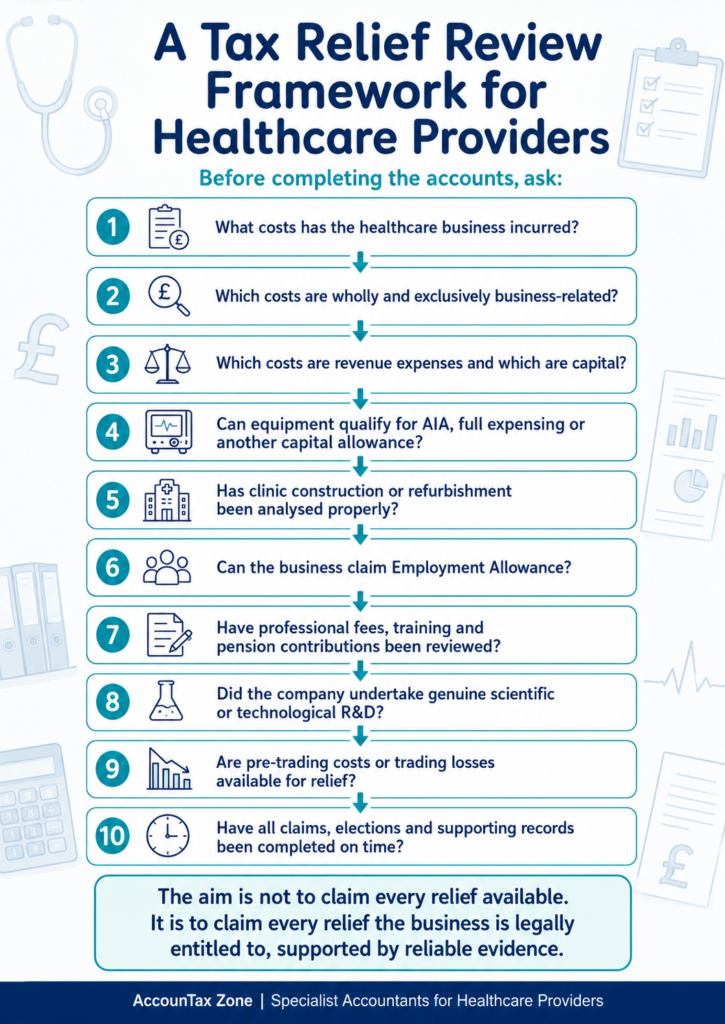
A Tax Relief Review Framework for Healthcare Providers
Records Needed to Support Healthcare Tax Relief
A strong tax-relief file may include:
- Purchase invoices
- Supplier contracts
- Proof of payment
- Asset registers
- Equipment specifications
- Refurbishment cost breakdowns
- Professional registration documents
- Subscription receipts
- Training course details
- Employee contracts
- Pension records
- Payroll reports
- Employment Allowance assessment
- R&D project documentation
- Technical reports
- Timesheets
- Pre-trading expense schedules
- Business mileage records
- Loss-relief calculations
- Patent documentation
- Business-rates correspondence
Poor records can turn an otherwise valid claim into a difficult HMRC enquiry.
When Should Tax Relief Be Reviewed?
Healthcare businesses should review tax relief:
- Before purchasing expensive equipment
- Before signing a clinic lease
- Before beginning a refurbishment
- Before opening a new location
- Before making a major pension contribution
- Before launching an R&D project
- Before hiring a large team
- Before changing legal structure
- Before acquiring another healthcare business
- Before the end of the accounting period
- Before filing the tax return
A year-end tax-planning review provides time to make informed decisions before the position becomes fixed.
How AccounTax Zone Helps Healthcare Providers
At AccounTax Zone, we help healthcare businesses identify legitimate tax relief while keeping claims accurate, commercial and defensible.
Our support can include:
- Healthcare expense reviews
- Capital allowance assessments
- Medical equipment claims
- Clinic refurbishment reviews
- Employment Allowance checks
- Professional fee and training analysis
- Employer pension planning
- R&D eligibility assessments
- R&D claim preparation
- Patent Box planning
- Pre-trading expense reviews
- Trading-loss claims
- Group relief
- Business structure reviews
- Corporation Tax planning
- HMRC enquiry support
We work with healthcare providers across London and the UK, including:
- Private clinics
- Care homes
- Domiciliary care agencies
- Medical practices
- Dental practices
- Pharmacies
- Consultants
- Therapy businesses
- Healthcare groups
- Healthtech companies
Our objective is not simply to reduce one tax bill.
We help healthcare businesses create a tax strategy that supports:
- Cash flow
- Investment
- Recruitment
- Expansion
- Innovation
- Retirement planning
- Long-term business value
FAQs About Healthcare Tax Relief
A healthcare business may potentially claim allowable business expenses, capital allowances, Employment Allowance, employer-pension deductions, R&D relief, loss relief and premises-related allowances. Eligibility depends on the business structure and expenditure.
Yes, qualifying medical equipment may be eligible for capital allowances. The appropriate claim could include AIA, full expensing, a first-year allowance or writing-down allowances.
Most businesses can claim AIA on qualifying plant and machinery, subject to the available limit and relevant restrictions. The standard annual limit is currently £1 million.
A self-employed doctor may be able to deduct qualifying professional costs incurred for the existing medical trade. Employees may be able to claim personal tax relief on qualifying fees they pay themselves where the employer has not reimbursed them.
Professional indemnity costs incurred wholly and exclusively for the healthcare business will normally be deductible. The policyholder, business purpose and any personal element should be checked.
Training that updates or improves skills used in an existing healthcare business can generally qualify. Training that creates an entirely new profession or unrelated trade may not be deductible under the same rules.
Potentially. The standard maximum for 2026/27 is £10,500, but public-sector work, connected companies, payroll structure and other eligibility conditions must be reviewed.
It depends on the proportion and nature of its public-sector work and whether another exception applies. A private legal structure does not automatically establish eligibility.
Yes, where the company seeks an advance in science or technology and attempts to resolve genuine scientific or technological uncertainty. Routine clinical work or ordinary software implementation does not qualify by itself.
Potentially. R&D relief may support qualifying development expenditure, while Patent Box may later reduce Corporation Tax on qualifying profits attributable to patented technology. Each relief has separate conditions.
Employer contributions to a registered pension scheme can generally reduce taxable business profit where they are made wholly and exclusively for the trade. The director’s personal pension allowances and wider circumstances must also be reviewed.
Qualifying revenue expenditure incurred within seven years before the trade starts may be treated as incurred on the first day of trading. Capital expenditure and non-business costs follow different rules.
A company can generally carry qualifying trading losses back against profits of the previous 12 months. Other loss-relief options may include carrying losses forward or using group relief.
VAT exemption is a VAT treatment rather than a deduction against Corporation Tax or Income Tax. It can prevent VAT being charged, but it may also restrict the recovery of VAT on business costs.
Speak to a Healthcare Tax Specialist
Healthcare tax relief is not about collecting receipts at the end of the year and hoping something can be claimed.
It requires the business to understand:
- What it is purchasing
- Why the cost is being incurred
- Which entity should make the purchase
- When the expenditure should occur
- Which relief applies
- What evidence HMRC would expect
- How the decision affects cash flow and future growth
AccounTax Zone helps healthcare businesses identify tax-saving opportunities before important decisions are made.
Book your free healthcare tax consultation
Call: 020 3740 7074
Email: info@accountaxzone.com


