Struggling to Keep Key Developers Without Inflating Payroll?
How EMI Share Options Can Help UK Tech Companies
Hiring great people is expensive.
For a growing software or technology company, the people you most want to retain are often the people who can command the highest salaries elsewhere:
- senior developers;
- CTOs and technical leads;
- product managers;
- sales leaders;
- AI and data specialists; and
- key employees who understand the product from the inside.
Increasing salaries can help.
But every permanent salary increase also increases the company’s ongoing cash requirements.
For a growing tech business trying to protect runway, that creates a difficult question:
How do you give important employees a meaningful reason to stay without simply increasing payroll every year?
For qualifying UK companies, EMI share options can provide one answer.
Enterprise Management Incentives allow a company to give selected employees the right to acquire shares in the future under a tax-advantaged arrangement.
Used properly, EMI can help align an employee’s financial reward with the long-term growth of the company.
But it is not simply a case of promising someone “1% of the business”.
There are rules around:
- company eligibility;
- employee eligibility;
- share valuation;
- exercise price;
- option limits;
- HMRC reporting;
- disqualifying events;
- tax on exercise;
- Capital Gains Tax; and
- what happens when the company is eventually sold.
And from 6 April 2026, the EMI limits were significantly expanded for most qualifying companies, bringing many larger scale-ups within the scheme.
This article explains how EMI share options can solve a real talent and retention problem for UK technology businesses, and what needs to be done properly before options are granted.
The Problem: Your Best Employee Has an Offer You Cannot Match
Imagine you employ a senior developer earning £85,000.
They have been instrumental in building your platform.
They understand:
- the architecture;
- the customers;
- the development roadmap;
- the technical debt;
- the product; and
- the team.
Another company offers them £110,000.
Matching it means another £25,000 of annual salary before considering the wider employment cost.
And if several employees need similar increases, the effect on cash flow becomes substantial.
You could increase salaries.
You could pay bonuses.
Or you could give key employees an opportunity to participate in the future value they help create.
That is where EMI can become valuable.
The objective should not be to replace appropriate salaries with options.
It is to give selected people an additional reason to think:
“If I help build this company successfully, I participate in some of the value created.”
What Do EMI Share Options Actually Give an Employee?
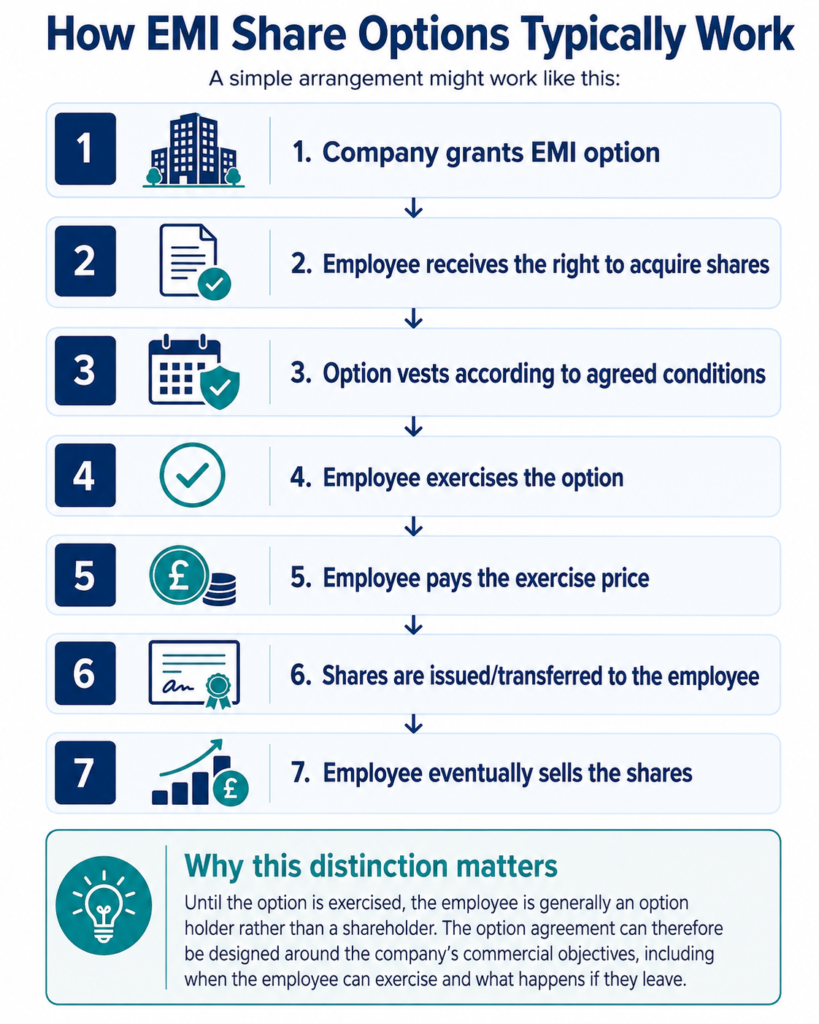
An EMI option does not normally give the employee shares immediately.
Instead, it gives them a right to acquire specified shares at an agreed exercise price, subject to the terms of the option.
Why EMI Has Become More Relevant for Scale-Up Companies in 2026
The EMI rules became significantly more generous from 6 April 2026.
For most qualifying companies granting EMI options from that date, the limits increased from:
| EMI requirement | Previous limit | From 6 April 2026 |
| Gross assets | £30 million | £120 million |
| Employees | Fewer than 250 | Fewer than 500 FTE |
| Total unexercised company EMI options | £3 million | £6 million |
| Maximum qualifying exercise period | 10 years | 15 years |
The individual employee limit remains £250,000 of qualifying options, measured using the relevant share value rules, subject to the three-year restriction.
There are special lower limits for certain Specified Northern Ireland Companies involved in goods or electricity, so Northern Ireland businesses within those rules require separate consideration.
AccounTax Zone Insight
Do not assume your business has become “too large for EMI”.
A tech company that exceeded the old £30 million gross-assets or 250-employee limits might now be eligible following the April 2026 changes.
For growing companies that previously dismissed EMI because of their size, it is worth testing eligibility again before moving immediately to a non-tax-advantaged share plan.
Solution 1: First Check Whether the Company Actually Qualifies
Before discussing option percentages with employees, establish whether the company is eligible.
For most companies, EMI is available to qualifying independent trading companies meeting the relevant asset, employee and option-value limits. A qualifying company also needs the required UK permanent establishment and must carry on, or be preparing to carry on, a qualifying trade.
For most companies granting options from 6 April 2026, that means testing:
- Gross assets: No more than £120 million.
- Employees: Fewer than 500 full-time equivalent employees at the date of grant.
- Company EMI option limit: The total unrestricted market value of shares under unexercised qualifying EMI options must generally remain within £6 million.
- Trading activity: The company’s business must fall within the EMI qualifying-trade rules. Certain activities are excluded, including some financial activities, property development, leasing, legal and accountancy services and other specifically listed activities.
A Particularly Important EMI Point for Software Companies
One of the EMI excluded activities is the receipt of certain royalties or licence fees.
That can initially sound worrying for software businesses.
After all, many software companies generate licence income.
However, HMRC’s rules contain an important exception involving relevant intangible assets. Broadly, the royalty/licence-fee exclusion can be waived where the income relates to qualifying intangible assets created by the company or, in appropriate circumstances, by a qualifying group company.
That distinction can be extremely important for:
- software companies;
- IP businesses;
- SaaS platforms;
- technology licensing businesses; and
- businesses commercialising internally developed intellectual property.
It means:
“We receive software licence fees” does not automatically equal “We cannot use EMI.”
The underlying IP and business model need to be reviewed.
Solution 2: Check Whether the Employee Qualifies
Even where the company qualifies, not every individual necessarily does.
An EMI participant must satisfy the employment requirements.
The individual generally needs to work for the company for at least:
25 hours per week or, if less: 75% of their total working time.
Directors can participate where they satisfy the relevant employee conditions.
External consultants or contractors do not become eligible simply because they are important to the business; EMI is an employee share-option regime.
The 30% ownership problem
An employee is also excluded if they have a material interest in the company.
Broadly, an employee cannot already have a material interest exceeding 30%, taking into account the detailed rules and relevant associates. HMRC specifically treats beneficial ownership or control of more than 30% of ordinary share capital as a material interest, alongside related tests for close companies.
This is particularly important for founders.
A founder owning 60% of the company cannot simply grant themselves EMI options in the same way as a qualifying employee with a small existing shareholding.
Solution 3: Decide What You Are Actually Trying to Achieve
EMI should begin with a commercial question, not a tax form.
Ask: Why are we granting these options?
Possible objectives include:
- retaining a CTO for the next four years;
- recruiting a senior developer;
- rewarding employees who helped build the product;
- incentivising a sales director to help reach an exit;
- building an employee ownership culture; or
- aligning senior management with shareholder value.
Once that objective is clear, the company can decide:
- who participates;
- how many options each individual receives;
- which shares the options relate to;
- vesting conditions;
- exercise conditions;
- leaver provisions; and
- what happens on an exit.
Giving everybody “1%” because it sounds simple is rarely a good share-plan strategy.
The percentage should be considered alongside the company’s fully diluted cap table.
Think About Dilution Before Promising Equity
Suppose the founders currently own: 100%
The company creates an employee option pool equivalent to: 10% of the fully diluted equity
A funding round then introduces investors.
Additional investment may dilute both:
- the founders; and
- employees holding options.
That does not necessarily make the scheme unattractive.
But everyone should understand what the percentage means.
For example: 1% today does not necessarily remain 1% after future fundraising.
This should be modelled before offers are communicated to employees.
AccounTax Zone Insight
Promise numbers, not vague percentages, until the cap table has been modelled properly.
Statements such as “you'll own 2% of the company” can create problems if nobody has clarified whether that means:
- 2% before the option pool;
- 2% after the option pool;
- 2% before an investment round; or
- 2% on a fully diluted basis.
For scaling software companies, option planning should be linked directly to the cap table.
Solution 4: Get the Share Valuation Right Before Grant
Valuation is one of the most important steps in an EMI arrangement.
Private company shares do not have an obvious stock-market price.
A valuation therefore needs to consider factors such as:
- recent investment rounds;
- company performance;
- share rights;
- restrictions;
- growth prospects;
- existing preference shares;
- planned transactions; and
- the company’s financial position.
HMRC’s Shares and Assets Valuation team provides a voluntary service through form VAL231 to agree EMI share values. HMRC asks companies to consider both Actual Market Value and Unrestricted Market Value where appropriate, and an agreed EMI valuation is normally valid for 90 days, provided relevant circumstances do not change.
Why does valuation matter so much?
Because it affects several parts of the scheme.
The Unrestricted Market Value is relevant when applying EMI option limits.
The market value at grant is also important when determining whether an employee has received their option at a discount.
If the exercise price is at least the relevant market value at grant and the other EMI conditions continue to be satisfied, qualifying exercise can generally take place without Income Tax or National Insurance arising.
A Low Exercise Price Is Not Automatically Better
A founder may initially think: “Why don’t we just let the employee buy the shares for £0.01?”
Commercially, that sounds attractive.
Tax-wise, it can create a different result.
Where an EMI option is granted at a discount to market value, an Income Tax charge can arise on the discount when the option is exercised. National Insurance can also become relevant where the shares are readily convertible assets.
That is why the exercise price and valuation should be considered together.
The objective is not automatically to set the lowest possible exercise price.
The objective is to understand the tax and commercial consequences of the price selected.
Solution 5: Design Vesting Around the Behaviour You Want
Once the tax framework is understood, the company needs to determine the commercial terms.
For example, options might vest:
25% after year one
↓
then monthly over the following three years
or according to performance milestones such as:
- revenue;
- ARR;
- product launch;
- customer numbers;
- fundraising;
- profitability; or
- an eventual exit.
But vesting conditions should not become unnecessarily complicated.
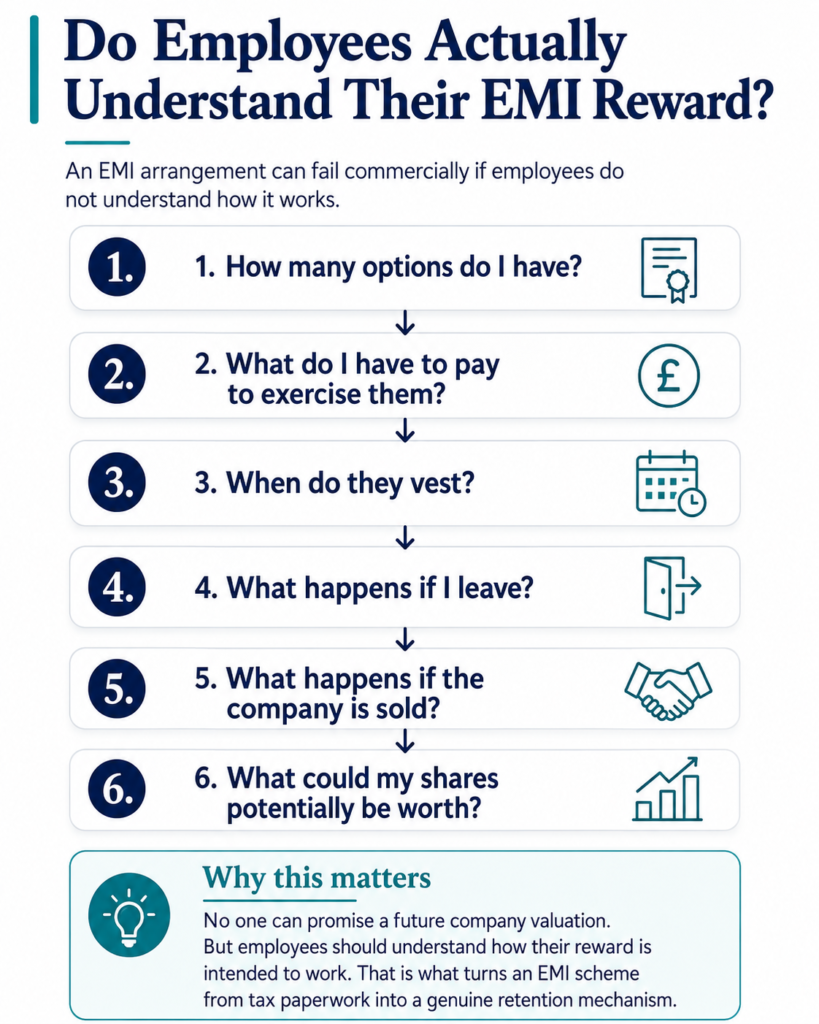
Employees need to understand what they are being offered.
A scheme that requires a 14-page spreadsheet to calculate whether an employee has vested may technically work but fail as an incentive.
What Happens If an Employee Leaves?
This is where EMI planning and the option agreement need to work together.
The agreement should define what happens to:
- vested options;
- unvested options;
- good leavers;
- bad leavers; and
- exercise rights after departure.
Leaving employment can also trigger an EMI disqualifying event because the employee may cease satisfying the eligibility conditions. HMRC’s rules generally preserve the EMI tax advantages if the relevant option is exercised within 90 days of a disqualifying event; exercise later can create an Income Tax charge.
The option agreement may impose a shorter contractual deadline, so the tax rules and legal terms both need checking.
Solution 6: Understand the Tax at Grant, Exercise and Sale
One of the reasons EMI can be attractive is that the tax treatment is divided across three distinct stages.
Stage 1: Option granted
There is generally no Income Tax or National Insurance charge merely because a qualifying EMI option is granted.
The employee has received an option, not cash.
Stage 2: Employee exercises
Where:
- the option remains qualifying;
- no relevant disqualifying issue has affected relief;
- the employee pays at least the market value applicable at grant; and
- exercise occurs within the qualifying period,
there will generally be no Income Tax or National Insurance on exercise. For most qualifying companies from 6 April 2026, the maximum qualifying period can extend to 15 years.
A discount at grant or exercise more than 90 days after certain disqualifying events can change the position.
Stage 3: Employee eventually sells the shares
Once shares acquired through exercising an EMI option are sold for more than their base cost, Capital Gains Tax may arise. The capital-gains base cost generally includes what the employee paid for the shares plus any amount charged to Income Tax on exercise.
In qualifying circumstances, Business Asset Disposal Relief (BADR) can apply to EMI shares.
EMI has particularly useful BADR rules because the normal 5% personal-company shareholding requirement does not apply in the same way, and the required two-year period can run from the date the EMI option was granted rather than only from exercise.
For qualifying disposals made from 6 April 2026, the BADR rate is 18%.
Eligibility should still be checked at the point of disposal rather than assumed when the option is first granted.
Example: How the EMI Growth Can Work
Suppose a software company grants a senior employee options over: 20,000 shares
Agreed market value at grant: £2 per share
Exercise price: £2 per share
Total exercise cost: £40,000
Four years later, the company is sold and each share is worth: £12
Value of employee’s shares: 20,000 × £12 = £240,000
Exercise price: £40,000
Increase in value: £200,000
Provided the EMI conditions have been satisfied and the option was not granted at a discount, that £200,000 increase would generally not be taxed as employment income on a qualifying exercise. Instead, the eventual disposal falls within the CGT regime. BADR may apply if its conditions are satisfied.
This example is deliberately simplified and does not take account of transaction costs, the employee’s annual CGT exemption, previous BADR claims or their individual tax circumstances.
The Employer Can Also Receive a Corporation Tax Deduction
This is an important part of EMI that companies sometimes overlook.
Where qualifying shares are acquired by an employee through exercise of an EMI option, the employing company can potentially obtain a statutory Corporation Tax deduction.
Broadly, the deduction corresponds to the difference between: market value of the shares when acquired minus amount paid by the employee.
Using our simplified example:
Value on exercise: £240,000
Employee pays: £40,000
Potential statutory CT deduction: £200,000
The actual Corporation Tax treatment should be confirmed as part of the company’s tax computation.
AccounTax Zone Insight
EMI should be reviewed from both sides of the transaction.
Founders naturally focus on the employee's tax position.
But the company should also track option exercises properly because a potentially valuable Corporation Tax deduction can arise when qualifying shares are acquired.
Your year-end accounts, option register, cap table and Corporation Tax computation therefore need to speak to each other.
Solution 7: Protect the EMI Status as the Company Changes
A company may qualify on the day options are granted but then change significantly.
HMRC identifies several events that can restrict EMI relief, including:
- loss of company independence;
- ceasing to meet the trading-activities requirement;
- the employee becoming ineligible;
- certain changes to option terms;
- certain share-capital alterations;
- share conversions; and
- particular breaches involving other qualifying share options.
These are known as disqualifying events.
Where a disqualifying event occurs, timing becomes extremely important.
Qualifying tax advantages are generally preserved if the option is exercised within 90 days of the event; waiting longer can lead to an Income Tax charge on subsequent growth.
This is why EMI cannot simply be filed away after grant.
It needs to be considered when:
- an employee leaves;
- the business is restructured;
- shares are reorganised;
- an acquisition occurs;
- the company’s activities change; or
- option terms are amended.
EMI and Funding Rounds
For venture-backed software businesses, EMI should be considered alongside fundraising.
A new investment round can change:
- company valuation;
- share rights;
- cap table percentages;
- option-pool requirements;
- dilution; and
- investor expectations.
An option pool created immediately before a funding round can also affect how dilution is economically shared between founders and incoming investors.
That is primarily a commercial negotiation rather than an EMI tax rule.
But the finance team should understand the effect before agreeing the investment terms.
Where an EMI valuation has already been agreed with HMRC, significant changes in company circumstances can also mean the valuation needs reconsideration before grants are made. HMRC’s EMI valuation agreement is generally valid for 90 days subject to there being no material change affecting the share value.
EMI and a Future Company Sale
Many tech companies design EMI arrangements with an eventual exit in mind.
Options may, depending on their legal terms, become exercisable in connection with:
- a share sale;
- acquisition;
- takeover; or
- another specified exit event.

Solution 8: Get the HMRC Reporting Right
EMI is not a scheme where HMRC formally approves every arrangement before it begins.
HMRC’s own manual states that there is no EMI approval or clearance mechanism, although companies have reporting obligations and can separately use HMRC’s voluntary share-valuation service.
For EMI options granted on or after 6 April 2024 and before the reporting changes due from April 2027, grants must generally be notified by 6 July following the end of the tax year in which they were granted.
An annual Employment Related Securities return is also required by 6 July following the tax year, including nil returns where appropriate.
There is a further simplification coming: for options granted on or after 6 April 2027, the government has legislated to remove the separate EMI grant-notification requirement, with grant information instead incorporated into the EMI end-of-year return.
So the reporting process needs to reflect when the options were granted.
Common EMI Share Option Mistakes in Tech Companies
1. Promising equity before checking eligibility
An employee is promised EMI options before anyone confirms that either the company or employee qualifies.
2. Using an outdated £30 million company limit
From 6 April 2026, most qualifying companies can use the new £120 million gross-assets threshold.
3. Not obtaining or documenting a sensible valuation
This creates uncertainty around the exercise price, option limits and tax position.
4. Setting the exercise price at a nominal amount without considering tax
A discounted option can create an Income Tax charge.
5. Ignoring the fully diluted cap table
The company promises employees percentages without modelling future dilution.
6. Assuming contractors qualify
EMI is designed around qualifying employees and the statutory working-time requirements.
7. Granting EMI to a founder who already controls too much of the company
The material-interest rules can prevent participation where the relevant interest exceeds 30%.
8. Forgetting the ERS return
The tax structure may be carefully planned but annual reporting is overlooked.
9. Ignoring EMI during a company restructure
A restructuring or change to share capital can create a disqualifying issue requiring immediate review.
10. Waiting until an exit is imminent
This can restrict planning opportunities and may affect the employee’s ability to meet the two-year BADR condition.
AccounTax Zone Insight: EMI Is a Retention Tool, Not Just a Tax Scheme
A Practical EMI Share Options Framework for Tech Companies

How AccounTax Zone Can Support Tech Companies With EMI
At AccounTax Zone, we can help technology and software businesses consider EMI as part of their wider financial and tax strategy.
Our support can include:
- EMI eligibility review;
- company and employee qualification checks;
- share valuation support;
- HMRC valuation submissions;
- tax modelling;
- cap-table and dilution modelling;
- exercise-price analysis;
- Employment Related Securities reporting;
- tax treatment on option exercise;
- Corporation Tax deductions;
- BADR considerations;
- funding and exit planning; and
- working alongside your legal adviser on the implementation of the option arrangements.
The aim is not simply to create a share scheme.
It is to build an arrangement where the commercial incentive, tax treatment, company structure and employee expectations work together.
FAQs related to EMI Share Options
Enterprise Management Incentive options allow qualifying companies to give qualifying employees options to acquire company shares under a tax-advantaged regime.
For most qualifying companies, options granted from 6 April 2026 can benefit from increased limits of £120 million gross assets, fewer than 500 FTE employees and up to £6 million of unexercised qualifying company EMI options.
An employee can generally receive EMI options over shares with relevant value of up to £250,000, subject to the three-year rule and interaction with qualifying CSOP options.
Yes, a director can potentially qualify where they satisfy the employee, working-time, ownership and other EMI conditions.
A contractor who is not a qualifying employee would not satisfy the normal EMI employment requirement.
Potentially, but the material-interest rules are particularly important. Broadly, someone with a material interest exceeding 30% cannot qualify for a new EMI grant.
There is generally no Income Tax or National Insurance charge on the grant of a qualifying EMI option.
Where the option remains qualifying and the exercise price is at least the relevant market value at grant, qualifying exercise will generally not trigger Income Tax or NIC. Discounted options and exercises following disqualifying events require separate analysis.
Capital Gains Tax may apply to the gain. Qualifying EMI shares may also benefit from Business Asset Disposal Relief. For qualifying disposals from 6 April 2026, the BADR rate is 18%.
EMI has special BADR rules under which the normal 5% shareholding requirement does not apply in the same way, provided the relevant EMI conditions are satisfied.
It is not compulsory to obtain an agreed valuation, but HMRC provides a voluntary valuation service using VAL231. An agreed EMI valuation is normally valid for 90 days, subject to there being no relevant change in circumstances.
Leaving may constitute a disqualifying event. Exercising within 90 days can preserve EMI tax advantages under the statutory rules, although the option agreement itself must also be checked to determine the employee’s contractual exercise rights.
Losing Key Employees Because You Cannot Keep Increasing Salaries?
Increasing payroll is not the only way to reward the people helping build your company’s value.
For eligible technology companies, EMI share options can give key employees meaningful participation in future growth while preserving cash for:
- product development;
- marketing;
- recruitment;
- infrastructure; and
- expansion.
But the scheme needs to be designed correctly from the start.
If you’re considering EMI share options, AccounTax Zone can help you review:
- whether your company qualifies;
- which employees qualify;
- your share valuation;
- the proposed option pool;
- employee tax consequences;
- HMRC reporting;
- Corporation Tax implications; and
- how EMI fits into your future funding or exit plans.
Book a FREE 30-minute initial consultation.
Call: 020 3740 7074
Email: info@accountaxzone.com


