Relief for double taxation – How UK Tech Companies Can Avoid Paying Tax Twice
You invoice an overseas customer for £100,000.
But only £90,000 reaches your bank account.
The customer explains that £10,000 has been withheld for local tax.
Now you have a problem.
Your UK company may still have to include the full income in its Corporation Tax calculation, while another country has already taken tax from the same payment.
So have you just been taxed twice?
Not necessarily.
Depending on the country, the type of income and the relevant tax treaty, your company may be able to:
- prevent or reduce the foreign tax before it is deducted;
- reclaim excess tax from the overseas country;
- claim Foreign Tax Credit Relief against UK Corporation Tax; or
- obtain another form of relief under the UK’s double taxation rules.
But there is an important catch:
You cannot simply assume that every foreign tax deduction can be credited against your UK Corporation Tax bill.
The first question is whether the overseas country was entitled to deduct the tax in the first place.
For software, SaaS and IT businesses, this can become particularly complicated because different countries may classify the same payment differently.
A SaaS subscription may be treated as ordinary business income in one situation, but another jurisdiction may attempt to treat software payments as royalties or technical service fees.
That classification can completely change the tax result.
This guide explains what to do when tax is deducted from your overseas income, how relief for double taxation works, and how to prevent foreign withholding tax from quietly reducing your international margins.
The Problem: Your Customer Has Deducted Tax From Your Invoice
A common situation looks like this:
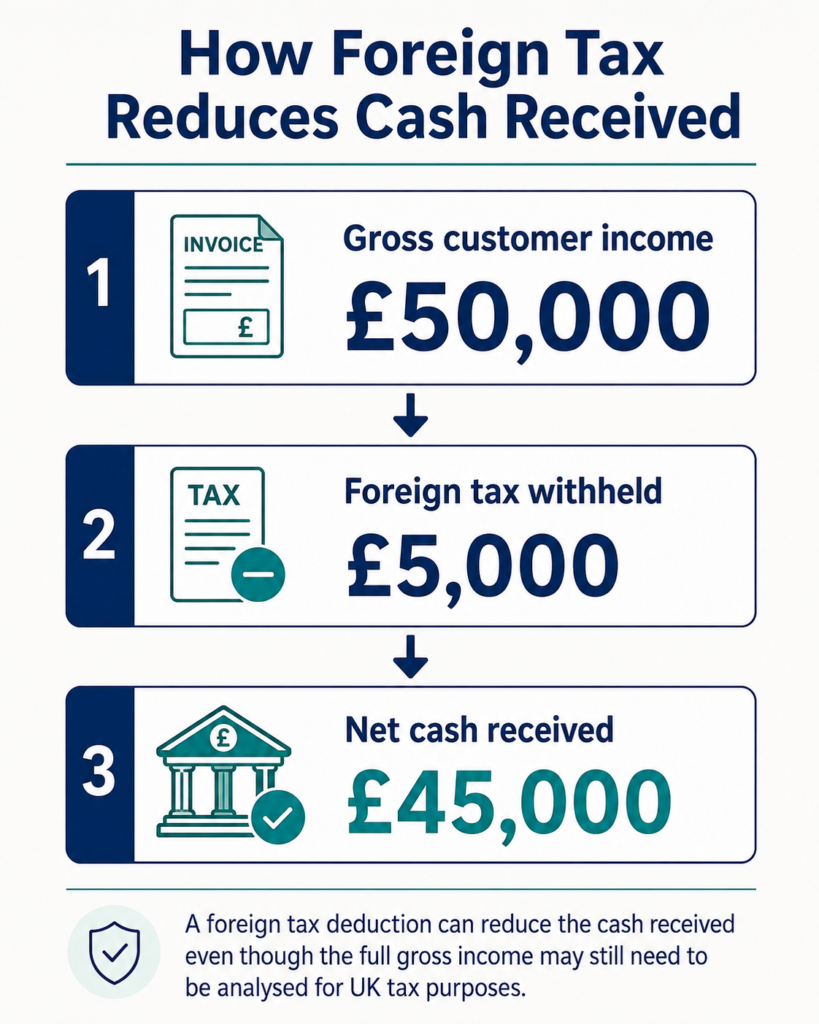
Invoice raised: £50,000
Foreign tax deducted: £5,000
Cash received: £45,000
From a cash-flow perspective, you are immediately £5,000 short.
But simply recording £45,000 as sales would usually hide what has actually happened.
The starting point should instead be:
You then need to determine what happens to the £5,000.
There are several possible outcomes.
Outcome 1: The foreign tax was correctly deducted
The company may be able to claim relief against its UK Corporation Tax liability.
Outcome 2: The correct treaty rate was lower
Part of the tax may need to be reclaimed from the overseas tax authority.
Outcome 3: The treaty says the foreign country should not have taxed the payment
The company may need to pursue repayment abroad rather than simply claim UK credit.
Outcome 4: UK relief is available, but only for part of the foreign tax
This can happen where the foreign tax exceeds the UK tax attributable to the same income.
The right solution therefore starts with identifying why the tax was deducted.
Solution 1: Check Whether the Foreign Country Was Entitled to Tax the Payment
Before claiming Double Taxation Relief in the UK, establish the legal basis for the overseas deduction.
Ask:
- Which country deducted the tax?
- What rate was applied?
- What type of payment did the customer say it was?
- Was the payment classified as a royalty?
- Was it treated as a technical service?
- Was it ordinary business income?
- Is there a Double Taxation Agreement between that country and the UK?
This step matters because a customer’s domestic tax rules do not automatically determine the final treaty position.
The applicable Double Taxation Agreement may restrict the overseas country’s taxing rights.
AccounTax Zone Insight
Do not accept foreign withholding tax simply because it appears on the remittance advice.
We recommend checking the treaty before posting the deduction as a permanent cost.
A customer may have applied its domestic withholding rate when a lower treaty rate, or potentially no withholding tax at all, should have applied.
Solution 2: Establish What Type of Income You Actually Earned
This is particularly important for software companies.
Your contract may involve:
- SaaS access;
- software licences;
- implementation;
- consultancy;
- support;
- maintenance;
- API access;
- intellectual property rights; or
- a combination of several services.
The tax treatment can depend heavily on what rights the customer actually receives.
For example, providing access to hosted software is not necessarily the same commercial arrangement as granting rights to exploit intellectual property.
Yet an overseas customer may initially treat both as a software royalty.
That can result in tax being deducted unnecessarily or at the wrong rate.
The contract therefore needs to be reviewed before determining which treaty provision applies.
Solution 3: Check the Double Taxation Agreement
Once the income type has been established, the relevant UK treaty should be reviewed.
The treaty may specify how items such as:
- business profits;
- royalties;
- interest; and
- other income
are divided between the UK and the overseas jurisdiction.
For example, where income falls within the business-profits provisions, the overseas country may have limited taxing rights if the UK business does not have a permanent establishment there.
Where the payment falls within a royalty provision, the source country may sometimes retain taxing rights but at a reduced treaty rate.
This is why the question is not simply: “Was foreign tax deducted?”
It is: “How much foreign tax was the overseas country entitled to deduct under the treaty?”
Solution 4: Establish the Correct Tax Treatment Before Payment
The best solution is often to prevent excessive withholding tax rather than recover it afterwards.
Depending on the country, the customer or overseas tax authority may request:
- a UK Certificate of Residence;
- treaty forms;
- declarations;
- company information; or
- other supporting documents.
If the correct documentation is supplied before payment, the customer may be able to apply:
- a reduced treaty rate; or
- an exemption from withholding tax.
This can materially improve cash flow.
Example
Annual overseas contract: £300,000
Domestic withholding rate: 10%
Potential cash withheld: £30,000
If the relevant treaty reduces the rate substantially, arranging treaty relief before payments begin can prevent significant amounts of working capital from becoming trapped overseas.
AccounTax Zone Insight
For recurring software contracts, solve the withholding-tax process once, rather than accepting the same deduction every month and attempting to correct it at year-end.
Solution 5: Claim Foreign Tax Credit Relief Where Appropriate
If qualifying foreign tax has properly been suffered, the UK company may be able to claim credit against Corporation Tax on the same income.
This is commonly referred to as Foreign Tax Credit Relief or Double Taxation Relief.
But an important restriction applies: The UK will not necessarily give credit for the full amount of foreign tax deducted.
The credit is generally restricted by reference to the UK tax attributable to the same foreign income or profit.
Example
Overseas revenue: £100,000
Foreign tax withheld: £15,000
Relevant costs attributable to earning that income: £60,000
UK taxable profit attributable to the income: £40,000
Assume the relevant UK Corporation Tax attributable to that profit is: £10,000
Even though £15,000 was deducted overseas, UK tax credit relief may be limited to: £10,000
That can leave £5,000 requiring further consideration.
The company may need to investigate whether:
- the foreign tax exceeded the treaty rate;
- an overseas repayment is available; or
- another treatment applies.
The Hidden Problem: Foreign Tax Is Often Charged on Revenue, While UK Tax Is Based on Profit
This is where international contracts can become commercially unattractive.
A foreign jurisdiction may deduct withholding tax from the gross invoice value.
But the UK company pays Corporation Tax on its taxable profit.
Consider a software consultancy with:
Overseas sales: £200,000
Relevant delivery costs: £160,000
Profit: £40,000
If the overseas country deducts 10% from gross revenue:
Foreign withholding tax = £20,000
That £20,000 is equal to half of the company’s underlying £40,000 profit.
Even if Double Taxation Relief is available, the UK tax-credit limit may mean the entire £20,000 cannot simply be recovered through the Corporation Tax return.
This is why withholding tax can become a pricing and profitability issue, not merely a tax-compliance issue.
Solution 6: Build Withholding Tax Into Your Pricing and Contracts
Before signing a substantial overseas contract, establish whether payments could be subject to withholding tax.
The contract should consider:
- whether the agreed fee is gross or net of withholding tax;
- whether the customer must deduct tax;
- whether a treaty reduction can be obtained;
- who provides the necessary forms;
- whether the customer must provide a tax certificate; and
- whether a gross-up clause is commercially appropriate.
Why this matters
Suppose you quote: £500,000
Your expected delivery margin is: 20% = £100,000
An unexpected 10% foreign tax deduction would remove: £50,000
Even before considering the eventual tax-relief position, half of your expected commercial margin has disappeared from immediate cash flow.
That is not something directors should discover after the first invoice has been paid.
Solution 7: Keep Proper Evidence of Foreign Tax Paid
Claiming relief requires evidence.
For each material overseas income stream, retain:
- customer contract;
- invoices;
- gross amount due;
- remittance advice;
- withholding-tax certificates;
- proof of cash received;
- Certificate of Residence where relevant;
- relevant treaty analysis;
- overseas correspondence;
- calculation of attributable profit;
- UK Corporation Tax computation; and
- calculation of relief claimed.
For companies trading with several countries, we recommend maintaining a separate international tax schedule.
For example:
| Country | Gross Revenue | Foreign Tax Deducted | Cash Received | Treaty Position | UK Credit Claimed |
| Country A | £100,000 | £5,000 | £95,000 | Reviewed | £5,000 |
| Country B | £80,000 | £8,000 | £72,000 | Review required | TBC |
| Country C | £150,000 | £0 | £150,000 | Business profits | £0 |
This makes it much easier to identify countries where tax leakage is affecting profitability.
Solution 8: Review Whether You Have Created a Taxable Overseas Presence
Withholding tax is not the only direct-tax issue.
As a software company expands internationally, activity in another country can potentially create a permanent establishment.
This may become relevant where the company has:
- an overseas office;
- local employees;
- a substantial operational presence;
- people negotiating or concluding contracts; or
- other fixed business activities abroad.
Where an overseas permanent establishment exists, part of the company’s profits may become taxable there.
The Double Taxation Relief analysis then moves beyond individual customer invoices and into the allocation of business profits between jurisdictions.
For fast-growing technology companies, this should be reviewed before overseas activity becomes substantial.
Do Not Confuse Double Taxation With Overseas VAT
A customer withholding income tax from your invoice and a foreign VAT liability are two completely different problems.
Foreign withholding tax
Usually concerns a direct tax on income or profits.
Potential solution: Tax treaty / Double Taxation Relief / foreign tax credit
VAT, GST or sales tax
An indirect tax on transactions.
Potential solution: VAT registration, OSS, local indirect-tax compliance or other relevant rules
One cannot normally be used to cancel the other.
For software companies selling internationally, both analyses may therefore be required.
Common Mistakes That Cause UK Tech Companies to Lose Money Overseas
- Recording only the net amount received: This hides both gross revenue and the foreign tax suffered.
- Assuming the customer deducted the correct tax: The customer may simply have applied its domestic withholding rate.
- Claiming the entire foreign tax against Corporation Tax: The UK tax-credit limitation may restrict the amount available.
- Ignoring the contract classification: SaaS, licences and intellectual property arrangements may have different treaty consequences.
- Reviewing tax after agreeing the price: By that stage, the company’s expected margin may already be compromised.
- Failing to obtain withholding certificates: Without proper evidence, supporting a UK relief claim becomes more difficult.
- Treating foreign tax as an ordinary bank charge: The accounting and Corporation Tax treatment should be considered separately.
- Looking only at one country at a time: As international sales grow, directors need visibility over the overall tax leakage across territories.
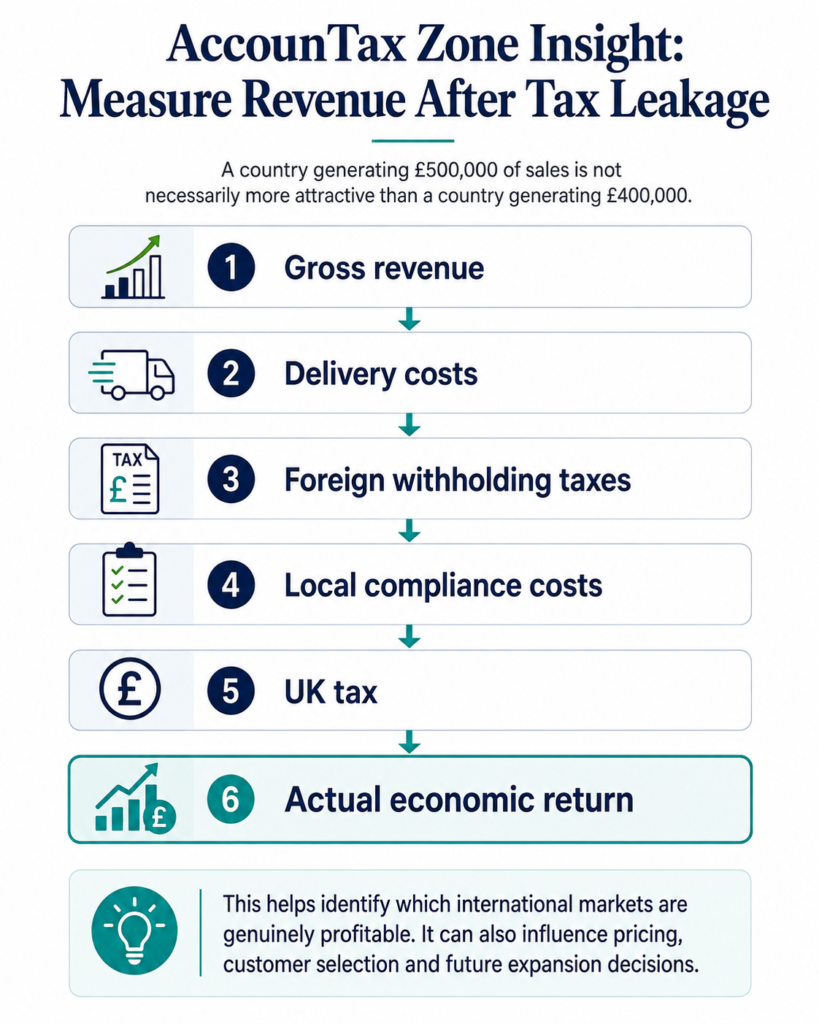
AccounTax Zone Insight: Measure Revenue After Tax Leakage
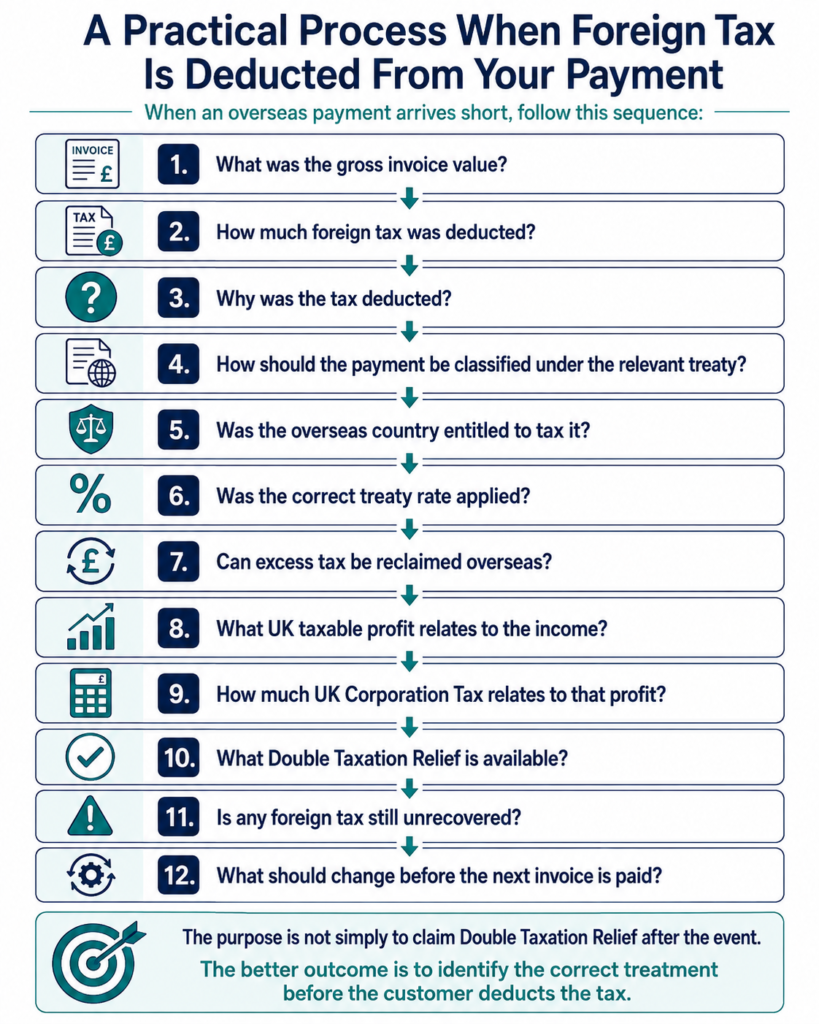
A Practical Process When Foreign Tax Is Deducted From Your Payment
How AccounTax Zone Can Help
At AccounTax Zone, we help UK software and technology businesses understand the tax consequences of international growth.
We can assist with:
- foreign withholding-tax reviews;
- Double Taxation Agreements;
- Foreign Tax Credit Relief;
- UK Certificates of Residence;
- overseas software and SaaS income;
- royalty and licensing arrangements;
- Corporation Tax calculations;
- overseas permanent-establishment considerations;
- cross-border VAT;
- international accounting;
- cash-flow forecasting; and
- international group structures.
Our aim is not simply to calculate the tax after the payment has arrived.
We help you understand what should happen before the contract is signed, before the invoice is raised and before foreign tax is deducted.
FAQs related to Relief for Double Taxation
First identify why the tax was deducted and obtain evidence such as a withholding-tax certificate. You should then check whether the relevant Double Taxation Agreement permits the deduction and whether a reduced treaty rate should have applied.
Potentially, where the foreign tax qualifies and the same income is subject to UK Corporation Tax. However, the amount of credit may be restricted by the UK tax attributable to the relevant foreign income.
Not necessarily. If the foreign tax exceeds the UK credit available, the excess may need to be considered under the treaty or reclaimed from the overseas jurisdiction where possible.
Yes. Some countries may seek to impose withholding tax depending on their domestic legislation and how the payment is classified. The relevant UK tax treaty should then be reviewed.
No. The correct classification depends on the contractual rights, the nature of the supply and the wording of the applicable treaty.
In some cases, treaty relief may reduce or eliminate withholding tax if the correct documentation is provided before payment.
It is evidence from HMRC confirming UK tax residence for relevant treaty purposes. Overseas tax authorities or customers may request one before granting treaty benefits.
No. Double Taxation Relief generally concerns direct taxes on income or profits. VAT and similar indirect taxes require separate analysis.
Stop Foreign Tax From Quietly Eating Into Your Software Company’s Margin
International sales growth looks impressive on the revenue line.
But what matters commercially is how much of that revenue eventually belongs to the business.
If overseas customers are:
- deducting tax from your invoices;
- asking for tax-residence certificates;
- treating software payments as royalties;
- applying unfamiliar withholding rates; or
- paying substantially less than your invoices,
do not automatically accept the deduction as a cost of doing business.
The treaty and UK relief position should be reviewed.
Book a FREE 30-minute initial consultation with AccounTax Zone.
We can review:
- why foreign tax is being deducted;
- the relevant Double Taxation Agreement;
- whether the correct rate is being used;
- whether relief or repayment may be available;
- how the position affects Corporation Tax; and
- how future contracts can be structured more effectively.
Call: 020 3740 7074
Email: info@accountaxzone.com


